I’ve never written that one definitive post that lists everything I find wrong with pink ribbon culture. Sure, I have put a warning on my About page: “I am not a fan of the pink ribbon culture, and—warning—my words are going to reflect that quite often.” And I’ve sprinkled various points of criticism randomly in many posts (or maybe just snide remarks), or maybe a post here and there focused solely on dislike of Pink —Take the Mythical Image of the Strong Warrior Breast Cancer Survivor And Bury HER Once And For All is only about one troubling aspect of Pink—it certainly does not take on the marketing, the sexualization, blah, blah, blah. So while I have not listed EVERYTHING I hate about Pink the way others have, I still think it is pretty clear exactly where I stand to be counted on the topic.
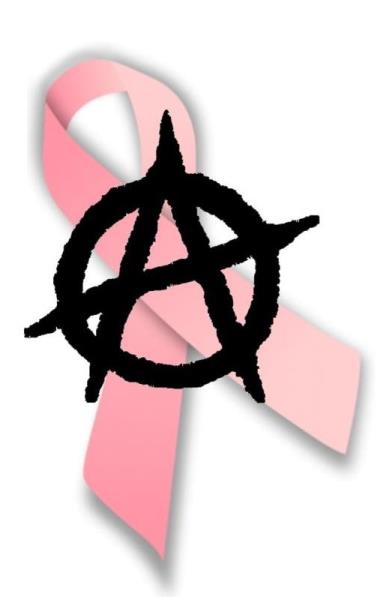
And if it isn’t clear, let me make it so: I reject the Pink Ribbon. It does not symbolize to me what it does to the general public. I only see a bundle of lies when I see it. I may have had breast cancer, but that symbol doesn’t represent me or my cancer experience. My beat up old rock concert t-shirts and rough denim cut-off shorts I wear most days symbolize who I am better than that ribbon.
I currently do not see the need to make my conclusive list supporting the “why” behind my ribbon rejection; there are a few books, at least one film adaptation, and countless essays and blogs that have expressed most of my thoughts on this topic, although I do not agree with exactly everything in the anti-Pink view, just most of it (I’m a Curmudgeon, I’ll always find something to pick on). I write this blog under the assumption that most readers are on the same page in dislike of the pink ribbon, so I’d be preaching to the converted. Since I do not wish to be told how to do cancer, I must respect how others do cancer, and lots of folks do it by embracing the ribbon. So who am I to try to convince anyone differently? So, I’m not gonna preach to the unconverted, either. For those on the fence, see the aforementioned other essays. Those others have written it far better than I ever could.
I’ve been feeling unmotivated, uninspired, and just plain down of late, especially in the area of my continued rants against all that I find objectionable in cancer culture, especially Pink. As Pinktober approached, I saw several blog posts encouraging the need for continued activism, including blogging. In my current state of mind, just writing a blog or letters to local papers about it is simply not enough, because like attracts like. People seek out the sites, essays, and letters that they already agree with, I do it too; leaving little chance for mind-changing to happen. I see lots of blogs and comments on blogs and website that criticize the ribbon, and I get all encouraged, but there must be tons more that are in favor of it, since it is still so prevalent. And like I said above, out of respect for those who embrace it, I just feel unmotivated to bother trying to convince anyone. So what’s the use?
What happened with that Peggy Orenstein article that was published in April? Please tell me it made a difference? Please tell me that people who normally do not give the issues around cancer and ribbons any thought maybe took a chance to read it and maybe learned something? From where I stand, all I can see is a shiny Pink machine that did not even get a dent or scratch, it just keeps rolling. Seriously, if someone can show me that some hearts and minds were changed, please do. I could never access the comments on the article so never got to see any responses to it in which maybe someone said, “oh wow, I had no idea, thanks for the eye-opener”. Races and all manner of events are proceeding, it seems to me, without a bat of the eye.
Back when that Orenstein piece was published I acknowledged the strange timing, about half a year away from October, and I knew that any 2013 Pinktober events were already planned and in motion, so no real change could happen. But here is the thing: I secretly hoped it would. I know my blog comes off as negative and angry, but I consider myself positive, because, get this, I actually expect change, and I think the change could be good, although I know those that embrace pink would disagree. Where I screw up is I expect it to be big and immediate (I lost all patience as a result of my cancer experience-I did NOT improve as a person because of cancer). Change takes a long time, and it happens in tiny, tiny doses. There will be more on this point later.
Some blogs/essays have suggested taking a positive approach, write about what awareness should mean—the real facts of breast cancer, rather than just writing about the awful feelings the ribbon churns up. I’m not smart enough, or have enough understanding of the medical facts to do that. I’ve been recently reminded that I’m a medical idiot, and as much as I thought I had the professional patient thing down, I really don’t. So I leave the imparting of wisdom and discussion of the Big Issues to the more knowledgeable and experienced bloggers. I’d like to not write about my feelings about the Pink too, as has been suggested, because I’m sick of it. But covering my eyes, ears, and mouth won’t make Pink go away either. I mean, I keep trying to ignore Miley Cyrus, and she still persists.
As fall approached this year, my heart began to sink despite my earlier wish to reclaim October as my favorite month. I hope to eventually answer the question I posed a few paragraphs ago—what’s the use?
Preface to a Series of Rants Called Symbols Are Not Solutions
Full disclosure: I have one of those stupid magnetic ribbons on my vehicle. It has been there since I got the car in 2004 and has been bleached white by time and sunshine. I can’t even remember the original color; I only remember it supports some animals/pets non-profit. I put it there before it ever occurred to me I’d one day get cancer, before I’d come to hate ribbons and ribbon culture. The thing is, I cannot peel it off now, the damn thing is seemingly welded onto the back of the car. Nine years is a long time.
I know as a breast cancer patient, my complaint against all ribbons is like having first world—or is it first ribbon?—problems, so I should not complain about ribbons and symbols, but I’m going to anyway. I know that I indirectly and directly benefited from Pink dollars and I’m grateful but I still want more and better. I recognize that since other ribbons/cancers do not get the same amount of attention, that some folks might think breast cancer patients who speak openly against Pink sound like whiny rock stars of the 90s, who complained about being rich and famous. But I hope that all the awful issues pointed out about pink ribbons can serve as an example of what can go wrong in any or all charity campaigns, since so many disease/ribbon campaigns seem determined to imitate Pink.
It’s just that I’m flat out tired of all ribbons, and even more tired of the need for them. And I mean all the damn ribbons, not just that Pink bully ribbon. I’m tired of the assembly-line, factory-like process: someone gets an idea that a certain cause needs attention, assign the cause a color, assign it a month (who cares if that month already has many other causes assigned to it, except don’t chose October because then the newly anointed cause won’t get any attention, because, you know, boobies), make a ribbon, hold a charity event, and then forget about it every other day or month of the year.
When September 1 arrived, I was confronted with a number of blog posts about cancers assigned to that month, in a plea for attention as Pinktober loomed ahead, and I became very discouraged. I was struck by how diseases have been reduced to symbols and the symbols are scrambling for attention in the shadow of the big Pink Machine. People are getting immune to seeing ribbons—it’s like, oh, here’s another one. Is there a conversation about that?
Sorry, I am not some professional investigative journalist who has the time to research and write about the history of ribbons; I’m a working woman with a physically tiring service industry job who blogs in down time, which is limited because I still find post-treatment life tiring. I think some collective societal memory can come into play here, however. I mean, remember “tie a ribbon around the old tree?” Remember the yellow ribbons for all the recent wars of the past few decades? Remember the red AIDS ribbons of the early 90s, which have somehow been forgotten as that disease got pushed aside, and now red has to do with February and heart disease? We all have some knowledge and ideas about ribbons and the surrounding culture, because we see and react to them every day, and have been doing so for a few decades.
I’ve been in a dark place lately. This will become apparent in subsequent posts. Proceed with caution. Unpleasant concepts loom ahead.
Yep, I’m complaining again without offering solutions, but then, I’m not so sure anyone will agree my complaints are even valid and in need of attention, but oh well, it’s my blog. I’m not writing some professional, sociological paper on this topic. I’m just a hick in a redneck town; I’m not equipped to make an informed, cultural critique like others. I’m just calling it like I see it. I hope some of my negative views expressed over the next few posts can be changed.
To be continued.
“Just because you’re offended, doesn’t mean you’re right.” — Ricky Gervais
I read in a recent post on Gayle Sulik’s Pink Ribbon Blues blog called The She-ro, about the problems with this idealized breast cancer she-ro stereotype, that Cate Blanchett will play the title role in HBO’s “Cancer Vixen”. I’m surprised, I’m usually clued in to entertainment/movie stories. But no matter.
I have not read this “Cancer Vixen”, and it looks horrible, from the way Sulik describes it. Sounds like everything I’ve ranted about in this repugnant warrior/cancer patient culture. And of course, because Hollywood wants to make a buck, and because viewers will buy into this crap, the film WILL be made.
I know it is wrong to criticize a film or show without watching it, or a book without reading it, but sorry, this looks like it will make me sick. I used to be a better person, I used have more patience, I would “give it a try”, and watch anything, read anything. No more with such wastes of time (cough, cough, “Twilight” series, cough cough). Why waste my precious resources and allow myself to get annoyed watching or reading something I can tell from a mile away is just going to make me nuts?
We do not need another example of this idealized version of how to “do” cancer as a woman, especially a woman with breast cancer. It is shoved down our throats endlessly. When is it ever going to be OK to not emerge from cancer as some super woman, having some major personal transformation that makes the woman better, when is going to be OK to go to infusion in yoga pants and athletic shoes rather than 5” heels and a pink feather boa in some hyped up vision of female power? The answer is never. Women are expected to “bear these things” with a smile, a positive attitude, and maybe a little sass to make it seem modern. But the strong woman labeling of it is just a lie; woman are supposed to act like they’ve always been expected to act: without complaint.
Will someone make a movie about a Cancer Curmudgeon? Oh yeah, a movie about an un-pretty, forty-something, foul-mouthed, rough around the edges, single woman typing away on a laptop (hitting those keys hard), not spewing rainbows or providing uplifting anecdotes won’t make anyone happy. I’d like to say there’s no money in being grumpy, but then, there’s Grumpy Cat, I guess with animals it’s OK. Like I heard on a TV show rerun recently: “no one likes an angry woman.”
Queen Elizabeth (twice), Katharine Hepburn, Veronica Guerin, and of course, Galadriel from “The Lord of the Rings”, are some of Cate Blanchett’s best “strong woman” roles, and are some of the reasons I’ve long admired her. I wish she were not doing this particular “strong woman”. Best that I do not watch this film when it is finished. I’ll wait for her next project instead.
A/N –This is the final part of my tattoo-instead-of-reconstruction story, click links for first parts. I’ve been lazy about finishing it, and now I realize I did not have the clear focus to say what needed to be said. I just got that focus.
The band’s logo, the idea behind the tattoo design
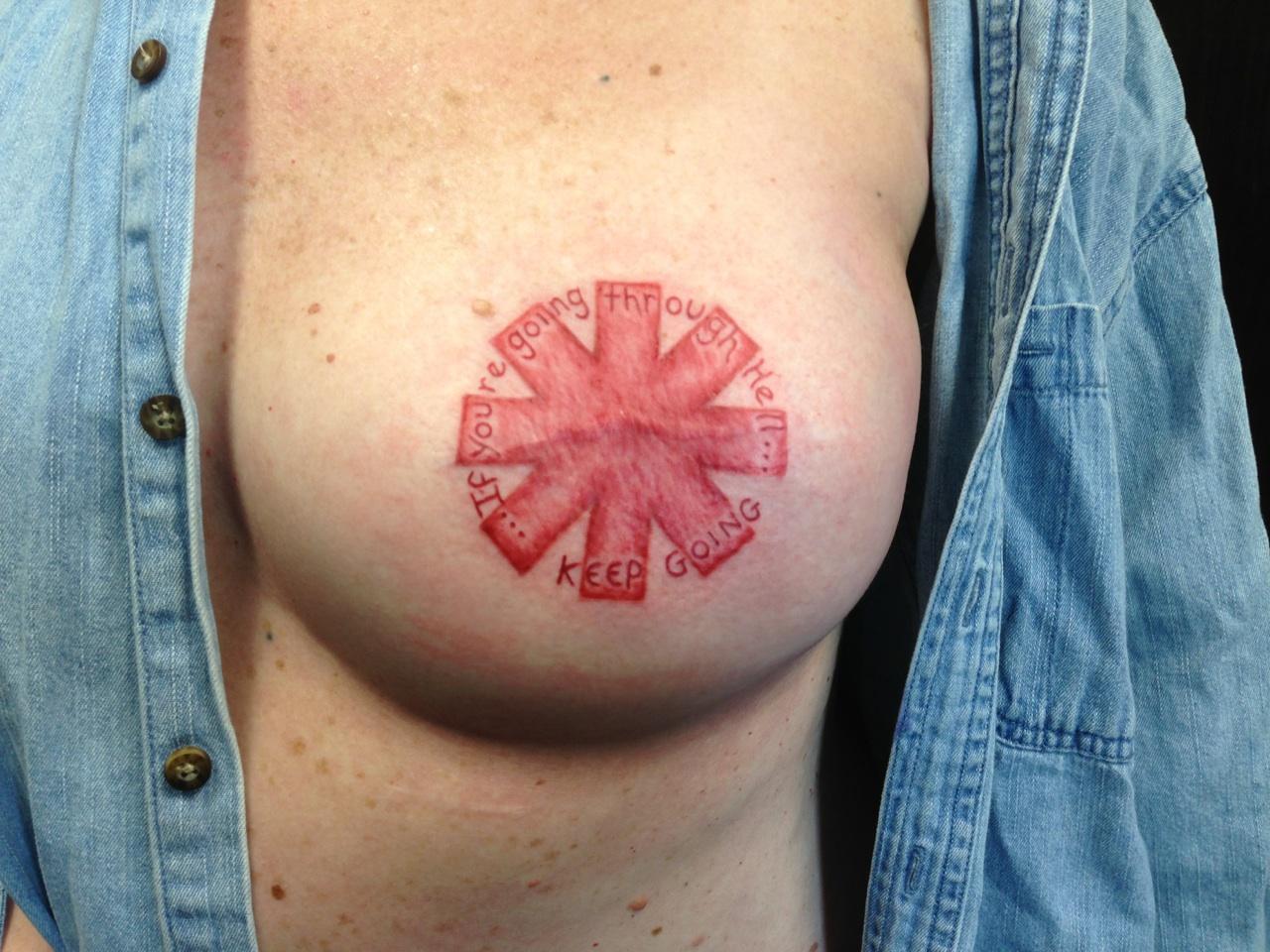
I’ve renamed the page that contains pictures of my non-reconstructed breast after lumpectomy and after tattooing to make a very important point: The Right Choice For Me – No Reconstruction. Let me, the Cancer Curmudgeon, state for the record, unequivocally, in the event I’ve not made it clear enough, that yes indeed, this is a very personal choice, and mine was perfect for me. I love my Red Hot Chili Peppers band logo tattoo. My tattoo in lieu of replaced nipple looks fabulous in and out of clothes.I’m very happy about my choice. I made the right choice for myself and I’d do it again in a heartbeat.
This is not a comment in any way on others who’ve elected to reconstruct. I simply want to reaffirm that my choice is right for me, and it might be for others as well. The point of all this is to reiterate, as I and many others have said before, there is no one right way to do cancer.
What brought this on? Commenting on HuffPo, of course. When will I get it through my thick head to avoid that site at all costs, even when other bloggers I like post links to it?
A few days ago I read some HuffPo blogger’s essay describing in detail her reconstruction. That’s great, there are a lot of these stories of mastectomy, expanders, reconstruction and etc. on blogs I follow. Hell, nearly all the comments on the essay itself included additional personal mastectomy stories. But stories of non-reconstruction seem a bit less prevalent, and therefore I’ve had to work harder to find them. I mean, sure, there is P.Ink on Pinterest, but that is pictures, mostly, the stories behind are not there (or they were not before, keep reading).
So in the comments, I said:
“I wish more shared their decision to NOT reconstruct, as I have done.”
I thought this statement expressed a simple wish, not a lament that I’d regretted my decision. Here is a response to my comment:
“Why? I can’t imagine not wanting to look good in your clothes and feel good about yourself. It’s also a very personal choice.
I lost one to cancer and one for preventative measures. I am very happy with my reconstruction. Originally I did not intend to have my breasts replaced but after talking to women who had done it, I changed my mind. Like the writer said, the physical impact is minimal, it’s a fairly minor surgery. And the mental consequences are only what you make them. I chose to accept it as over and done with. Every woman should aim for that attitude. It’s just not that big of a deal.”
(My response to her is a condensed version of this post.)
Where did I say in that one sentence that I thought I did not look good or feel good? Where did I criticize anyone’s choice to get reconstruction, just because I’m curious about different stories? Why did this woman assume that any woman who opts out of reconstruction looks and feels bad, and that this bad feeling was the motivation behind my comment? The third sentence, in which she acknowledges that it is a personal choice, does not make up for the judgmental tone of the previous. To me, in my irritated state, it implies that the ONLY presumed way a woman can look and feel good about herself is to have replacements. It negates her following statements about mental consequence and attitude, which again, assumes that any woman who elects to not reconstruct must not be happy—like I’m just sitting here, crying over my scar, because that is the mental consequence I’ve chosen. Again, read the links above to understand fully the path to my decision.
Granted I might be a tad unfair here, she does not know me or my blog, or the story I’ve documented on my blog. But, again, that’s just it—she doesn’t know “me”; it was just a comment from another reader, one she has no knowledge of. I’m stupefied that anyone would just automatically assume some random reader (in this instance, me) made this comment out of being unhappy with the choice, would NOT have done something totally different—like get a tattoo—and do it on purpose and LIKE IT, and not consider many other women might also have made unconventional choices and were happy about them. Seems there is a whole world of cancer patients out here that refuse to fit into any a narrow world view. I happen to be one of them, and I’m blabbing my story.
Of course, her opening shot of “Why?” says it all. Not only does she not think anyone could be happy doing anything other than reconstruction, she doesn’t think those who’ve opted out should even speak up. “Why” she asks, as if we do not even deserve a voice, especially since she assumes that voice to be only whining about our “wrong” choice.
I HATE breast cancer, that I had it, and that it damaged my breasts, anyone’s breasts. The pink ribbon’s “tyranny of cheerfulness” (Samantha King, “Pink Ribbons, Inc.” film) demands women conceal the sadness that can accompany loss of breasts falsely presents breast cancer as a party, whose attendees are warriors who never falter. I especially hate this notion that women who have mastectomies “just get new ones”, a comment I’ve seen/heard mastectomy patients REALLY condemn. I hate the save the ta-tas culture that blithely dismisses the lives in need of saving with that slogan, and that to save those lives ta-tas usually need to be lost, making the slogan a total lie. Indicating the loss is “no big deal”, to me, is incredibly dismissive of those of us who’ve really struggled and mourned our breasts, and by reading numerous other bloggers’ stories of mastectomy and reconstruction, sounds like many women I admire mourned their breast loss, and have written about it quite well. See Nancy’s Point and Chemo-brain, just for starters.
Another thing to consider in the story of how everyone does cancer: some folks have better emotional support and tools. Or some of us know the best way to deal with anger, sadness, and negative emotions is to let them out, not submerge them. And some folks have some incredibly tough personal situations in addition to cancer which can make the experiences much more difficult—it isn’t like every other problem in life ceases during cancer. If anyone is lucky enough to have a no big deal kind of cancer experience, great; now, stop lecturing everyone else. Stop telling others what kind of attitude is appropriate, because some of us choose to point out the dark side of breast cancer because we want to help the patients coming up behind us, rather than just glibly telling others to improve the attitude. And certainly stop assuming knowledge of others’ extenuating circumstances beyond cancer—it greatly influences the cancer experience—it is no one else’s right to determine for others what is or is not a big deal.
The completed tattoo, same day
I may hate what cancer did to my breasts, and I once mourned the damage, but I love what I did to reclaim them, to own my scars and to own my experience, to make my cancer experience absolutely Cancer Curmudgeon-y. My scar and the fact I had cancer are a part of me now. Just like the time I got hit in the face with a clothes hanger, leaving a dent at the top of my nose. Just like the time I dropped a very large, heavy piece of glass on my foot which has left my left toenail forever screwed up. All of this is a part of me. So I took the breast surgery scar and used it as a backdrop, a canvas, if you will, that reveals even more important aspects of me than my cancer status— which is a lifelong love of GREAT music. For a year I avoided looking at my body, my scar, I just hated it so much. Now, I catch sight of my scar, I smirk, and laugh at the anti-reconstruction rebel in me, the late bloomer/formerly-uptight-woman-worried-about-how-a-tattoo-would-look-at-40 me who finally got a 90s tattoo, two decades later. I think about RHCP bassist Flea, one of the greatest, or maybe THE greatest, bass player of the rock era—sorry Geddy Lee, John Entwistle, John Paul Jones, and Les Claypool. Oh, well, lookee there—I’ve used my cancer scar to jump off and think about things far more important and interesting to me than my case of cancer. Mental consequences, indeed.
(Source: around—the–world)
I pondered in a recent post about folks judging others’ “unnecessary mastectomies” what those of us making our choices public could and should expect in terms of criticism and applause. I concluded that it does not matter if it is tens or millions of people who know of any of our choices, no one has the right to judge decisions of others that only impact the person making those choices. I also acknowledged that it did feel good to get the compliments. So I pause here to thank anyone who has liked my numerous posts on my story and pictures, and for all the wonderful comments. I thank women who’ve shared their non-reconstruction stories in comments on my blog. I thank other women who’ve told their stories, anywhere. Mostly, I especially thank tattoo artist Eric, who helped me with the concept and design of the tattoo, and who made that particular section of having cancer the only good days in the whole mess. Visiting him for the first time to pitch the idea and getting an “I love it” response—well if there were ever a cure for my cancer blues, that was it. Going back to get the work done, having him tell me that he was so glad I wanted to do it, because he wanted to execute such a cool idea—it was a great feeling to be the source of an excellent opportunity, to make something good out of bad. I hated being topless for 15 minutes for those 30+ days getting radiation—I hated the whole radiation experience. But lying topless for 3 hours to get the tattoo, I loved that. I cannot express in words why this is so, but the fact I hated one and loved the other probably says more than I even realize.
I stared writing this post over 5 days ago—my life got very hectic and it was too much trouble to sit down and finish. I began in a fit of pique at the response to my comment, but by now I’m not that annoyed anymore. More like, just rolling my eyes at the ignorance of it all. It is this ignorance that compels me to finish and post this, rather than abandon it, which I considered. Things may never change; people will never stop judging each other, will never stop thinking that everyone’s feelings and actions should be exactly like their own. But I don’t have to like it, and I can speak up as long as I have the energy and will to do so. If this rambling tale helps even one woman someday realize she does not have to go with the status quo if it doesn’t work for her, then I’ve done alright.
This incident inspired me to revisit P.Ink on Pinterest, and revisit my own neglected boards there (oops!). I’m not much for joining groups or picking one breast cancer organization as better than others—I am still a Cancer Curmudgeon after all—but I think I’ll do this. I asked to submit my pictures to P.Ink, and received a wonderful email informing me that they are adding a new dimension—interviews to get those of us with tattoos to share our stories to inspire others, to let others know that getting tattooed instead of reconstruction is a valid option.
Looks like I’ll get to read similar stories—the ones I asked for that kicked off this whole mess—after all.
“But know that we live in a culture that both exploits a woman’s sexuality and denies her own control of it…” from “Pole-Dancing with the Stars” in Entertainment Weekly, Karen Valby
Yes, that is a reference to the musical genius, who fought a battle with a corporation for artistic control and eventually was able to resume being Prince. And yes, I am revisiting the issue of what to call myself, and the struggle with accepted cancer norms, like the battle language.
The other day a blogger on Tumblr wondered, if not fighters or warriors, what exactly are we? And another wondered how to get a loved one to stop using warrior talk in conversation with her, and I have a similar problem, in that my own mother keeps telling me a positive attitude helps one beat cancer (because she refuses to see the scientific proof otherwise). If that were true, I have a friend who should still be alive, instead of me, the realist who should not have made it, apparently.
Well, shit, I wish I knew the answer to these things. There are so many unknowns in Cancerland, that I wish I could embrace the warrior, ass-kicker talk. But I cannot, leaving me with one more unknown, another hassle to navigate. I do not actively choose to not embrace it. I am simply who I am.
It was easier when I was in treatment; I could dodge the warrior and survivor labels by referring to myself as a cancer patient. But now I am out of treatment. I mean, I still need to identify as a patient when I call the cancer center/oncologist’s office. I say my name and that I am a patient of Dr._________, and what I mean by that is, hey, you have a very thick file with my name on it, filled with my info, so let’s cut to the chase so I can get my appointment changed or my question answered.
So WTF do I do and say now? What do I call myself, and how can I interact with the rest of a world that engages in cancer warrior talk?
I know some of how this language came into use is revealed in Gayle Sulik’s “Pink Ribbon Blues”; she covers various contributions to how this language became acceptable—and for once pink ribbon culture is not the only culprit, yellow bracelets have a hand in it, too, if I remember correctly. I’ll have to re-read it, I know. But knowing the how and the why probably won’t help anyone figure out how to change, or at least challenge, this acceptable language of cancer.
I tend to define myself, not just regarding cancer, in negatives; I don’t want this, I don’t want to do that. Hey, I’m a fan of The Ramones and lots of their songs have titles like “I Don’t Wanna Grow Up”, “I Don’t Want to Fight Tonight”. I seem to approach this conversation in cancer the same way: I DON’T WANNA be called fighter or survivor! I DON’T WANNA run a race while wearing pink! I DON’T WANNA participate in pink ribbon culture.
But then I remember, the band was sometimes positive—“Now I Wanna Sniff Some Glue”, “We Want the Airwaves” and “I Wanna Be Sedated”. Well, OK, maybe not positive, but they didn’t just always list stuff they did NOT want—they listed what they wanted as well. There is an online game, and I once found a funny picture, devoted to what The Ramones did or did not want, just because that is what most of their song titles addressed!
So if I’ve got the “don’t wanna” portion covered, what do I want?
Once upon a post, I wrote that I wanted a guide book of sorts for how to do cancer:
I longed for guidance on how to “do cancer”, because I suspected I was doing it wrong…What is offered is “The Idiot’s Guide to Breast Cancer”, when what I needed was “The Asshole’s Guide to Cancer”, with chapters like “You Don’t Have to Wear Heels and a Pink Feather Boa to Infusion to Show Strength” or “(You Gotta) Fight For Your Right (Treatment Plan)”.
And yes, that final imaginary chapter title is another song reference. I’m going somewhere with the music references.
I’ve said many times, littered in various posts on this blog o’ mine, that not everyone does cancer the same way, nor should that be required. Maybe this blog, with every post I write, I’ve written my own personal not-so-silver-lined playbook on how to do cancer, the one I wanted while in treatment. Clearly, I deal with my cancer and all the surrounding bullshit by looking under rocks, pointing at the ugly worms and bugs underneath, trying to understand the whole truth behind whatever health “news/ads/feel-good-news-filler” is being broadcast in a sanitized manner (“…the hidden side of everything” is part of a tagline of a favorite podcast program of mine). I do not find inspiration and coping mechanisms in the packaged pink message, so I draw it from anywhere and everywhere else.
Granted, because of who I am and my tastes, I tend to draw inspiration from some strange and disparate sources. I think one can tell from most of my blog that I won’t be found listening to Kool and the Gang’s “Celebration”, that sickening staple of pink marathons (because having cancer is such a party, NOT).
A few posts ago I mentioned a NPR interview with Elmore Leonard, and his story about filmmaking with Quentin Tarantino that gave me a much needed reminder of my ability to know my own cancer better than random people who deem it fit to tell me (or anyone) how to treat cancer. I think I once repeated the infamous Conan O’Brien quote from a commencement address he gave in the wake of his fracas with Jay Leno: “What Nietzsche should have said is, ‘Whatever doesn’t kill you, makes you watch a lot of Cartoon Network and drink mid-price Chardonnay at 11 in the morning.’” I have much affinity for O’ Brien; his new TBS show began just as I was about to start treatment. Sleepless, I watched his new show and reveled in his new success, and as I look back, I think I may have irrationally and illogically regarded him as a lucky charm: he prevailed, and then, so did I.
But it isn’t just Prince, The Ramones, Beastie Boys, O’Brien, and Tarantino I’m building my playbook from. I absorb and apply any tidbit that works. There are likely hundreds of bits of inspiration I’ve found that simply would not be considered inspirational, or even recognizable, to most folks, but they work for me, so I use the bits. The biggest, of course, is Dave Grohl, ironically, a “survivor” it there ever was one, given his former band mate’s affinity for heroin and guns. In many interviews with him I’ve heard recently he has talked about the power of not knowing the “right way” of doing something, he has touted the DIY ethic that brought alternative musicians, himself included, to great fame in the early 90s.
source:bandlogos.wordpress.com
It is this DIY ethic I’ve applied to my cancer playbook. It isn’t pretty, this book, it is filled with the heavy and sometimes not-so-cheery-fluffy-pink things that I like. The only smiley face in it is the old Nirvana band logo. The book is not yet finished and maybe never will be. I still don’t know what those of us who object to a label of survivor or warrior should call ourselves, although I’m sticking with Cancer Curmudgeon for myself for now, given the accuracy of the name. I still don’t know how to have conversations with others who rattle on about positive attitudes, or who use battle talk. But I am always searching for those answers.
But I do know this: you can borrow a page from my un-pretty book if you need it. And I know you can make your own playbook. No one has to accept the cancer mainstream language and attitudes if they do not fit. It is difficult, but it can be done. The more of us that reject the sanitized and non-inclusive versions of cancer presented in the mainstream (need I remind everyone that pink ribbon culture ignores those with Stage IV, and any other kind of cancer, hence, non-inclusive), the more our voices of dissent will be heard.
Here’s to a new playbook that replaces that damn pink one.
Relieved to see that this seems to be written by someone “younger”, as in under 30. When this 41 year old complains about the boobies and ta-tas language, I am told it appeals to young folks and that is why it is needed.
Like I said in the previous post, it is nearly impossible to explain Labor Day in a beach resort town to those who’ve not experienced it. It is a complete and sudden absence of people, attention, and activity. (See previous post for background on life at the beach.)
I thought maybe post-treatment cancer patients would like to know they have a little insight about how life in a resort beach town on Labor Day feels: it is that “my treatment just ended” feeling. I can certainly say to non-cancer patients who live in my town, “you know that Labor Day feeling?” when I want to describe how it feels when cancer treatment ends.
Driving around the beach highway at 4PM on Labor Day is a strange experience. Everyone is gone. The hub-bub that made traffic unbearable a few weeks ago is non-existent. I love fall and Halloween, but am always a little bummed to see summer go, and this sudden exodus just makes it so real. Labor Day just always makes me a little sad.
Oddly enough, the hub-bub returns a couple of weeks later—not full swing and full-on noisy mind you. But there are those folks that come to the beach in September because there are no kids, less people, less activity. But folks always seem to think it will be quieter the more weeks out from summer it gets. Not so. If one wants a super quiet vacation while the beach is still warm, start it on Labor Day. Sure the service at stores and eateries might be slow, due to a small staff of a few shell-shocked souls who are serving customers and wondering what the hell just happened (the answer is: August, the worst month to work at the beach, just happened).
Cancer patients, does this sound familiar? The treatment experience is very much like the beach in the summer. Super intense, something going on just non-stop, until…it just stops. Finishing the last treatment is like a good-bye: “you did great, good luck, see ya in six months!” It is just a full on system shock, when your every single day was wrapped up in going to a medical facility, and then suddenly it is over. I re-experienced that on this Labor Day…everyone was gone, and I was still on that beach highway.
But it’s good to not have to deal with treatments every day, and it is good to have less traffic. I know the tourists and cars will return in full force next summer. I just don’t want cancer and the whirlwind of dealing with treatment to ever come back.
People always tell me writing is therapeutic, and while I of course believe this, I never experienced it so viscerally until I began this post and the next.
I’ve mentioned many times in various posts that I loathe the battle language of cancer (the most pointed example is in The D-Word). I do not call myself a survivor because I have not died of something else yet, and some with Stage IV have animosity toward the word, rightly so. Battle, fight, warrior, kick cancer’s ass—all those words or phrases continue to rub me the wrong way, and I never questioned why. I guess I just assumed myself to be practical, pragmatic, and I’m just not the cheerleader type.
Then, I started a post about how the drop-off in activity and in amount of people in a beach resort town on Labor Day is similar to the weird quiet that happens when cancer treatment ends. It is nearly impossible to explain this kind of sudden absence of people, attention, and activity to those who’ve not experienced it. So I began writing and thought I should include some examples of beach life, what my experience has been living and working here all of my life. And that is where I veered off track. But as I wrote, I learned that this life I’ve led that is so entwined with the rhythms of beach life really influenced my way of thinking about cancer in ways I am still understanding. I learned something about myself…grrr, no, wait, I mean…good!
So this post is about how life-long residency at the beach shaped my views as a cancer patient. The next post, Labor Day, will be what started me thinking about it all.
Shopping Madness at the Beach
A couple of careers back, I worked in retail. Working in retail is a special kind of hell. At the beach, it takes a peculiar turn, especially on rainy summer days. All the “sister” stores under the management of the area supervisor are two hours away in the cities. The supervisor and staff members of those city stores never understood rainy beach days; at least while I still worked there (this was several years ago). Rain at the beach makes people shop and spend lots of money. So a GREAT business day would result, in which sales would be as much as ten times the normal day. Well, income-wise it would be great—but days like that are trying, customers are grumpy and angry at staff as if we caused the inconvenience in their vacation, the store would get destroyed, a lot of theft would occur, and it took a lot of work to restock and recover. In short, we earned our minimum wage and then some on those days.
When reviewing sales increases and decreases on a later conference call with other area stores, our beach store would get accolades on the “great day” and invariably would get asked, “what did you do?” Saying “it rained” was not an acceptable answer. “You and your staff should take credit for such an awesome day,” someone would chirp, probably a cheerleader type. I never would and here’s why: if I said “yeah, we sold the crap out of those t-shirts, we’re awesome, hurray for us,” that would mean I’d have to accept blame for the opposite. A store is always compared to the sales of the same day the previous year. I HATED days when it was sunny, and I could tell by the ginormous sales numbers from the year before that it had rained. “Why are your sales so much lower this year compared to last year?” the district supervisor would ask, sternly. And yes, again, “it rained on this day last year and this year it is a totally sunny day,” is not an acceptable answer. Someone had to be held accountable, for not leading, selling, motivating and what have you. But I refused to blame myself and the staff for something beyond our control. We could not sell t-shirts to people who opted to take advantage of a great beach day rather than go shopping.
I’ve been dealing with the influx and outflow of people to the beach, how that impacts things like traffic, how busy the grocery store will be, and just a bunch of other quirks I could never explain, for most of my life. But now I see how my resort business approach shaped my view of cancer.
I never took credit for a good thing that happened when I did not have anything to do with it, like rainy day sales, because I did not want to be blamed for not making it rain when sales tanked—because I cannot control the weather.
It is the same with cancer. I will NEVER blame anyone who dies of cancer as someone who failed to “think positive to overcome the disease” or who “just gave up, did not fight hard enough, a LOSER”. Those people died because cancer kills, and cancer causes death because medicine still cannot stop that. Cures still seem pretty far out of reach. The latest Pink Ribbon Blues essay reminds us that there is no link between positive attitude and surviving cancer. Treatment effectiveness was NOT a result of my adoption or rejection of “warrior” status.
Conversely, I am not going to label myself as some kind of cancer ass-kicker. I may be frustrated at the medical industry for not being as far into conquering cancer as I’d like, but I know that leaps have been made and I benefited directly from the current successes in medical knowledge, and from the decisions of my medical team. I did not kick cancer’s ass because I’m so positive—I am a curmudgeon when it comes to cancer, after all. And I’m lucky enough to not be Stage IV.
I’m glad the drugs and the medical team were effective, me and the insurance company (and the money I paid into my insurance plan) paid enough for those things, so I shouldn’t need to do any ass-kicking.
People throw around terms like optimist, pessimist. I just try to be a realist. A life of beach business brain got me here, apparently.



 anotheronewiththecancer