Cells Don’t Have Brains

Reblogging my own piece from a few months ago. Why? Here ya go:
I am getting very tired of the over-dramatization of cancer, of giving cancer human or monster attributes it cannot possibly possess. That is why I do NOT write “letters to my cancer”.
Those ACS ads that came out at the end of 2015 were awful; I tried to avoid them. Didn’t know about the one in which “cancer fears love” until my friend Luna wrote about it. On the whole this ad campaign is terrible, but this one really plucks my nerves for this “make cancer a person/monster” angle.
Look, some people clearly need to anthropomorphize cancer to cope–but organizations that provide scientific info should NOT do this. I don’t write letters to cancer because cancer can’t read. But I assume someone at ‪#‎AmericanCancerSociety‬ can read. So Dear Person In Charge of this Campaign, STOP IT!

Cancer Curmudgeon's avataranotheronewiththecancer

Or: Why I’ll never write one of those “dear cancer” letters

Cancer is not a person, or even a sentient being, or even a separate life form. It is not an invader. Cells divide, that is what they do, except with cancer, it’s an anomaly of cell division. My cancer is just of my own cells running amok.

I see lots of “dear cancer” letters, especially in October, and they always make me uncomfortable. I know, I know, it’s just a way of coping with cancer. For me, it is sort of in the same category as going into “warrior mode” then “kicking cancer’s ass”.

Except I’m that jerk who points out that cancer has no ass to kick, not being a person or animal or whatever. This is one of the reasons I hate the “kick cancer’s ass” slogan—I won’t go into the bigger reason for that right now…

View original post 600 more words

Medical Obligations

I’ve been giving much thought to all the accumulated knowledge cancer patients get once we’ve lived in CancerLand a little while. Staying active in social media especially builds that knowledge as we interact with other patients in various stages of treatment. I’m not talking about strictly scientific, medical knowledge; I’m talking about cultural knowledge as well. Not only are patients filled with this knowledge, but so too are medical facilities and fundraising and support organizations.

Or are they? Continue reading “Medical Obligations”

Free Remedial Journalism Lesson Here!

OK, I HATE that I noticed this mere minutes after learning of Alan Rickman’s death. I even hated making a small note on Facebook about the language surrounding David Bowie’s death:

I didn’t want to gripe about language so soon after ‪#‎DavidBowie‘s death. But, damn, one UK headline I saw actually said Bowie “lost” his battle to cancer.

Now, it’s bad enough that the people behind the official Facebook announcement used regrettable language about his “courageous battle”, but at least they did not say lose. I cannot blame the media for using “courageous battle” when it was part of the official announcement. But putting “lose” in there–for fuck’s sake!

As I’ve said MANY times I just don’t even buy into this whole battle structure. But if I were to go with that flow for a moment, and concede that perhaps Bowie was framing the last months of his life with cancer as a battle…who in their right mind would say he lost? He released this album–kind of made it all like his art….seems to me he did his death on his own terms. Hardly a loss!

I mean, Bowie just seemed so alien, such an Artist with a capital “A”, that bringing up the old CancerLand semantics quibble seemed silly, petty, small.

But this morning I’m seeing that Rickman “suffered” from cancer, while Bowie “courageously battled” cancer. What the hell? Who is writing this? What idiot editor is approving this? Continue reading “Free Remedial Journalism Lesson Here!”

“I Know It When I See It”

US Supreme Court Justice Potter Stewart said this phrase in 1964 describing how to define obscenity. Yeah, I looked it up because I was trying to remember how/why the phrase was familiar. I seemed to remember it in relation to either the Robert Mapplethorpe exhibitions, or with the “Piss Christ” exhibition, or was it the Tipper Gore/PMRC/Moral Majority stuff back in the day? Which time did the phrase pop up, from my late high school and early college memories? All three? Probably!

It is interesting to note that Justice Stewart said this line in a ruling about a film (“The Lovers”), proclaiming it to NOT be obscene. Film, ratings, and obscene content pop up every now and then. I’m thinking most recently of the film “Blue Valentine”. Remember Ryan Gosling criticizing the MPAA over the initial NC-17 rating? He pointed out that when men receive oral sex in film, it is “acceptable”, but when it is a woman—well much gasping and pearl clutching ensued (my words, Gosling never said “pearl clutching” that I know of, but I’d love to hear him do so!). Go back about a decade and check out the documentary “This Film Is Not Yet Rated” for an illuminating look at the sex-obsessed, secretive, MPAA board. Filmmaker Kimberly Pierce (“Boys Don’t Cry”) makes the same point as Gosling in the first few minutes of the film. Filmmakers interviewed in the film gripe the most gruesome violence merely gets an “R” rating, but too much use of the word “fuck” and too much, or ahem, “certain”, read: gay, intimacy scenes gets you a “NC-17”. There are many gripes in addition to this—such as the accusation that the MPAA serves the big studios and punishes the small independently made films—but the pearl-clutching, community standards claim is what I’m interested here. It seems the standards—if there are any—are based on personal prejudice rather than what most of America thinks. The documentary explains all this much better than I; go check it out.

Continue reading ““I Know It When I See It””

What Gets Lost in Translation

This is another “cancer language sucks” post. And yes, it is about the celebrity stories and wacky headlines bombarding the entertainment news sections: Rita Wilson and her 100% healthy and cancer free—which it seems she actually did say; Former President Carter’s cancer free status, though I think that was said about him, not sure what he actually said; and the completely baffling story of Lorna Luft and her seven ribs. I admit, I gave up reading pieces about her, could not figure out the details and her clichéd quotes, her need to adhere to the culturally approved cancer script, just sickened me and I gave up.

I’ve written about my rejection of the terms like survivor and warrior (here and here, that’s two in my mind, too lazy to look for more), and no doubt will again. I’ve especially written about my confusion about remission. I cannot recall exactly what phrases any of my oncologists have ever said to me. While never grim, they were always cautious. I do not remember anyone using NED with me; I picked that up via social media. I’m sure no one ever said “cured” or “cancer free”. The vibe was always: “we don’t see any cancer, and your chances are good, but let’s keep an eye on it all”. I was told from the very first meeting with the oncologist the odds of my kind of cancer (HER2+) and stage coming back. I was always aware it could go other places, and was told how lucky I was the cancer had not reached the chest wall—tho’ it almost had reached it.

But the general population just cannot understand all of that. I’m learning some cancer patients don’t understand it fully either, and nor do they try. I am still in slight shock, all these years later, when I think of that little “live healthy post cancer” workshop I attended—in a room with about 10 other women, none of them understanding what I meant when I announced my stage and type at the meet and greet part. “HER2? What does that mean?” Guess they were all estrogen receptor positive? Good thing a triple negative patient wasn’t there that day.

People like a beginning and an end—a cure, and end to treatment, and the absence of ever needing to think about cancer again. They like slogans and soundbites. And everyone especially likes a happy ending. A story about a former president’s cancer, the idea it might come back, but given his age, something else will cause his death earlier—that is too confusing! Better to simply think he “won”. An aging actress on the road with her play needs to reassure potential ticket buyers all is well; she’s going to be in the show coming to your town next year. Sell the joy! And so what if, 15 years from now, a small news item in the back pages appears announcing her recurrence and quick death—“I thought she beat that”, people will think before quickly forgetting the story and moving on to the latest young pop stars’ exploits.

But here’s the thing.

When celebrities and headlines go on and on about “cured!” and “beat cancer!” it confuses the people we—regular average cancer patients—have to interact with every day. What do I mean I have an oncologist appointment? Didn’t I finish up with cancer years ago? Old old old Jimmy Carter beat cancer, why can’t I? Look how peppy Joan Lunden is, why isn’t my breast cancer over and done with? Do I really need to point out that celebrities stick to a cancer culture approved script? Am I being too hard on actors and TV talks show hosts for needing a script rather than thinking and speaking for themselves? Whoopsie, did I just write that out loud?

Words matter, as so many inspirational posters like to remind us. A little celebratory slip of the tongue: “I’m cancer free” confuses the cultural conversation around cancer. And that is why so many of us in CancerLand got so bent out of shape about these stories. People without up close and personal cancer experience will happily go back to their fairy tale (My Reality and Your Fairy Tale), and assume the celebrity is “all done”, and cancer is curable.

It seems once I got my cancer diagnosis, I learned a second language. NED, estrogen receptors, chemobrain, pinkwashing, argh, do I need to go on? I do find myself translating at times. And it seems that the area of language in which we CancerLand residents must be MOST careful is when discussing the after-treatment (if there is even a post-treatment status, because generally for Stage 4, there is not) time. So when Rita Wilson says something like cancer-free, we find ourselves having to explain so much. And it is tiring.

This brings me to another little tidbit of translation, or more like re-defining words.

Reading FB comments is always a hazard, I know, but of course I did and the typical stuff happened in threads about Wilson’s news. A few advocates attempted to explain and correct the “cancer-free” issue. Naturally, those who believe that any kind of truth-telling automatically equals negativity, began to scream about it, calling the comments “toxic”. I’m not as active or strident as breast cancer advocates; unwilling to “get into it” very much. But I could not help but chime in with my annoyance at this. I mean, come on, why call a different opinion toxic? Isn’t that a bit overdramatic? In my mind’s eye, I saw a person clamping hands over ears to shut out the opinions they disagree with. And yes, I over-dramatized myself, picturing Gollum saying “not listening, not listening!” LOTR nerds will know what scene I’m referencing.

It irritates me that thoughtful dialogue cannot occur without the situation devolving to this. I found myself wanting to engage in a little careless re-defining or mis-translation myself. I get sick of reading about false positives (because I was a false negative). I know what it really means here in CancerLand, town of breast, but I have this fantasy. I want to call all these people who redefine words like toxic, who think cancer is curable by eating right and keeping a kick cancer’s ass attitude, I want to call these people “false positive”. Because to me that is what is going on: thinking something is one thing, and maybe it isn’t. So part of me is like, OK fine, embrace the positive-negative dichotomy and let’s hope you don’t end up bitterly disappointed in your mistaken idea cancer is really, really gone.

But of course, it is not in me to do that. I don’t like the misinterpretation of words and concepts. And I am tired of the strict black and white boxes being forced around the cancer conversation. Spouting facts does not equal being negative—looking at stats and numbers can actually be quite apart from such silly notions as “don’t be a negative nelly, be positive”. That kind of black/white, half-full/half-empty thinking must come to an end. Embrace the complexity of life, people!!!!

But then, who am I kidding? Everyone wants pat slogans that translate to their liking: “cancer can be cured!” Conversation over, and what have we lost in translation?

But Not Too Real, OK?

I was trying to avoid all effort of any kind last weekend. I wanted to just sit on my butt and do nothing—well, maybe read or watch TV. I chose the latter, and landed on a “Brady Bunch” re-run.

I do not remember the episode from childhood, although I’m sure I saw it back then. In it, Mrs. Brady attempts to write a magazine article about her life with 6 kids, the blending of 2 households, all that jazz. Her submission is turned down by the head of the magazine for not being positive or uplifting. So she rewrites and sanitizes her piece, makes the kids seem like angels and their lives ideal. Of course the fairy tale version gets accepted, and an appointment with a group of magazine staff at her home is made to photograph her, do a little background on her family. Naturally everything goes wrong—miscommunicated time leads to her answering the door in hair rollers, the kids are arguing, one of them has poison oak—you get the idea. Normal life with kids (I guess). Mrs. Brady is mortified of course, but the magazine staff is delighted, and wonders aloud to her why she did not write THIS—real life with troubles and disappointments—challenges of a modern household. She does, it gets published: happy sitcom ending at last.

Despite my aim to not do ANYTHING as I vegged out in front of the tube last Sunday, I could not help but contemplate the meaning of “real life” in Brady Bunch Land, and compare it to our current cancer culture. Now, given that it is the weekend again as I write this, and it is the holiday season and I’m just exhausted, my thoughts aren’t going real deep or anything—more of a passing ponder. I’m sure some social/pop culture critic/anthropologist can take a better crack at this.

Things like poison oak, screaming and arguing kids, answering the door less than camera-ready are not disasters compared to cancer. (I know, I know, I HATE the comparison thing, and I know that just because someone’s struggle is minor compared to others I should not diminish said struggle—but indulge me here, OK?) In fact, as someone who once answered the front door wearing pajamas at 3:47 PM one December afternoon (hey I was ready for bed!)—I found Mrs. Brady’s hair-in-rollers-yet-makeup-perfect-and-cute-lounge-robe-at-the-door laughable.

This weekend, catching up on blog reading, I came across a gentle criticism of pictures used on social media when another metster dies—always an old photo from the time the deceased was still relatively healthy, or at least not in the final days of wasting away. The blogger prefers the VERY few times patients have posted those less than photogenic pictures of what those last days really look like.

I think about this blogger’s words. I think about Facebook constantly removing pictures of breasts in the process of reconstruction. I think about how bald heads are now considered “real”—think about that fracas in October 2014 when a morning TV program did not want to feature a Stage IV patient because she was not bald like a “real” cancer patient. Even society’s version of real is kind of fake! We have this language of “grit”—the warrior/soldier with a bald head—but otherwise looking hale and hearty—wearing boas and heels, or tastefully/professionally photographed mastectomy photos, the new breastless nude that is maybe just as fetishized as the bald beatific smiling warrior (see Random Thoughts On Baring the Scars for my worries on that subject). I think about that scene in the final “The Hunger Games” book, when Katniss is “too scarred/ugly” for the propaganda video to be filmed—no, they make her pretty then artfully use make-up to create new, less scary, more visually appealing and inspiring scars. (Just read a fascinating essay reminding me the books were inspired by our current reality TV shows, and all the implications of that.)

A fake real is what we want. Don’t make it too real. Or hopefully your reality is just Brady Bunch cute.

The debate about how much to “show”, about deathbed selfie culture/oversharing will rage on. I recently read a piece that took a jab at the country star and how the blog/pictures chronicling her final days are boosting record sales. A paragraph about Jolie’s publicized surgeries and how her essays allowed her to control her image while appearing to share “realness” for reasons of awareness-raising struck a chord for me. She was real—but only in a managed “I woke up like this” way, maybe? Is it annoying when celebrities do it because they might gain fame and success, but in cases of regular patients who are really trying to tell it like it is, it’s OK? I admit, I was reminded of the Keller’s attacks on Lisa Adams when I read the piece. Not the same, but the underlying sentiment made me wonder if the writer was even aware of that fracas a few Januarys ago. (And the near universal praise for the “real” surgery dancer, see here.)

What is real and when is it too much? I don’t share pictures of myself very much because I dislike the way I look. But I’ve not held back (too much) on exposing my ugly thoughts. Are they too real? Do you recoil?

I’m not sure many people are ready for REAL reality, despite the popularity of reality shows.

“I fake it so real I am beyond fake”

“Doll Parts” by Hole, Courtney Love knows a few things about real/fake I wager!!!

Take Away This Ball and Chain

This is a sequel of sorts to a post I wrote this summer, Burden of Gratitude. I’d struggled for over a year to write that post. I still wrestle with my feelings of tainted gratitude. I still get a knot in my middle when I see/hear critics of the sexualization, commercialization, and etc. of breast cancer told they should just be thankful for the achievements of the ribbon, especially the just being alive part.

In that previous post I noted that gratitude is used almost like a paddle to smack the hands and mouths of these “naughty and ungrateful” critics. I still think this is the case, only more so. I’m not sure I stressed that point enough in that previous post. While I view gratitude as an internal burden for myself, I also think it is becoming a huge obstacle in moving forward in breast cancer culture, and yes, even funding/research/cure/prevention.

I’ve complained VERY often on this blog about how cancer culture seems to be stuck in a rut, stuck in TV re-runs. Watching this latest episode of Pinktober this year, the business-as-usual races, beer-and-boobs parties, and pink shopping bonanzas, I’m more convinced than ever of the existence of this rut cancer is in. Each issue acts like a ball and chain, shackling breast cancer culture to the same old song and dance, preventing forward motion.

pinkblack

Side note: I get really sick of metaphors in cancer language, but it seems we cannot talk about cancer without them, so I am giving in. So, yep, I’m gonna call anything preventing progress in cancer a ball and chain.

There are many ball and chain combos I could criticize—the never-ending debate about mammograms, the argument that fussing about sexualization is a waste of time—but I think gratitude is the biggest ball and chain.

Why do I say this? Simple. Because when ANYONE—whether they be the head of a major cancer organization, or a mere Facebook commenter—uses the “be grateful for all that pink has done for you” argument to anyone asking for more and better, they are looking back, not forward.

Hey, I said it was simple.

I realize how oddly timed this is. With the holidays and end of year around the corner, most people will be writing about all they are thankful for, and here comes the cranky ol’ Cancer Curmudgeon, saying stuff like “gratitude is bad”.

Of course, I do not mean all gratitude is bad—I’ve made it very clear (seriously, read that previous post) that I am grateful that I am still alive, that angry women decades ago became vocal about breast cancer and the disease got attention, then funding, then treatments. In fact, let’s think more about those women of the past. I am sure that women who “complained” about going under for surgery and waking up with a disfiguring, extreme mastectomy were told “you should just be grateful you’re still alive”, too. Just like those of us “complaining” now.

I’m glad they didn’t just sit quietly with deferential gratitude. Because of their actions, I was able to have chemo first to avoid a disfiguring surgery, to only get a lumpectomy.

You see, I am looking back, considering all that has been done in the history of breast cancer. Why do so many people think only the pink ribbon parades ever did anything for cancer? And why do people assume it was easy to put a pink ribbon parade (or whatever event) on in the first place? Do they really think it was always easy? It ALWAYS takes agitators—yes, complainers—to move things forward.

If I see one more comment on any article or on Facebook tsk-tsking those of us asking questions, raising objections, asking for more, I will scream. It baffles me that whenever anyone criticizes something they are automatically labeled ungrateful and negative. It is possible to be grateful AND critical/analytical AND angry all at once. I am again reminded of a scene in the Harry Potter series, in which Ron thinks a girl with conflicting emotions will explode from it all. Hermione points out that he must have the emotional range of a teaspoon. I cannot help but think anyone resorting to the “haters gonna hate (oh that phrase MUST stop)/you should be grateful/you’re negative” hand-smacking comments, also has a limited emotional range. Being human is complex and involves having conflicting feelings at times. Grow up.

As the saying goes, some people prefer bathing in compliments and being ruined by that practice, rather than listening to criticisms and ascertaining if there is a legitimate need for improvement. Of course there is always room for improvement. Why does anyone ever think things are perfect just the way they are?

It is fine to look back on accomplishments, to acknowledge achievement. But at the same time, one must ask, what else is to be done, what improvements can be made, how much more is there to go? Otherwise, one is just resting on laurels, and I think that is happening in many areas of cancer culture. Yes, lessons can be learned from past examples, but don’t ever think the job is done.

I implore everyone to remove the shackles of gratitude. Gratitude is good in small doses, but don’t let it lull us into a sense of thinking all problems are solved. If the old methods (races, ribbons, and the like) have taken us as far as they can, time for something new. No, I don’t know what “new” is. But I do know when something is at an end.

“While I’m singin’ to myself
There’s got to be another way

Take away, take away
Take away this ball and chain
Well I’m lonely and I’m tired
And I can’t take any more pain
Take away, take away
Never to return again
Take away, take away
Take away
Take away this ball and chain”

“Ball and Chain” by Social Distortion

Thanks And Feel Free!

Big THANK YOU to everyone who likes my last post–a response to Nancy Brinker’s “Seeing Red” letter to the New York Times. And special thanks to those who are sharing my post–even directly to Brinker.

I did consider sending it as a letter to NYT, but their hoops were ridiculous. The suggested word limit is far too constricting for this topic–at least for me. And I want it to be an open letter–I’m not going to wait to see if they deign to give a redneck small time blogger space in their paper. Puh-leeze.

I’ve been tweeting my post to her, Komen, and NYT, but I do not have many followers–or social standing to make much of an impact (remember, Curmudgeon, I’m not very cuddly!). So if you think my post says the things you’d like to say to Brinker/Komen, please feel free to use it–tweet it at them, post it wherever!

And thanks again!!

Symbols Are Stagnant Institutions, Not Solutions, Nancy G. Brinker

Nancy Brinker is “seeing red” over the recent New York Times article detailing how some breast cancer patients are tired of the “pinkification” of disease (see her letter here, see what she is angry about here). Her letter was strange to me, and would be laughable except 1) as the head of Komen her voice will be heard (although she claims she is NOT responding as a Komen representative) and 2) so many people will agree with her, will not look at her defensive whining with a critical and analytical eye.

I find soooooo many problems with her letter—and I’m not even as staunchly anti-Komen as so many other bloggers!! But here are my gripes.

Well, Nancy, you say the Pink Ribbon now symbolizes breast cancer. You’re not wrong there.

You go on to say breast cancer is very personal for you. It is personal for me too, since, you know, I actually was diagnosed with it myself at age 38. It continues to be personal for me as I know I could have a recurrence at any time. It is personal for thousands of other patients currently living with metastatic breast cancer. What makes you think you have a monopoly on personal feelings about breast cancer? Your claim of it being personal just illustrates your tone deafness, your inability to realize the cancer demographic is made up of lots of individuals with VERY different perspectives. We are not homogenous, and no one’s personal relationship with breast cancer is more important than another’s, not even yours.

You say you made a promise to your sister to work to find a cure, to raise awareness for the need for testing, treatment, research, cures, and to raise money for research. Let’s unpack these promises, shall we?

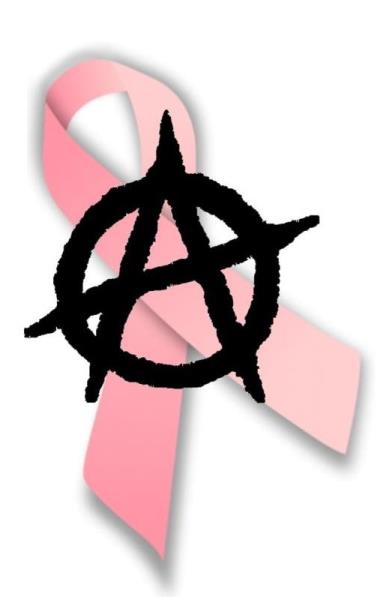
Your first promise, to find a cure, has not been fulfilled. The second promise, to raise awareness, you’ve been successful—congratulations. But that awareness has not translated to meaningful results—see broken promise #1. Instead, you continue to work on “awareness” as if no one is aware, as if you only wish to do what you know, rather than face new challenges. This has made you, your organization, and other pink organizations, stagnant institutions. The stagnation is killing people. Rather than evolving, than checking off the “raised awareness” task from your list, you continue to only do what has been done for 20+ years. That’s why my avatar is the anarchy symbol over “A” (not YOUR, copyrighted) pink ribbon. We need a little anarchy—or at least an overhaul.

random find

And oh my goodness, the third promise you state in your letter. You’ve raised billions, but has it gone to research? No. More money goes to education, screening (and screening is ALWAYS controversial), and of course to fundraising (it takes money to raise money) than to research (see here, page 7).

You list the (non)-achievements of the Pink Ribbon as allowing Komen to stage races with over a million racers, establishing partnerships in numerous countries, and engaging thousands of volunteers. I am NOT impressed by any of that. Big deal, people ran in races—there are plenty of marathons out there. The partnerships—good grief, look no further than the recent fracking/drill bit fiasco for the worth of those partnerships (but if anyone wants to look further, well, there’s the KFC chicken, the Dietz & Watson—because cured meats are so good for you, and all the shopping, shopping, shopping). And you provided opportunities for volunteers to do what they do: volunteer. Hey volunteers are gold. But their work needs to be meaningful. It seems all the work has achieved is perpetuating your stagnant institution.

You close with “Pink Ribbons matter”. I hope that was NOT a reference to the “#(whatever)livesmatter” campaigns. Komen has already proven time and again their inability to come up with original ideas. See your own admission about “borrowing” the red ribbon idea from the AIDS movement. How about the elephant stolen from METAvivor last year in that stupid Kohl’s campaign?

Originality is part of evolution.

Yes, lives matter, mine too. Most of the non-achievements did not benefit me. Early detection and screening? Nope—I tried that, but the mammogram (or rather the radiologist) did not find my cancer. Sure, the awareness raised by pink ribbons funded research that created drugs like Herceptin, which allows me to still be here writing this critique. However, unless I’m mistaken, the money raised for Herceptin research came from Avon—but never mind, let the ribbon’s ubiquity claim that prize. But all the races, pink ribbons, and volunteers did not prevent me from getting cancer in the first place. Ribbons won’t prevent my likelihood of recurrence and metastasis.

Right now, Pink Ribbons don’t matter. Even non-breast cancer patients are tired of them, have become immune, sometimes blind to them. (That was one of the points of the piece to which you object–how did you miss that?) Pink Ribbons are stagnant and Pinktober has become an institution, celebrated right along with Halloween. They symbolize breast cancer, but the threats to me and others remain. The death rate has not really changed. (Sure, there are more survivors, but the controversy surrounding the screening debates can tell anyone that it’s easy to create more survivors, if you create more patients that maybe never should’ve been called patients. But I digress). That symbol is no solution for my breast cancer, for my friends’ cancers.

Here is my challenge to you Brinker—realize how ridiculous Komen has become and do something about it. I think Komen is incapable of evolution. Prove me wrong.

Cells Don’t Have Brains

Or: Why I’ll never write one of those “dear cancer” letters

Cancer is not a person, or even a sentient being, or even a separate life form. It is not an invader. Cells divide, that is what they do, except with cancer, it’s an anomaly of cell division. My cancer is just of my own cells running amok.

I see lots of “dear cancer” letters, especially in October, and they always make me uncomfortable. I know, I know, it’s just a way of coping with cancer. For me, it is sort of in the same category as going into “warrior mode” then “kicking cancer’s ass”.

Except I’m that jerk who points out that cancer has no ass to kick, not being a person or animal or whatever. This is one of the reasons I hate the “kick cancer’s ass” slogan—I won’t go into the bigger reason for that right now (see this old post Why This Smart Ass Does Not Kick Ass for early thoughts on the subject).

I’ve been writing this post, off and on, for a long while now—maybe years. I got started one day reading a post I heartily agreed with; a discussion on why cancer is not a gift (roll my eyes over that old cliché, gag!). I read through the comments and one patient vehemently declared, no, cancer is not a gift—it’s evil!

While yes, I certainly am on board with the whole “not a gift” thing—nooooo, it isn’t evil either. Without a brain, cancer cells cannot have purpose or intent. Without purpose or intent, cancer cannot be evil. Don’t get me wrong, it feels that way to me much of the time. My first reaction, like so many other patients, was cut this thing out of me now! I envisioned the classic “invader”, the idea it was some sci-fi “Alien” thing.

It took a long time, and I still must curb my thoughts and reactions, to ground myself and my view of cancer as some fantastical creature, some demonic possession to overcome. It is easier to think cancer is some evil invader, not one’s own body gone wrong, failing, betraying. Cancer is not sci-fi, it isn’t even alien. It’s just me, my cells—but gone wrong.

I have nothing to say to cancer, because cancer doesn’t have ears, so cancer ain’t listening. And yes, again, I realize letters are a coping strategy—like journaling or, cough cough, blogging! I realize many of us must frame cancer experiences as a story. And as someone who has shared her story via blogging, it is a bit unfair of me to criticize the storytelling of cancer—this beast or invader who must be met on a battlefield, and vanquished like a dragon or something from King Arthur times.

I guess some of my discomfort stems from a growing unease with the storification of cancer, and yes I do it too. But sometimes it strikes me silly. Like, did I battle the traffic to get to the grocery story, fight my way through obstacles (other customers in the check-out line), to emerge victorious and return home with my booty (groceries)?

I know, I know, having cancer is not as mundane as a trip to the store. But on the other hand, I fear making it too epic. I mean, maybe I have made it epic too much my own stupid self—I’m still blogging about it all these years later after all.

I guess what I’m saying is—my coping strategy is quite different. I NEED to know that cancer was not deserved, that it was in fact, maybe quite random. Something happened that triggered the cells to divide improperly—and it is just that simple. It is tempting still, to view my body as a traitor, but it isn’t. My body just isn’t smart enough to make a plan of betrayal—my body contains a brain, but each cell doesn’t have one. I NEED to know that my current status of not having any evidence of cancer is just a result of methodical medical interventions, not any of my lackluster abilities (because if it depended on me, well, I’d probably still have a tumor). I take perverse comfort in the randomness. At some point, maybe someone will discover cell division run amok is not random, that there are triggers, and I NEED to think about that, to know that science, not epic tales, will be the end of this.

*Special thanks to one of my clients, The Engineer, for playing midwife to this post.