My Reality and Your Fairy Tale

I’ve never really had that one post about the dumbass things people say to cancer patients. The one time I started to write such a post, I wound up focusing on a small slice of all those irritating phrases—I focused on the awful, blame-the-patient phrase of “lost the battle to cancer”, and how much I dislike the euphemisms for death.

Books and many essays have been written about the dumbass things said to cancer patients, and I couldn’t really add to the conversation, so I lost my motivation to do so. Now that I’m a couple of years past my final Herceptin infusion, these dumbass things are not said to me, so they are not on my mind as much. And really, I’ve finally accepted the idea that sometimes what is said to cancer patients is really meant to soothe the cancer fears of the person doing the talking, not just the fears of the actual patient.

But I had the bad luck to reflect on one particular dumbass thing today; the phrases that reassure the patient that “everything will be alright,” or “my friend/relative got cancer when she was 35 and lived to be (some big number), and she was fine…never had any more cancer!”

I’ve had a lousy month, or maybe a lousy past two months what with one problem after another. The latest involves finding new insurance, and in turn, I’ve just learned I will need to find a new oncologist because my current one does not participate in any of my new, limited choices. I’ve been scrambling to find out which of my current doctors do what plans (the internet is a failure on this, gotta call each of them to get the nitty gritty details). Long story short, I got into a conversation today with the surgeon who performed my lumpectomy two years ago and asked her for suggestions for other oncologists I might try.

I think she actually thought I was considering just abandoning oncology altogether, just not even bothering to see one anymore, since I’m about three years out from initial diagnosis. She became a bit grave on the phone.  She told me I had a “very aggressive, serious cancer” and, given my younger age and the type of cancer (aggressive, fast growing, HER2+), I need to be in the care of an oncologist “for a long, long time.” That last phrase she said slowly and with great emphasis.

Yeah, I know. I need to see an oncologist twice a year for 2014 & 2015, and then once a year for the five years after that. It is a long time, and I hope I can reach 2021 to see my first calendar year free of oncology appointments. Honestly I’m afraid to let myself look forward to that day, it seems so far away. And I know my cancer was serious. I do not take my cancer lightly, and I’m not going to blow off getting a new oncologist because I feel fine right now, which I don’t anyway. Rather, I tend to suspect every twinge of pain, every change in body shape or function, thinking it means cancer is back. The sense of threat is real and sometimes very near the surface.

I really like my surgeon, maybe a bit more than I like my other doctors, especially because she is frank, no non-sense, and always gives me all the odds, probabilities, and facts sans sugar coating. But today I thought, great, I do not need that reminder now, when I already have bajillion other things sending me into panic mode. I began to talk myself down, to remind myself that just because I read blogs reporting various tales of recurrence, that isn’t necessarily going to be my fate as well. Then I thought back to all the times I heard people with their dumbass things said to cancer patients telling me it will all be ok in the end, because there is always so-and-so who just had a little cancer that one time and lived another 50 years.

There are so many reasons to dislike this little anecdote about the person who lived oh so long after that one little cancer incident. It is so dismissive of the very real fear and very real—sometimes high—possibility that cancer will recur in the person to whom this is said. While I do welcome anecdotes, because the small percentages or small likelihood stats (some of which I fall into) are made up of people, I still tend to consider all the possibilities. And this will sound so snotty, but when I weigh the tale of some random person told by some other random person against the word of my doctor, I take the word of the medical professional—who I give money to, BTW—over the random feel good story.

The words of my surgeon are my stark reality and the reality of many cancer patients, one that sometimes is conveniently ignored by those who wish to believe in the tale of the person who lived 50 or so more years. It isn’t a total fairy tale, but it may as well be for some. For those with Stage 4, whether upon initial diagnosis or recurrence, cancer is the rest of life, and that may be a long, long time, but probably not. For me, with my likelihood of recurrence, cancer is the 10 years from October 2010 until sometime in 2019 or 2020, if I’m lucky, and then who knows how many more years if that likely recurrence happens. Cancer does not claim my every moment right now, although it occupies more moments lately as I grapple with an upcoming 6 month check-up, that is, if I can get my insurance organized and get a new oncologist.  Right now, it is taking up a lot of my long, long time.

So to those who insist on the idea cancer is no big deal, that it will be tiny a blip and I’ll get another 50 years without incident—if you continue to ignore my reality, I’ll continue to ignore your fairy tale.
He’s Honest

My Tumblr buddy Greg has Stage 4 Prostate cancer. 

Click a couple of times here to get to his piece.

Cancer & Money

The Cancer Industry and the True Cost of Treatment

Would curing cancer crash the economy? Stuff I don’t want to think about but I do. 

Tamoxifen takers should read final portion of this article. 

Make No Mistake About Where I Stand

Symbols Are Not Solutions Rant 1

 I’ve never written that one definitive post that lists everything I find wrong with pink ribbon culture. Sure, I have put a warning on my About page: “I am not a fan of the pink ribbon culture, and—warning—my words are going to reflect that quite often.” And I’ve sprinkled various points of criticism randomly in many posts (or maybe just snide remarks), or maybe a post here and there focused solely on dislike of Pink —Take the Mythical Image of the Strong Warrior Breast Cancer Survivor And Bury HER Once And For All is only about one troubling aspect of Pink—it certainly does not take on the marketing, the sexualization, blah, blah, blah.  So while I have not listed EVERYTHING I hate about Pink the way others have, I still think it is pretty clear exactly where I stand to be counted on the topic.

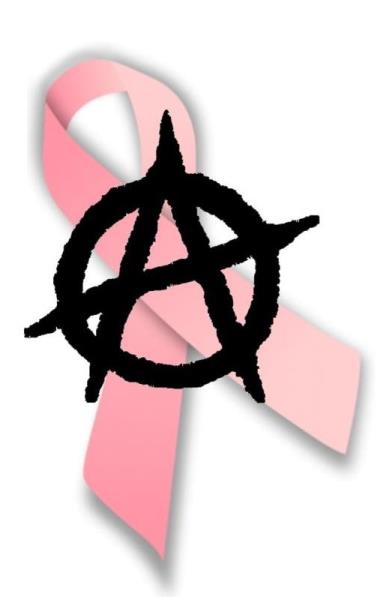
And if it isn’t clear, let me make it so: I reject the Pink Ribbon. It does not symbolize to me what it does to the general public. I only see a bundle of lies when I see it. I may have had breast cancer, but that symbol doesn’t represent me or my cancer experience. My beat up old rock concert t-shirts and rough denim cut-off shorts I wear most days symbolize who I am better than that ribbon.

random find

I currently do not see the need to make my conclusive list supporting the “why” behind my ribbon rejection; there are a few books, at least one film adaptation, and countless essays and blogs that have expressed most of my thoughts on this topic, although I do not agree with exactly everything in the anti-Pink view, just most of it (I’m a Curmudgeon, I’ll always find something to pick on). I write this blog under the assumption that most readers are on the same page in dislike of the pink ribbon, so I’d be preaching to the converted. Since I do not wish to be told how to do cancer, I must respect how others do cancer, and lots of folks do it by embracing the ribbon. So who am I to try to convince anyone differently? So, I’m not gonna preach to the unconverted, either. For those on the fence, see the aforementioned other essays. Those others have written it far better than I ever could.

I’ve been feeling unmotivated, uninspired, and just plain down of late, especially in the area of my continued rants against all that I find objectionable in cancer culture, especially Pink. As Pinktober approached, I saw several blog posts encouraging the need for continued activism, including blogging. In my current state of mind, just writing a blog or letters to local papers about it is simply not enough, because like attracts like. People seek out the sites, essays, and letters that they already agree with, I do it too; leaving little chance for mind-changing to happen. I see lots of blogs and comments on blogs and website that criticize the ribbon, and I get all encouraged, but there must be tons more that are in favor of it, since it is still so prevalent. And like I said above, out of respect for those who embrace it, I just feel unmotivated to bother trying to convince anyone. So what’s the use?

What happened with that Peggy Orenstein article that was published in April? Please tell me it made a difference? Please tell me that people who normally do not give the issues around cancer and ribbons any thought maybe took a chance to read it and maybe learned something? From where I stand, all I can see is a shiny Pink machine that did not even get a dent or scratch, it just keeps rolling. Seriously, if someone can show me that some hearts and minds were changed, please do. I could never access the comments on the article so never got to see any responses to it in which maybe someone said, “oh wow, I had no idea, thanks for the eye-opener”. Races and all manner of events are proceeding, it seems to me, without a bat of the eye.

Back when that Orenstein piece was published I acknowledged the strange timing, about half a year away from October, and I knew that any 2013 Pinktober events were already planned and in motion, so no real change could happen. But here is the thing: I secretly hoped it would. I know my blog comes off as negative and angry, but I consider myself positive, because, get this, I actually expect change, and I think the change could be good, although I know those that embrace pink would disagree. Where I screw up is I expect it to be big and immediate (I lost all patience as a result of my cancer experience-I did NOT improve as a person because of cancer). Change takes a long time, and it happens in tiny, tiny doses. There will be more on this point later.

Some blogs/essays have suggested taking a positive approach, write about what awareness should mean—the real facts of breast cancer, rather than just writing about the awful feelings the ribbon churns up. I’m not smart enough, or have enough understanding of the medical facts to do that. I’ve been recently reminded that I’m a medical idiot, and as much as I thought I had the professional patient thing down, I really don’t. So I leave the imparting of wisdom and discussion of the Big Issues to the more knowledgeable and experienced bloggers. I’d like to not write about my feelings about the Pink too, as has been suggested, because I’m sick of it. But covering my eyes, ears, and mouth won’t make Pink go away either. I mean, I keep trying to ignore Miley Cyrus, and she still persists.

As fall approached this year, my heart began to sink despite my earlier wish to reclaim October as my favorite month. I hope to eventually answer the question I posed a few paragraphs ago—what’s the use?

To be continued.

First Ribbon Problems

Preface to a Series of Rants Called Symbols Are Not Solutions

 Full disclosure: I have one of those stupid magnetic ribbons on my vehicle. It has been there since I got the car in 2004 and has been bleached white by time and sunshine. I can’t even remember the original color; I only remember it supports some animals/pets non-profit. I put it there before it ever occurred to me I’d one day get cancer, before I’d come to hate ribbons and ribbon culture. The thing is, I cannot peel it off now, the damn thing is seemingly welded onto the back of the car. Nine years is a long time.

I know as a breast cancer patient, my complaint against all ribbons is like having first world—or is it first ribbon?—problems, so I should not complain about ribbons and symbols, but I’m going to anyway. I know that I indirectly and directly benefited from Pink dollars and I’m grateful but I still want more and better. I recognize that since other ribbons/cancers do not get the same amount of attention, that some folks might think breast cancer patients who speak openly against Pink sound like whiny rock stars of the 90s, who complained about being rich and famous. But I hope that all the awful issues pointed out about pink ribbons can serve as an example of what can go wrong in any or all charity campaigns, since so many disease/ribbon campaigns seem determined to imitate Pink.

random find

It’s just that I’m flat out tired of all ribbons, and even more tired of the need for them. And I mean all the damn ribbons, not just that Pink bully ribbon. I’m tired of the assembly-line, factory-like process: someone gets an idea that a certain cause needs attention, assign the cause a color, assign it a month (who cares if that month already has many other causes assigned to it, except don’t chose October because then the newly anointed cause won’t get any attention, because, you know, boobies), make a ribbon, hold a charity event, and then forget about it every other day or month of the year.

When September 1 arrived, I was confronted with a number of blog posts about cancers assigned to that month, in a plea for attention as Pinktober loomed ahead, and I became very discouraged. I was struck by how diseases have been reduced to symbols and the symbols are scrambling for attention in the shadow of the big Pink Machine. People are getting immune to seeing ribbons—it’s like, oh, here’s another one. Is there a conversation about that?

Sorry, I am not some professional investigative journalist who has the time to research and write about the history of ribbons; I’m a working woman with a physically tiring service industry job who blogs in down time, which is limited because I still find post-treatment life tiring. I think some collective societal memory can come into play here, however. I mean, remember “tie a ribbon around the old tree?” Remember the yellow ribbons for all the recent wars of the past few decades? Remember the red AIDS ribbons of the early 90s, which have somehow been forgotten as that disease got pushed aside, and now red has to do with February and heart disease? We all have some knowledge and ideas about ribbons and the surrounding culture, because we see and react to them every day, and have been doing so for a few decades.

I’ve been in a dark place lately. This will become apparent in subsequent posts. Proceed with caution. Unpleasant concepts loom ahead.

Yep, I’m complaining again without offering solutions, but then, I’m not so sure anyone will agree my complaints are even valid and in need of attention, but oh well, it’s my blog. I’m not writing some professional, sociological paper on this topic. I’m just a hick in a redneck town; I’m not equipped to make an informed, cultural critique like others. I’m just calling it like I see it. I hope some of my negative views expressed over the next few posts can be changed.

To be continued.

 “Just because you’re offended, doesn’t mean you’re right.” — Ricky Gervais

The Curmudgeon Formerly Known as Cancer Patient

Yes, that is a reference to the musical genius, who fought a battle with a corporation for artistic control and eventually was able to resume being Prince. And yes, I am revisiting the issue of what to call myself, and the struggle with accepted cancer norms, like the battle language.

The other day a blogger on Tumblr wondered, if not fighters or warriors, what exactly are we? And another wondered how to get a loved one to stop using warrior talk in conversation with her, and I have a similar problem, in that my own mother keeps telling me a positive attitude helps one beat cancer (because she refuses to see the scientific proof otherwise). If that were true, I have a friend who should still be alive, instead of me, the realist who should not have made it, apparently.

Well, shit, I wish I knew the answer to these things. There are so many unknowns in Cancerland, that I wish I could embrace the warrior, ass-kicker talk. But I cannot, leaving me with one more unknown, another hassle to navigate. I do not actively choose to not embrace it. I am simply who I am.

It was easier when I was in treatment; I could dodge the warrior and survivor labels by referring to myself as a cancer patient. But now I am out of treatment. I mean, I still need to identify as a patient when I call the cancer center/oncologist’s office. I say my name and that I am a patient of Dr._________, and what I mean by that is, hey, you have a very thick file with my name on it, filled with my info, so let’s cut to the chase so I can get my appointment changed or my question answered.

So WTF do I do and say now? What do I call myself, and how can I interact with the rest of a world that engages in cancer warrior talk?

I know some of how this language came into use is revealed in Gayle Sulik’s “Pink Ribbon Blues”; she covers various contributions to how this language became acceptable—and for once pink ribbon culture is not the only culprit, yellow bracelets have a hand in it, too, if I remember correctly. I’ll have to re-read it, I know. But knowing the how and the why probably won’t help anyone figure out how to change, or at least challenge, this acceptable language of cancer.

I tend to define myself, not just regarding cancer, in negatives; I don’t want this, I don’t want to do that. Hey, I’m a fan of The Ramones and lots of their songs have titles like “I Don’t Wanna Grow Up”, “I Don’t Want to Fight Tonight”. I seem to approach this conversation in cancer the same way: I DON’T WANNA be called fighter or survivor! I DON’T WANNA run a race while wearing pink! I DON’T WANNA participate in pink ribbon culture.

But then I remember, the band was sometimes positive—“Now I Wanna Sniff Some Glue”, “We Want the Airwaves” and “I Wanna Be Sedated”. Well, OK, maybe not positive, but they didn’t just always list stuff they did NOT want—they listed what they wanted as well. There is an online game, and I once found a funny picture, devoted to what The Ramones did or did not want, just because that is what most of their song titles addressed!

edited funny ramones

So if I’ve got the “don’t wanna” portion covered, what do I want?

Once upon a post, I wrote that I wanted a guide book of sorts for how to do cancer:

I longed for guidance on how to “do cancer”, because I suspected I was doing it wrong…What is offered is “The Idiot’s Guide to Breast Cancer”, when what I needed was “The Asshole’s Guide to Cancer”, with chapters like “You Don’t Have to Wear Heels and a Pink Feather Boa to Infusion to Show Strength” or “(You Gotta) Fight For Your Right (Treatment Plan)”.

And yes, that final imaginary chapter title is another song reference. I’m going somewhere with the music references.

I’ve said many times, littered in various posts on this blog o’ mine, that not everyone does cancer the same way, nor should that be required. Maybe this blog, with every post I write, I’ve written my own personal not-so-silver-lined playbook on how to do cancer, the one I wanted while in treatment. Clearly, I deal with my cancer and all the surrounding bullshit by looking under rocks, pointing at the ugly worms and bugs underneath, trying to understand the whole truth behind whatever health “news/ads/feel-good-news-filler” is being broadcast in a sanitized manner (“…the hidden side of everything” is part of a tagline of a favorite podcast program of mine). I do not find inspiration and coping mechanisms in the packaged pink message, so I draw it from anywhere and everywhere else.

Granted, because of who I am and my tastes, I tend to draw inspiration from some strange and disparate sources. I think one can tell from most of my blog that I won’t be found listening to Kool and the Gang’s “Celebration”, that sickening staple of pink marathons (because having cancer is such a party, NOT).

A few posts ago I mentioned a NPR interview with Elmore Leonard, and his story about filmmaking with Quentin Tarantino that gave me a much needed reminder of my ability to know my own cancer better than random people who deem it fit to tell me (or anyone) how to treat cancer. I think I once repeated the infamous Conan O’Brien quote from a commencement address he gave in the wake of his fracas with Jay Leno: “What Nietzsche should have said is, ‘Whatever doesn’t kill you, makes you watch a lot of Cartoon Network and drink mid-price Chardonnay at 11 in the morning.’” I have much affinity for O’ Brien; his new TBS show began just as I was about to start treatment. Sleepless, I watched his new show and reveled in his new success, and as I look back, I think I may have irrationally and illogically regarded him as a lucky charm: he prevailed, and then, so did I.

But it isn’t just Prince, The Ramones, Beastie Boys, O’Brien, and Tarantino I’m building my playbook from. I absorb and apply any tidbit that works. There are likely hundreds of bits of inspiration I’ve found that simply would not be considered inspirational, or even recognizable, to most folks, but they work for me, so I use the bits. The biggest, of course, is Dave Grohl, ironically, a “survivor” it there ever was one, given his former band mate’s affinity for heroin and guns. In many interviews with him I’ve heard recently he has talked about the power of not knowing the “right way” of doing something, he has touted the DIY ethic that brought alternative musicians, himself included, to great fame in the early 90s.

source:bandlogos.wordpress.com

It is this DIY ethic I’ve applied to my cancer playbook. It isn’t pretty, this book, it is filled with the heavy and sometimes not-so-cheery-fluffy-pink things that I like. The only smiley face in it is the old Nirvana band logo. The book is not yet finished and maybe never will be. I still don’t know what those of us who object to a label of survivor or warrior should call ourselves, although I’m sticking with Cancer Curmudgeon for myself for now, given the accuracy of the name. I still don’t know how to have conversations with others who rattle on about positive attitudes, or who use battle talk. But I am always searching for those answers.

But I do know this: you can borrow a page from my un-pretty book if you need it. And I know you can make your own playbook. No one has to accept the cancer mainstream language and attitudes if they do not fit. It is difficult, but it can be done. The more of us that reject the sanitized and non-inclusive versions of cancer presented in the mainstream (need I remind everyone that pink ribbon culture ignores those with Stage IV, and any other kind of cancer, hence, non-inclusive), the more our voices of dissent will be heard.

Here’s to a new playbook that replaces that damn pink one.

Labor Day

Like I said in the previous post, it is nearly impossible to explain Labor Day in a beach resort town to those who’ve not experienced it. It is a complete and sudden absence of people, attention, and activity. (See previous post for background on life at the beach.)

eastcoast

I thought maybe post-treatment cancer patients would like to know they have a little insight about how life in a resort beach town on Labor Day feels: it is that “my treatment just ended” feeling. I can certainly say to non-cancer patients who live in my town, “you know that Labor Day feeling?” when I want to describe how it feels when cancer treatment ends.

Driving around the beach highway at 4PM on Labor Day is a strange experience. Everyone is gone. The hub-bub that made traffic unbearable a few weeks ago is non-existent. I love fall and Halloween, but am always a little bummed to see summer go, and this sudden exodus just makes it so real. Labor Day just always makes me a little sad.

Oddly enough, the hub-bub returns a couple of weeks later—not full swing and full-on noisy mind you. But there are those folks that come to the beach in September because there are no kids, less people, less activity. But folks always seem to think it will be quieter the more weeks out from summer it gets. Not so. If one wants a super quiet vacation while the beach is still warm, start it on Labor Day. Sure the service at stores and eateries might be slow, due to a small staff of a few shell-shocked souls who are serving customers and wondering what the hell just happened (the answer is: August, the worst month to work at the beach, just happened).

Cancer patients, does this sound familiar? The treatment experience is very much like the beach in the summer. Super intense, something going on just non-stop, until…it just stops. Finishing the last treatment is like a good-bye: “you did great, good luck, see ya in six months!” It is just a full on system shock, when your every single day was wrapped up in going to a medical facility, and then suddenly it is over. I re-experienced that on this Labor Day…everyone was gone, and I was still on that beach highway.

But it’s good to not have to deal with treatments every day, and it is good to have less traffic. I know the tourists and cars will return in full force next summer. I just don’t want cancer and the whirlwind of dealing with treatment to ever come back.

Unlikely Resources – Elmore Leonard, Tarantino, & NPR

Some will read this post and say, “why does the Cancer Curmudgeon always have to filter everything through cancer, or apply cancer to everything?” I would counter that maybe it is a good idea to take lessons from other aspects of life and apply it productively to coping with cancer.

In an earlier post, in the very first paragraph, I wrote “…does it not occur to anyone that maybe the author did research, already knows and considered whatever tiny-ass piece of advice someone clearly without experience and knowledge—like that particular commenter—could offer?”

I started writing the post a few days ago, and during that time I caught up on NPR podcasts while walking dogs. I managed to listen to a tribute to Elmore Leonard including pieces of an old interview. In this interview, Leonard discussed how Quentin Tarantino insisted the actors perform a scene exactly as written, with no improvisation, for at least one take, during the filming of “Jackie Brown”, the adaptation of Leonard’s “Rum Punch”. Leonard discussed how when taking a film script to company big wigs, and later when filming, various parties make suggestions about the words, the plot—the stuff the writer (in this case Leonard and Tarantino) has invested a great amount of time in creating. Leonard talks about how vaguely insulting this is, that these folks don’t seem to get that the writer has usually already had the thought suggested, considered it, and then discarded it.

Listening to Leonard say this reminded me of something so simple: it’s OK to tell others that I’ve done the research, I know what I’m doing, I KNOW this subject—my cancer. I’m hardly the Leonard or Tarantino of breast cancer, but I know enough. I researched, I considered, and chose a course of action, and discarded what I did not need. Thanks Elmore Leonard and Quentin Tarantino, for reminding me it is OK to be confident in my choices when others throw ideas out that I’ve already had. Maybe I needed the reminder more than I thought.

I’m a major movie geek, and a huge fan of Tarantino, so it natural for me to find inspiration in this odd place. I only hope other cancer patients being deluged with advice that might be unneeded, have the resources they need to shut out the noise and move forward with resolve (and then not look back). And to be open to finding wisdom in the damnedest places

If You Don’t Approve of Preventative Mastectomy Don’t Get One

When I recently came across yet another criticism of “unnecessary preventative mastectomy” I reacted angrily. It was on HuffPo, and the article wasn’t even about the preventative mastectomy or the decision to get one so much as the author describing her husband’s reaction, but of course a commenter started in about “unnecessary mastectomy”, thinking all these BRCA folks with their 90% chance of getting cancer just need a little vitamin D. Puhleeze, so tired of this nonsense—does it not occur to anyone that maybe the author did research, already knows and considered whatever tiny-ass piece of advice someone clearly without experience and knowledge—like that particular commenter—could offer? OK, tiny subsidiary rant over.

I am so tired of people judging others’ medical choices. If you don’t like preventative mastectomy, don’t get one. No one, not even other breast cancer patients, let alone anyone else, has any idea of the millions of little details of another’s situation, medical and otherwise, and therefore are never in a position to criticize the choices of others.

But then I think: by sharing her decision (this blogger had previously written about why she’d had the procedure) and writing about it—and by extension, when any of us who put our stories on the internet—are we inviting this judgment? I’m not suggesting anyone stop sharing, not by a long shot. While I’d like to shout at folks like the commenter, “how are any of our choices impacting you—it’s none of your business,” did we make it public business, by, ya know, sharing our business? She put her story out there and she should not expect only bravos and applause, nor should I, nor should anyone. People judge each other all the time, but do we have a reasonable expectation to have them shut their mouths, not share those judgments, when we publicize our choices?

I’m actually not asking a rhetorical question here.

As I consider this most recent fuss that has come into my line of vision, I revisit what makes me write my story and show my pictures. I put my story and my pic here and the complimentary comments are great—I do feel good when I get that support. And it hurt to be told one time in comments on HuffPo that ugly pictures of breast surgery scars should not be posted on the internet (this was during the Facebook kerfuffle).

I certainly am not providing advice about medical choices by sharing my information (see my About page), nor do I assume anyone else’s information or choices will work for me. The more I haunt the internet, the more I think every single case of breast cancer is totally unlike the next. But I like hearing about other options, about other experiences, and other opinions—it helps me think and process my own experience, my questions. For example, I know most breast cancer patients choose reconstruction.  In fact, I’m starting to feel like a freak more and more for just going with a lumpectomy. It seems everyone I read on the blogs had at least a mastectomy, usually double. I wanted to show–hey there are other options and that’s ok—we all don’t have to do the same. So I present my choice, how I got there and what happened with it, as just another experience or example, and maybe someone can benefit from knowing about it.

If I inspire, great, if not, great. I’m sure the folks who complained to Facebook about the SCAR project would just accuse me and my posting of my nippleless breast of being some attention seeking exhibitionist. If people think that, I cannot help it. All I know is, it took a long time for me to find images that matched what happened to me (as I’ve mentioned a few times on my blog, I was clumsy at searching cancer issues on the web for a long while). So the more photos of breast surgery examples there are out there for people to find, and if they can help someone else who is just now going through it, then good. I remember how alone I felt, and I remember the relief I got from seeing images similar to mine, when I finally found them. That is why I do it, it is that simple.

I think back to the woman mentioned above who criticized the influx of breast surgery scar photos on the internet, and her comment to me in which she claimed that if she ever got breast cancer she would deal with it with a positive attitude and not post her pictures on the internet. Funny, I once thought I’d never post pictures of myself either. It is impossible to know what you will do in any situation until you are absolutely faced with it. The blogger inspiring this post was indeed BRCA positive. I got the test planning that if it was positive—not realizing how unlikely that would be—I would just get a double mastectomy and be done with it. It wasn’t, obviously, but even now, I don’t know for certain that if I’d gotten a positive result I would’ve gone through with it. I cannot possibly know that unless it actually happened that way. I literally do not know what I would do in any other situation other than the ones I actually faced. If I cannot even know what I’d do with one little situational change—how can anyone have the temerity to call it an unnecessary mastectomy if they’ve never even been close to such a choice? And even if they were close enough—then they should know how awful the choice is, and why not judging others’ decisions is so important.

Ultimately I think it does not matter if the HuffPo blogger, or me, or anyone, posts our story for anyone to read. If I’d just kept the info quiet, restricted to a few IRL people, I would expect none of those people to tell me if they thought I was right or wrong in my choice—I may have shared my business but it’s still not their call. What does it matter if 15 people, or 1500, or a million people know what I did, no one has the right to question my judgment on medical decisions that impact me alone.

Hamster Wheel

I think a lot about the risks and statistics regarding cancer. I think a lot about past post topics, like how folks in the kingdom of the well just want people who have/had cancer to move on already, just “get over” all the cancer. I don’t think about these things on purpose, they just pop up, unwanted. This post is about how these seemingly unrelated ideas mesh.

For those of us lucky enough to be former cancer patients, as in NOT Stage 4, our lives become about reducing risk of recurrence—diet, exercise, eliminating bad habits, taking up yoga/meditation/acupuncture (if you can afford the organic foods and things like acupuncture). Do all these right things and maybe cancer won’t come back. Then again, maybe it will.

What no one ever seems to mention (at least as far as I can tell) is another percentage or increased risk. The more former/current cancer patients in my social circle (in addition to or in place of those untouched by cancer? I don’t know) the more chances are I will hear bad news more often.  It is just the way the odds are.

Sometimes with the various blogs I read or the few folks I interact with on the interwebs, plus those IRL, it means I hear more bad news than average, meaning more sadness.

Make no mistake, my sadness is NOTHING compared to what is felt by those whose news I’m hearing.

All I’m referring to here is the fact that by hanging out in Cancerland even while I have no evidence of disease, I am still wallowing in cancer, quite the opposite of “getting over cancer” which so many of those untouched by cancer wish I would do: “get over cancer”—snort of derision.

Being in Cancerland is like getting on a hamster wheel I cannot seem to escape. Every time I turn around, someone else is getting bad news, because that is the increased risk that comes with knowing cancer patients. Maybe in 7 years I can exit the wheel—after I get through my next 2 years of bi-annual onco visits, after the following 5 of annual visits, and hopefully after that I never see him or another oncologist again. And after I stop interacting online with other cancer patients. But right now I run on that wheel like a furry critter, chased by cancer, Cancer, CANCER. Whereas before October 2010, cancer was hardly a blip in my consciousness.

I don’t know what to make of my increased risk of hearing bad news, either for myself or for others. In a conversation with Tumblr buddy Greg, he pointed out we have to celebrate the rare bits of good news, because they are indeed so rare in Cancerland. Most of the news for me has been good, but I find myself thinking often of those who keep getting hit with the bad news.

I’ve often pointed out on my blog that I am not sentimental, that I do sarcasm far better than true emotion. It is difficult for me to express words of encouragement or support or any of the other things those in pain need to hear. I think I never come off sincere, even when I am at my most sincere. So I tend not comment to others these messages, because I find words so inadequate at those most awful times. But I am heartbroken for all the sadness I hear about, I want the reason for the sadness to just STOP already. It really is that simple.

So to those reading who are Stage 4, and/or who’ve had recurrence, take this post as my message of support.

And I’m not stepping off the wheel today. I’ll keep my risk for increased chance of sadness high for now.