
In the Moment
I am re-posting something I wrote in January. While each age group has specific challenges in cancer, putting patients into boxes based solely on age can be problematic. As someone diagnosed under 40, yet branded a survivor once over 40, yet unmarried and childless, I just seem to fall through a lot of cracks. I feel like I have little to nothing in common with people in my alleged age group these days, and certainly little to nothing with those younger and older. Feeling lonely about that today. I guess I have felt that way for a while. I’m tired of not only the health industry making these boxes based on age, but groups designed to help patients doing it too.
When I was first diagnosed a few days before my 39th birthday, I concentrated on just the big picture of breast cancer, and I did not really pay attention to issues of age…at first. I was lucky to be treated at a facility that, despite its location in a small-town and rural area, was evolved enough to have a resource for young adults with cancer. A special support group was started for us by my friend, diagnosed a few years earlier with ovarian and uterine cancer. Joining support groups is so the opposite of my personality, but I am so glad I joined this one. It helped offset the annoyance I still felt going into the infusion room and seeing the looks of surprise given by my fellow patients as they watched me, not my mother, sit in that chair each time (even though I was the bald one, go figure).
As I progressed through treatment and began interacting with the others in our support group, I have researched a few resources outside of our little local circle for “young adults with cancer”. There are some cool things out there, like Huffington Post’s Generation Why blog, Stupid Cancer/I’m Too Young For This! Foundation, and First Descent.
But I wouldn’t be the Cancer Curmudgeon if I did not have a complaint. Generation Why is a play on “generation y”; naturally I am “generation x”. First Descent and events produced by Stupid Cancer are for anyone with cancer ages 13-39. Since I was going through treatment the entire time I was 39, and I worked while in treatment, I did not have much left-over energy or vacation time for anything like that. Hell, even the SCAR Project, which I admire greatly, had a limit of age 35 for participants. So does that mean, since I am 41, I am no longer allowed to be a sexual being, upset at the scar and lack of nipple that cancer left me? I do not think this, but it seems that “society”, or certain organizations, or who knows else, is putting these parameters in place, once again trying to fit cancer experiences into these little boxes.
Cancer sucks no matter what number of years you’ve walked this earth. Maybe people should not be reduced to age brackets when it comes to cancer. At 41 I should be at a certain place in a career, married with 2 kids? Nope, I don’t fit the “profile”. No kids…so the worries of informing my kids, raising kids, and worrying about their future without me does not apply. But I am single and would like to find a husband, and hell yeah, I am worried that my “damaged goods” are going to impact my chances of finding a one, a problem I see discussed in articles targeted to those in their 20s and 30s. In addition, I am certainly nowhere near retirement, in fact, am still searching for my “perfect” job. In short, I know what my particular challenges are, and there may be someone out there in the same or a similar boat, or maybe not. I’m sure lots of patients cannot imagine facing my set of circumstances, the same way I am baffled when I read other bloggers’ posts of trying to go through college while in chemo, some without family support.
Look, I am not poo-pooing these resources I’ve mentioned, I am grateful they exist. I sort it out as I research & read, and just try to take what applies to me and move on. I know that the medical community and these various organizations have to create these age brackets in order to do the testing, compile data, and create their target markets. I especially would like the medical testing industry to expand their vision to include testing and results for each and every age bracket, so treatment can be improved and prevention discovered. It’s all about the stats and the odds, I know.
I just want everyone, especially the number-crunchers, to remember that the one common thread in cancer patients no matter the age is that we all want to survive and live well, and that there is a person behind each number or stat.
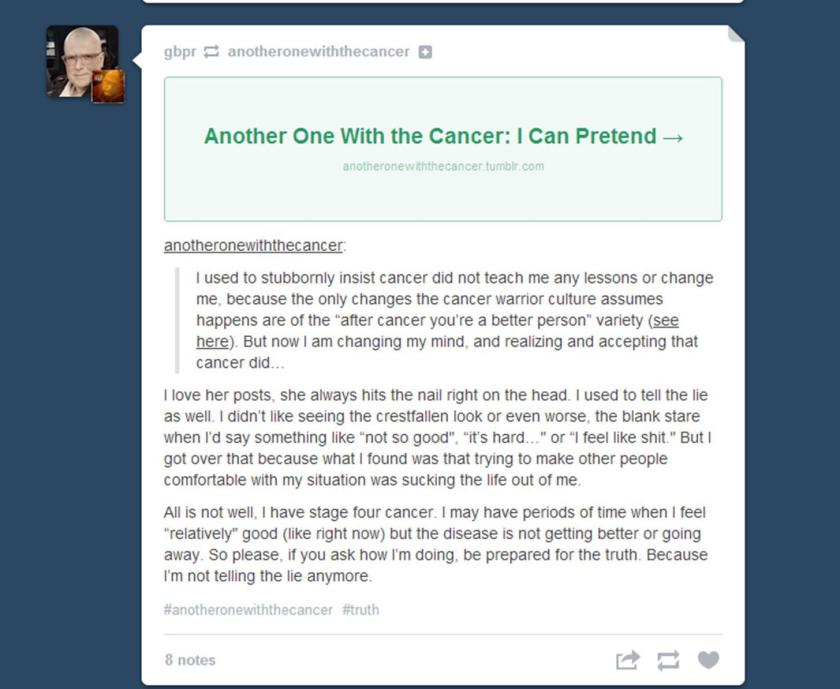
I used to stubbornly insist cancer did not teach me any lessons or change me, because the only changes the cancer warrior culture assumes happens are of the “after cancer you’re a better person” variety (see here). But now I am changing my mind, and realizing and accepting that cancer did change me, teach me lessons…and they are NOT the happy sappy lessons that society wants learned. No, cancer is teaching me that it is preferable to lie.
Much ink is dedicated to the Dumbass Things People Say to Cancer Patients. Now I’m considering the opposite: Dumbass Things People Want Cancer Patients to Say. I’ve seen a couple of pieces lately that talk about how cancer patients are asked “how’s your cancer?” or some such nonsense, and how lame it is to try to answer, because the person asking only wants to hear that everything is OK. As discussed before, some folks are all in during the first few weeks of diagnosis, then tend to fall away as treatment drags on, like treatment always does. The expectation is the patient should be all done, right away, and people are tired of hearing about the boring cancer. So I see bloggers and hear others admit they just lie, and say they are “OK”, when nothing could be further from the truth.
I experienced this my own stupid self a couple of weeks ago. Typically, if it is someone I only slightly know who is doing the asking, I tend to just say “I’m fine,” or “no tumor today!” The person who asked me recently was someone a bit closer, so I felt more comfortable giving the long form answer. Unfortunately, I happened to be going through the impending check-up dance—you know, blood tests, mammogram, see the ol’ oncologist—all that jazz. So in short, I was nervous, having no idea what kind of news I was about to receive. Perhaps I should’ve just said, “I’ll get back to you next week.”
But no, I rambled on about how this, that, and the other is still a worry and about things like the thrill of being able to stay up to see the late night talk shows without having to take a nap during the primetime shows, how great it feels to not make a choice between the two. Stupid little victories over side effects.
When I finished my ramble about the joys of staying up late without napping, the person who asked about my cancer said, “oh, you’re not as tired as you were during treatment, that’s good, that’s all I wanted to know—you’re better.”
The job I held when diagnosed with cancer required much interaction with the public, in a small town, at large public events, and I did a good bit of standing up and speaking in front of small audiences. My absences and changing appearance (my wigs sucked and I never wore them) were noticed, so I was upfront about my cancer diagnosis right away. It was just easier than dodging it or beating around the bush, or so I thought at the time. I hold a different view now. I wish I had not told anyone really. Oh people would’ve found out; that is just small town grapevine stuff. But folks would’ve been less likely to bring it up to my face. Because now I’d rather not be asked about it by people I don’t remember well when I run into them at the store or wherever.
When people now ask me about my cancer, my true, big-mouth nature just wants to lay it all out there—the constant fear cancer will come back, my paranoia that every strange bump or slow healing scratch screams “cancer”. I worry that the changes in my body that are in reality PROBABLY just the signs of aging and being 41 years old, might be lingering side effects.
But no, more and more these days I feel the necessity of participating in this small aspect of the societal expectation of the warrior/survivor/cancer-ass-kicking myth (I tend to thank the doctors and drugs for my survival; I’m not a warrior). It is just easier to lie and say “I’m fine.” No one wants to hear my whining, my fear, MY REALITY that cancer is always around the corner for me. Because if that is the truth for me, it could be the truth for anyone, and no one wants to think about that.
I think back to the conversation I had with the person mentioned above. The morbid, exasperated side of me wonders if I show up in a month with a recurrence, how will that play out? Will the person who asked me say, when chatting with others, “I saw her not long ago and she was fine, getting back to normal.” Will she sigh, shake her head, and make some comment about the unpredictability of cancer, how it strikes when all seems well, when recovery is within grasp?
That’s just it isn’t it? Some cancer patients know how cancer came out of the blue. And we never think it’s “all fine”, we’re always worried it will come back, no matter how great everything seems to be going. It doesn’t matter how many lies I tell, including the big “I’m fine” lie, I know what can happen, I’m aware of it every single second.
Related:
Take the Mythical Image of the Strong Warrior Breast Cancer Survivor And Bury HER Once & For All
A very special thanks to Tumblr buddy lux-fiam, who guided me as I struggled with this post, and to my IRL spoonie/fake psychiatrist/professor friend, with whom I fight The Overwhelming.
For the people who say “thanks for this.”
This post is about allowing myself and encouraging others to do cancer any way we damn well please.
Just prior to starting this blog, and in the hazy days of bouncing back from the treatment side effects, I was in a bit of a depression. As I’ve mentioned in previous posts, I had no time or energy to find blogs while I was actively in treatment and working my ass off. During treatment I was not happy with the rah-rah/pink/warrior culture that was the most prevalent form of support available (except in the diagnosed-under-40 support group, thank goodness). After I made some life changes, I was pleased to finally be able to take some time and dig around and find blogs or articles that said some of the thoughts that were more like mine, and I began blogging to interact a bit.
Around the same time I found other blogs, I had an epiphany. I was at some event last autumn with other cancer patients and expressing some anger. A fellow attendee started suggesting stress reduction methods, telling me that I must “accept” my cancer and ended her pseudo-lecture with “you can’t be angry all the time.” I was just so sick of this type of lecture; it wasn’t the first time I’d heard words of that nature. And BTW, I don’t think people mean the dictionary definition of “accept” when they tell me to do that; I think they really mean “shut up and sit down”.
There I was, a 40-year-old woman, being talked down to like a 6-year-old, because, being, ahem, a couple decades younger than most in the room, I was the youngster, the newbie; never mind I’d finished treatment already. I was not a cancer expert (and still am not), but I wasn’t a novice either, for crying out loud.
Then it hit me—why was I even listening? I can be angry if I want! I probably thought those sentences in the petulant voice of the 6-year-old me, but the minute I did, half the anger just fell away. And it continues to fall away still. By giving myself permission to be angry, sad, frustrated, etc., I become less so, especially with each post I write. Sure, anger & other bad company are still there, but in a weakened and more useful way–they inspire and motivate me, to speak up or write these posts. Whether they should be posted and sent into the blogosphere—I’ll get to that in a minute.
While I get that people who say “think positive/cheer up” and that sort of thing are well-intentioned, maybe even trying to help—the result for me is the opposite. I just get more pissed off, because in my mind, my feelings are being diminished, dismissed, blown off. That never feels good. Cancer sucks, but being told how to do cancer sucks too. Part of the crapfest that is cancer is the culture around it (especially true in breast cancer), and the culture demands conformity, and as I’ve said in previous posts, I cannot do conformity. It is great that the normal, socially acceptable warrior/pink/rah-rah methods work for the majority of folks, I can respect that. I’ve seen people swallow negativity and wondered if they could achieve better peace by letting it out, but it is not my place to tell them what to do. And I don’t want to be told what to do/how to handle cancer either.
This blog is to escape and to challenge all of the bullshit in the warrior cancer/don’t worry, be happy world that just does not ring true for me. Here, I express my thoughts in my way, no matter if they are angry, or blunt, or whatever other unpleasant adjectives can be applied to them. Here, I express my experiences of cancer without (much) self-censorship. My professional life before 2012 was very constricting, so I wanted a space where the rules, limits, deadlines, ideas were mine alone. This is that space.
I think many would tell me I should keep my ugly thoughts to myself; I should stop sending negativity out into the universe, or blogosphere. But my challenge to that attitude is this: why is expressing negative feelings automatically considered a negative action—why can it not be viewed as a positive, “working through it” technique, which is kind of the point of a lot of therapy? How can bad feelings be turned around if not confronted, if they are constantly submerged, denied, hidden politely away? And most of all, why is it assumed that expressing negativity means the one expressing it is negative on the whole, and somehow not capable of experiencing other emotions (sometimes simultaneously)?
My blogs are not read by many, but the few comments I’ve gotten here or on the other blog tend to say “thanks”, and some variation of “I thought I was the only one who felt that/this is what I’ve been trying to say.” So while many hear/read thoughts that make them uncomfortable (which might be behind some of the “get happy” suggestions rather than a desire to really help), those same thoughts provide comfort to a few. I remember all too well last October not knowing what search terms to use to find people with opinions similar to mine, and I remember all too well how relieved I was to stumble, bass-ackwards, onto blogs that did express such opinions. So if my blog is just one more place someone can stumble upon and find relief, then my own victory over anger & company is nearly complete. I hope your victory can be found here too.
Subtitle: (and I probably don’t want to hear it)
Note 1: NSFW-picture of my bare, cancer-scarred breast below
Note 2: Controversial and offensive content—something about a woman writing about feminist issues makes everyone lose their shit. Please read all the way through including the note at the end if you wish to send anger or hate, which will simply be removed—it’s my blog, my rules
One thing that continually irks me in Cancerland is the expectation that cancer patients are supposed to emerge from treatment a better person—healthier, better attitude, new respect for life, yada, yada. This issue pops up every now and again. I get mad, start a post, lose interest, trash post. But it has started to pop up with a monthly regularity now in a newsletter from a local breast cancer support organization, because they’ve started some kind of cooking class series with a name that implies cancer turns patients into new and improved versions of themselves, and that involves learning to cook healthier, you know, because clearly everyone who has cancer was living on fast food and soda before. (Yes, being sarcastic. Again.)
Several weeks ago, Nancy’s Point posted this great piece, After A Cancer Diagnosis, You’re A Better Person, Right?, and there was a lovely discussion that ensued. I was so happy to read it, and kind of thought this issue out of my system. Nancy talks about the cancer as a gift concept and how she is uncomfortable with that. She also mentions how this is yet another expectation of the cancer patient—to “do” cancer right, as if cancer patients did not have enough to do.
But what else bothering me about this “better person” idea is that it gets too close to the blame game—as in, if I’m choosing to “do everything right” now that I’ve had cancer, does that mean I did something or maybe everything wrong before and therefore caused my cancer?
I was not perfect before cancer, and I’m sure as hell not perfect now. In some ways cancer has made me worse. I am much less patient and tolerant. And now I have a cancer-focused blog in which I write and share my rants with anyone who’ll read them. I’m sure there are many that would count that as NOT an improvement. Yet, I couldn’t, wouldn’t, have done this without cancer. (Hint: I like my blog and think it’s a good thing.) I documented in my post Punk Rock (Breast) Cancer that I once thought cancer was magic, that I would get this new, wonderful outlook on life and I’d handle things better. I learned that is not true real quick. Cancer just makes a person more who they really are—good, bad, ugly, and/or unable to behave in an appropriate manner while having cancer, or after it.
I often wonder if folks who throw themselves into this “new me” idea and action plan blame themselves for getting cancer in the first place, and hope they are not devastated if cancer returns. I’ve said too many times on this blog that cancer’s motto is “shit happens”, because sometimes illness is out of an individual human’s control.
I recently came into contact with a woman who had just finished treatment and was near tears as she talked about how she was improving her diet and exercise regime to do anything to prevent recurrence. I wondered if thinks she caused her cancer in the first place, since she is doing all these different things now. It was not my place to ask her, and I did not.
You see, I recognize myself in her. Oh, I talk a good game here in my various blog posts about how I refuse to blame myself for my cancer. But I’ve also admitted that I eat tomatoes now because of their cancer-fighting properties. Because in the center of me that is filled with self-doubt, I still somehow believe it was that hatred of tomatoes that put me in that damn infusion chair in 2010-11.
While I cannot judge how any other person “does” cancer, I sometimes think I must seem rather stubborn, or stupid, or both, in comparison to the “change my life” patients, for accepting that maybe I could not have stopped cancer from happening to me.
I’ve covered the diet-exercise angle quite a bit in terms of blame, prevention, and moving forward. And I suspect those things aren’t even the half of it. I’m too afraid to deal with the karma/philosophical aspect; as in if you shoplifted at age 5, is that why you have cancer now? (No, I did not shoplift, but I’ve done other bad things, who has not, unless you are some deity?) That is a whole other post, and I’ll get there someday. But I do know this, whatever bad things I’ve done, I’d already learned lessons from those things and improved (in MY way) because of them. I did not need the added punishment of cancer to motivate me to improve myself. It is sad to think that it takes something as dire as cancer to inspire self-improvement. I reject that notion completely.
There are only a million things to say about Telling Knots’ recent Larry Flynt piece, and all the comments, and I may or may not write more about it. But I have to tackle a weird thing first.
One of the defending comments came from a Hustler Club employee, and in her defense of the event (perceived as offensive by many) she states that two female relatives had breast cancer, one of whom died. Kudos to Telling Knots for expressing sorrow right away in response. Not that I am not sorry for the woman’s loss, but my irritation at this disclosure is strong.
This is not the first time I’ve heard/seen this kind of “my (relative) died of breast cancer, and my (other relative) is a x number of years survivor of breast cancer” comment; it isn’t even the first time I’ve heard/seen it used by a person participating in or supporting an offensive type of “ta-ta” event as a reason why the speaker is doing it. What is this phrase supposed to achieve? That because she witnessed breast cancer she has special understanding of what it is like to have it, and all the issues surrounding it? And that this is somehow a rational argument as to why the event should not offend patients, simply because it does not offend patients she knows? Does this claim of having relatives with cancer give her some authority?
But then I think, cool it with the perpetual outrage Curmudgeon, perhaps she is trying to be empathetic, and most people don’t even try to do this. So am I bitching because I think it is the wrong kind of empathy?
It would be absurd to always be annoyed if one person speaks up on behalf of another. I think back to a post I wrote months ago, where I, as someone who chose a lumpectomy, pondered unfair judgment made of women who chose the so-called “unnecessary” mastectomy. I think back to a recent awful IRL incident: “Well he smoked for soooo long,” an acquaintance said of a person dying of lung cancer. “And, what, so he deserves this then?!” I sputtered back angrily. Perhaps I was out of line to speak up; certainly I was, ah, a bit aggressive. I know I cannot speak for lung cancer patients, but it seemed wrong, in that moment, not to point out how awful it is (and always will be) to blame the patient, any patient, or to imply anyone deserves cancer. I remember once hearing an anecdote about an ovarian cancer patient wanting breast cancer patients to speak out for ovarian cancer patients, because there are so many more breast cancer survivors, given that ovarian cancer patients have a lower survival rate (and yes lower incidence rate as well…but that does NOT make the cancer less important—read this). What a horribly practical view on the part of the ovarian cancer patient, and totally understandable. So then I think, yeah, there is a need to speak up for one another, but not always to speak for one another, if that makes any kind of sense.
But on the flip side, none of us experience cancer, or even breast cancer the same way. Sure, many of us have lots in common, and that is how bonds are formed and so on, but there are differences. Heck, there are a great many breast cancer patients who have no qualms with Flynt’s event, or other slogans, events, and organizations I find so extremely offensive. Just because I’m offended, doesn’t make me right, I keep whispering to myself, unsuccessfully, because I can get a little self-righteous on that topic. I cannot speak for them and they damn well can’t speak for me. In fact, I am pretty certain most readers are not going to agree with my irritation here.
For me, “my (relative) had (some kind of) cancer” is going to have to go into my list of things I don’t want to hear as a cancer patient. I just think, if I went around saying I understood all about any kind of cancer because I know a few people with other cancers, it would be utterly ridiculous. As if other cancer patients did not already feel marginalized enough by the Big Pink October machine! Me, with breast cancer, the most well-know, probably the most funded and researched cancer, might as well just use the insulting phrase, “well, some of my best friends are (whatever type of cancer patients)”. As if I had some special insight into the issues or problems people with other diseases face; puhleeze, snort of derision. I can’t speak for people with other kinds of cancer, or other breast cancer patients, hell, I can barely speak for my own self!
Look, all I know is that however unfair I’m being, when I hear someone say “my relative had/has breast cancer”, all I want to say is, “that doesn’t mean you know or understand ME, or all the bullshit baggage I bring to my own personal case of cancer. I don’t have cancer the same way your relatives have it.”
That baggage we all bring to our cases of cancer is a topic for another day. But in the meantime…am I being unfair to those who drag out a faux cancer card, the “my relative has cancer” card for whatever reason?
 anotheronewiththecancer