What Is My Psychological Damage?

Warning: controversial topic, I’m not taking much of a stand, just trying to work out my thoughts and feelings here, so be gentle in comments to me and to others.

“’Cause I’m just a girl, a little ‘ol me”

-“Just A Girl”, by No Doubt

“Oh I’ve had it up to here” Gwen Stefani sings in that old song. What I’ve had it up to here with is the use of “needless worry” and similar phrases as a reason to advise against screenings (annual or additional), or a reason to not inform women of breast density.

As I’ve said many times on this blog, I am not in the “a mammogram saved my life” camp—in fact that is one of the clichés of cancer driving me crazy lately. I hate the hyperbole of the phrase. I actually do understand to a degree when advocates point out that mammograms are not reducing the number of breast cancer deaths. But I have reservations about eliminating routine screening, and BIG reservations about not informing patients about density and potential problems, regardless of whether it can impact them or not. But whenever the needless worry reason is invoked, I stop reading/listening, and therefore am not absorbing the information advocates are trying to present, and I am not persuaded.

Don’t get me wrong—cancer is an emotional topic, like any illness or anything that severely alters life. And I have an emotional reaction to the emotional issue raised. I’ve started this post so many times in the past few months. I see yet another article about the uselessness of mammograms or over-diagnosis and start writing, but my emotions get in the way of making my points. I’m trying again, and hope I’m articulate. It seems this debate pops up every few months—whether it is this or that study, with whatever slight difference (I’ve written about that before).

I’m not suggesting worry and other emotions should not be brought into the discussion—my problem is the tone in which they are brought up, and the fact that the anxiety is used as a reason to discourage screenings or informing patients of density, right alongside data and stats showing mammograms don’t improve death by cancer rates or extra screenings won’t help those with density. I’m hearing: “tests are scary, so don’t worry your pretty little head”, and for me that cancels out the numbers and facts proving screenings are not as effective as we’ve been led to believe.

In many ways I’m the poster child for the ineffectiveness of mammograms and why routine screening should cease (or at least my cancer experience is on the poster). Propelled by my aunt’s diagnosis of Stage 3 cancer in August 2010 (and her experience was complex; including numerous tests the previous year, and a wait and see suggestion, but hers is not my story to tell), I asked for a mammogram at age 38, September 2010. I got an all clear, and 5 weeks later with an inverted nipple, I learned I had Stage 3, an oblong tumor approximately 5×6 cm going from nipple to almost the chest wall, with some spread to lymph nodes (that spread had not been made clear to me back then, I recently learned about it). I get very tired of the word “over” (as in over-diagnosed, treated, tested), and I think wow, I was UNDER-diagnosed. But really I was misdiagnosed. A false negative, I guess. So, in short, routine screening—not that great for me, and I have no call to defend it.

To be clear, it was not an issue of the technology not displaying the tumor. That old analogy of screening dense breasts being like trying find a snowball in a snowstorm also fails in my case. For me, no storm, only snowball. The tumor was dismissed as a density by the human looking at my images (my oncologists punt on this—they both say I have average age related dense breasts—not actual dense breasts), but I was not informed. I did not even know the radiologist wrote on a report not given to me that he saw a dense left breast until I confronted my oncologist in 2013, long after treatment ended. Did the radiologist hear all the rumbles about over-diagnosis, and all the needless worry, and decided it wasn’t worth having me worry my pretty little head about it—when clearly I had cause to worry? Was this debate raging in 2010? How the hell should I know? I didn’t read this stuff back then, I thought breast cancer was an older woman’s problem. And even then I figured I’d be one of the other 7, not 1 in 8 (yes I now know I was actually 1 in 233 or whatever other large number applies to the 30-39 crowd, I’ve seen a few conflicting things). In short, while I was trying to be proactive and dutiful, I did not really have any concerns. But I am sure some would consider me a victim of the awareness campaigns’ fear-mongering practices used to drive women to useless mammograms, simply because I went.

The eliminate screenings advocates would point out that not being informed made no difference to me. I developed symptoms, I sought medical attention, and nearly 5 years later, I’m still here, bitching about everything. I was saved 5 weeks of worry—gee whiz, aren’t I lucky (yes being sarcastic).

The recent Newsweek piece says, “Not every woman with dense breast tissue should be subjected to additional screening tests, which can be psychologically damaging and contribute to unnecessary health care costs…” and I just cringe. The latest to invoke the “needless worry and anxiety” cliché, it just sent me over the edge. I have a clear memory during the first few awful infusion weeks that included getting the Red Devil. A woman decided to tell me about that one time a worrisome mammogram forced her to go back for a biopsy, how awful those days of waiting were for her, until thankfully she learned she did not have cancer. Obviously, this did not sit well with me. All I could think about was how lucky she was, for her worry to be revealed as needless.

I hate that I think this way. I hate the disease comparison/competitions that are so prevalent lately. I catch myself thinking “I WISH I’d had a false positive” and sternly rebuke myself for sounding like that cancer patient in the UK Pancreatic Cancer PSA (“I wish I had breast cancer”) that inflamed so many breast cancer patients last year. (Want Attention? Just Say Breast Cancer.) But I am envious; I do wish I’d had a false positive instead of cancer because, well, I wish I’d never had cancer. I know I sound like I’m diminishing the fears of others, I sound not so compassionate–I’m working on this—I’m human, not perfect.

I think I have psychological damage, but the opposite kind of damage that all the hand-wringing is about. I worry because I didn’t worry back when I had reason to worry (am I making up for lost worry?). I do not trust tests, even when I have them and the results are showing no signs of cancer. I mean, I’ve heard that bad joke before, haven’t I? You’re fine—no, wait, no you’re not! Some say the government should not legislate the doctor-patient conversation. But having been a patient with the experience of finding out bits and pieces during and after treatment, well, I am left distrustful, doubtful, and faithless in most medical professionals’ abilities. That is just how it is for me. One big mistake was made about me, and I am unforgiving and taking it out on everyone else I guess. So when I read the hand-wringing about needless worry, all I can think is, “man, I got nothin’ but worry now, how about we trade, I’ll take some of that needless worry”.

This ramble is just to explain how I arrived at this point of view now, unsettled by use of emotion as an excuse to withhold information from women. I’m sure other bloggers can tackle the patriarchal medicine issues I think, and others might think, are going on here. A few months ago I caught a re-run of “Designing Women”, in which a character was encouraged to get a second opinion and biopsy. The first doctor was framed as a villain—accused of telling women to let him do the worrying for them. While I doubt we are on the path back to those dark ages (the 80s!), there is still a…I don’t know…”whiff” of “let the omnipotent medical professionals handle everything” when I hear an argument to withhold information—however useless—from a patient.

I also realize that far reaching public policy should not be influenced by the individual, stereotypical “personal cancer story”, just like my boring version I tell here. What happened to me was statistically rare (or so I understand and I do not think singular), so what is the use of telling every single woman under 40 about densities and risk. None, I guess, except to keep 1 in 233 women from experiencing the same sucker punch I did. The push for laws informing women of density was beginning while I was in treatment. I became dimly aware of it, having first ever heard the phrase dense breasts in the daze-filled first days of cancer, when I weakly asked how on earth my first mammogram was clear, what with all this cancer I suddenly had. All I got was the lame shrug and “young women have dense breasts” line, absent of further explanation. I still hold resentment—psychological damage, if you will—about that.

I want to jump on the “eliminate needless screenings” bandwagon, since I run away from the “mammograms/early detection saves lives” chants. But as long as that specter of “don’t let these emotional women worry so much” remains in the arguments, I will not be listening, much less agreeing.

Not Long and Beautiful

There are some issues that get talked about quite a bit in cancer. I admit, some of them were huge issues for me, like the Dumb Shit People Say to Cancer Patients—but I’m kinda over that now. I do revisit the topic if something happens that grinds my gears, then I write a post, thinking to myself, “OK, I’ve overdone that topic, don’t want to write about it anymore.” Ha ha, until the next time. The Dumb Shit will always irritate me, but just less than it used to in the first confusing, angry, depression-filled months after my treatment ended.

Hair was not a big issue for me either. Of course, I did write about it in a guest post elsewhere, but that was enough—or so I thought. (Read the old post here, but I’ll sum up and refer to the finer points in this post.)

I’ve heard some tales in CancerLand that some women found the loss of hair more emotionally challenging than loss of breast tissue. Not so for me, and I only had a lumpectomy that left me lopsided and single-nippled (is that a word? it is now). As much as I find the “don’t worry it will grow back” comment insensitive when said to me, deep down, I knew it would grow back–unlike my nipple. So that is how I rationalized that the hair loss was of less importance than breast surgery.

Where it gets complicated for me is the old myth that my hair would grow back better, stronger, and curlier. I always had curly hair, and having my regrowth even curlier was and remains a problem. A big, fuzzy, my-head-looks-like-a-dandelion kind of problem.

Now, as I said in that old post, I do not mean to diminish the very real sadness many women feel about going bald. But for me, it was more of a symbolic problem. When I had long hair before cancer, the first thing I did each morning was pull my hair into a messy bun or ponytail to get it out of my face. During my time of chemo baldness, I’d reach up each morning to get the non-existent hair out of my face, only to find myself grabbing air. I was cruelly reminded each morning, before even managing to get totally awake: “oh right, I have cancer.” I never got a moment’s respite.

When the hair (ALL the bodily hair, again, that is what that old post is about) began to return, I vowed to let all my hair grow back–long, beautiful hair, just like that hippy dippy song says. But, I did go back to some very private hair removal for a VERY good reason (again, covered in the old post, click above). And since writing that post, within the past 8 months or so, yes, I’ve even resumed eyebrow waxes. So my “let it grow, let it grow” phase was nearly over.

As of the other day I can officially declare my let it grow mantra kaput. I was having an extraordinarily bad hair day. I heard myself mutter, “maybe I should just shave it all off.”

Whoa.

Some of the bitter moments during treatment would find me remembering how I’d wanted to just shave all my hair off on a bad hair day, and kicking myself for taking my hair for granted. I vowed to never make that half-joking comment again. But, I did.

So how did it come to this? This is where the myth, told to me by a few well-meaning souls, of hair coming back thicker and better, proves to be just that: myth. My hair has become more unmanageable each day post-cancer treatment; it is not thick and lustrous. It is coarse, thin, frizzy-curly, and just awful. That vow to be grateful is forgotten, and here I am, not only taking it for granted, but saying what I used to say in my younger carefree days, “….(sigh)….I should just shave it off”.

Because I over-think everything, seek symbolic meaning where it should not be sought, of course I began to rack my brain for other lapses I might have committed as my treatment days recede into memory. Are there other bad habits I indulged, or things I once took for granted that I now take for granted again?

I cannot think of anything right now, but I am on alert. I mean, I certainly do NOT take my health for granted like I did. On the contrary, I constantly scan for aches and pains, miniscule changes in anything, because I am sure I’m in a downward health spiral, what with cancer and just plain being over 40. I’m not the sappy, mushy, treacly type (I’m more lemon-acid-sour), so I never had some big clichéd epiphany of “life is precious, I’ll be a better person”, so overdone in mainstream cancer stories. I think perhaps I’ve slipped back into some fatalistic thinking again lately: “oh everything causes cancer, just eat what I want, do what I want, it is unavoidable”. This is in stark contrast to the first post treatment years of carefully avoiding nail polish and eating or drinking out plastic containers. I know that is irrational; one self-applied manicure and one microwaved dinner by themselves maybe won’t push my cells into unrestrained division to form a tumor. But I avoided those things right after treatment as more of superstition. Like I know stepping on cracks would never break my mother’s back—yet I’ve never intentionally stepped on one. (My mother is highly superstitious to the point of never walking out a different door of a building than the one she used to enter, because she thinks it causes bad luck. Of course, I make a point to use different doors to drive her crazy, because sometimes I just like to push people’s buttons—what can I say? I can be a brat for fun.)

OK, OK. This whole post is an exercise in overthinking dumb shit. And maybe being too hard on myself simply because I had a bad hair day.

On the other hand, maybe it is time for a drastic haircut, time to let go of the long hair to which I’ve formed an unhealthy attachment. Cancer made some terrible physical changes for me. It is time to adapt.

Shoes and Vigilance

Cancer has made me hate clichés and metaphors (I’ve got a big rant in the works about THAT). But, I admit clichés can be useful because sometimes they are just so accurate, and I find myself using them in spite of myself. The cliché that has ruled my life for the past several years is “waiting for the other shoe to drop”.

I’ll admit up front it isn’t just cancer that made this cliché so dominant in my life. Prior to and during cancer I was in a situation where I was always waiting for the drop of that other shoe. Some detail or whatnot I missed months ago had a way of biting me in the ass much later. By the time I was diagnosed with cancer, I lived constantly on the edge of my seat, waiting for bad repercussions of I-don’t-know-what. I kept vigilant, couldn’t make the smallest decision, without over-thinking it, looking for all the possible outcomes that could turn bad. And yet I still seemed to miss something, and I always felt like I didn’t even know what I was looking for. Too many times a detail would seem benign, only later to be revealed as THE ONE THING that I should’ve realized would explode months later. This repeated experience paralyzed me into often just not making decisions at all—which produces yet another horrible outcome. So you can see how a cancer experience can intensify living in a constant state of red alert. It is an exhausting way to live.

After treatment ended, I extricated myself from that horrible situation, but I remained in a state of constant vigilance for a loooooong time. As my “mythical” 5 year mark approaches (snort of derision), I have relaxed a little bit. I’ve even relaxed in spite of the awful mammography-to-MRI scare last spring (see Complicated Relationship with Hope and Scar Tissue). But I guess it is scanxiety causing me to get a bit tense right now—annual mammogram is tomorrow.

I realize it is not just in terms of cancer that I have this motto of constant vigilance—like Mad Eye Moody in the “Harry Potter” books. (Didn’t he always used to sternly tell the students: “Constant Vigilance!!”? Been a while since I read the books.) I find that when I start feeling all is right with the world, when I think, yeah, I’m “happy”, I get a nagging feeling in my stomach—something is bound to go wrong, that shoe is gonna drop. I chastise myself for not being hyper-alert at all times. I worry over every little thing I said to every single person in the previous week. Or worry that the funny sound I noticed in the car a few days ago is the first sign of my engine’s impending explosion (sometimes my imagination goes to the fantastic, what can I say?). Ugh, why was I not vigilant? Why did I relax? Everything is going too well and it can’t last.

Now, I am sure this ramble proves I’m “stressed out”, and invites the gentle rebuke that I should relax—and some folks think stress causes cancer. I don’t even wanna go down that rabbit hole today—because in my mind that is just another way for me to blame myself for getting cancer (I put myself in a situation of greats stress 10 years ago and did not get myself out, thus causing all my own stress, so I got cancer, and deserved it—ugh, please, don’t lecture me, I can do that all by myself).

But what the act of writing this reminds me is that I learned so many lessons from cancer—but not the kind that get written up in feel good stories on cancer treatment/organization websites, or local and national newspapers touting the newest cancer hero. I learned lots of bad stuff—someday I will write Cancer Curmudgeon’s bad cancer lessons handbook, I swear! But specifically today I’m thinking of how cancer taught me I’ll never be safe again. I guess if I were to get all philosophical, I could realize that bad stuff happens and everyone dies, safety is no guarantee. (Again, I don’t want to hear trite tidbits like I could get hit by a bus any moment—ugh, so overdone.)

The concept of control is a post for another time, not today (though I have flirted with the topic in a past post). I do try to control things that are out of my control; that has been a lifelong struggle. I’ve always been a conservative (not in the political sense) person, careful with risk to the point of avoiding it at all costs, especially money—given that my parents were and remain financially strapped—and we all know that cancer is an economic disaster (no I don’t like gambling, how’d ya guess?).

Two years ago I foolishly put my phone in pocket which led to the dang thing falling in the toilet, getting utterly ruined, and I had to go through the annoying process of waiting and replacing. I vowed to be forever careful, to NEVER let something so stupid happen again. And I was successful until a few days ago. I allowed myself the luxury of a pedicure—only the second in my life—had the phone in my lap, leaned forward, and boom! Phone slid into pool of whirring water intended for feet. I did all the “right” things (put in rice overnight) but the charging apparatus was ruined, and yep, I just got my replacement and I’m going through the gymnastics of re-setting it all up without the ability to import anything from the old dead phone. I’ve been kicking myself for my lack of vigilance the past few days—how could I let this happen?!

So today I must talk myself off the cliff. My lack of vigilance about the phone is not some cosmic sign that my lack of worrying about recurrence will result in disaster tomorrow. I don’t believe in that “cosmic” stuff anyway.

I just have to keep telling myself that.

Looking At Pictures

So my most recent posts have been about the spring runs/walks/arts events to benefit local breast cancer organizations. Last week was the annual Komen on the boardwalk at the beach 10 minutes away from my hometown. The weekly freebie newspapers just came out yesterday and the pictures were all over the covers—bright pink splashes on the front pages.

Usually I avoid those rags of local “news” this time of year and in October because of the breast cancer celebrations coverage. But I did pick a couple up this time. I stared at the picture of the survivors’ parade. Every single woman wore a bright pink t-shirt with a lighter pink ribbon on it, the word survivor under the ribbon. A few women wore pink wigs, and/or pink boas. One woman wore a boa/necklace/garland of paper pink ribbons of various sizes. I realize that if I thought such races/walks were a useful pursuit (I do not), if I called myself survivor (I don’t), if I embraced the Pink (I really, really don’t), I’d be in that survivors’ parade wearing that t-shirt. So why aren’t I?

It is strange how humans behave I guess, what we believe, what social groups we join. I just had a conversation the other day with a client about how people start to take on the beliefs of those they live near and interact with (we were discussing how both our parents were becoming more conservative and saying offensive things—obviously things they’ve heard from other folks they interact with now that they are out of the work force—very ugly stuff). But I wonder what made me reject all that Pink stuff that is the norm in my region. The others in the small support group I attended (for people diagnosed with any cancer under the age of 40) were mostly disdainful of Pink, a few loved it. But all the major breast cancer groups that organize and/or benefit from these events recite the Pink, stay positive script, which is why I avoid them.

I stared at the picture of the women in pink shirts on the cover. I cannot imagine loving any ribbon so much as to wear a garland of them. I looked at pictures further inside the paper—some women in pink pants and hats and…just covered in Pink! Fortunately, no panties and bras pulled on over bike shorts like that other beach event last year. But still.

In the years from diagnosis up until last spring, these pictures filled me with disgust. All I could think about was how Pink and the stay positive pressure had harmed me. (For those who’ve not read my other posts, in short—the Komen dogma of get your mammo for early detection did not work for me, and the be positive at all costs made me miserable until I figured out I’m Allowed to be however I wanted—it’s more complex, this is the Cliff Notes version.)

I’m a bit more detached now. It makes me a little sad I guess—I know my natural social awkwardness, and trait of playing devil’s advocate, or desire to go against the grain are a few of the reasons I do not join the Pink parades. I think it would be easier if I would just go with the flow, if I could. But I can’t.

Always questioning everything can really suck sometimes.

But in an uncharacteristic move from someone calling herself Cancer Curmudgeon, I take a moment to be grateful (no griping—what???). So what if I can’t walk in that Pink parade? I found other bloggers that have many similar opinions and I found solace there. I started—and continue—blogging to keep in contact. For one who does not make friends easily, I began to do just that. I even began to “friend” some on my personal Facebook—waaaay out my comfort zone. Too many bloggers and folks to list for fear of missing someone, which would mortify me if I left anyone out and offended in that way.

Sure the women in the pictures of the parade look like they’re having fun. But I’m having fun too. And I have peace. It may not seem like it when I go on rants or give in to the anxiety—but I do have it. Because I know others feel the same way. At some point a post about this value of what others would call “complaining”—and a ponder on that word—will be written. Right now it’s enough to know I’m not the only one.

“Walked out this morning
Don’t believe what I saw
A hundred billion bottles
Washed up on the shore
Seems I’m not alone at being alone
A hundred billion casatways
Looking for a home”

“Message in a Bottle” by The Police

Random Reminder of the Nature of This Blog

Random Reminder of the Nature of This Blog.

Correcting Every Little Language Lapse

My previous post griped about a local annual spring run/walk for breast cancer fundraising. There was another fundraiser going on that weekend I noticed but just couldn’t focus on until it was over. It was called Arts & Crabs Against Cancer—get it? Like arts & crafts but I’m at the Delmarva beaches so crabs are a big thing.

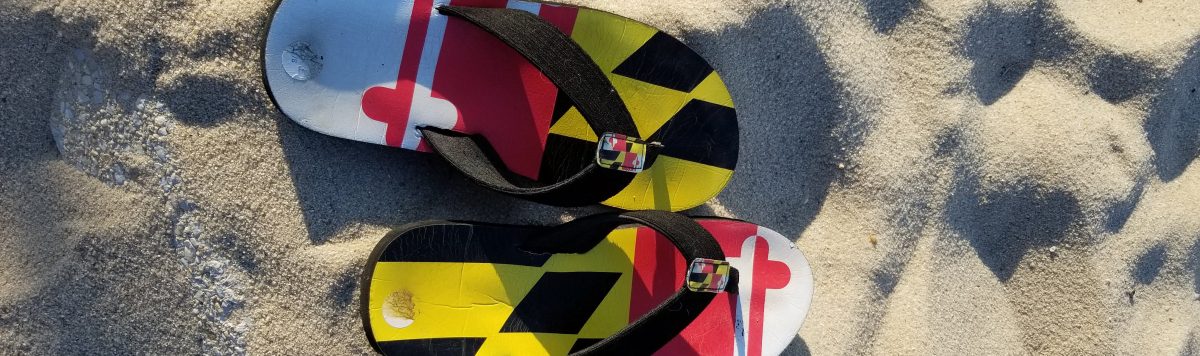
I wonder if the creators of the event realized the crab/cancer connection. I used a Maryland tote bag with crab decoration to carry my cancer notebook to each infusion and doctor visit—I still do. It gave me a grim chuckle to know that my home state’s claim to fame (crabs/Maryland crab cakes) was also the sign of cancer. I wonder if they know the crab connection for how and why cancer came to be called cancer. (So glad the filmmakers put that little tidbit right in the beginning of the PBS film.)

I could find very little about the event other than date, location, planned activities, and a vague mention that proceeds would benefit cancer research. There was no website, just a Facebook page. After the event was over, on Monday or Tuesday I saw a thank you post on their page, with the note that the money raised would go to “12 fantastic cancer-battling causes”.

It is often noted in cancer blogs that words have meaning, be careful with them. So the “12 fantastic cancer-battling causes” is disconcerting. I think they mean organizations, not causes—isn’t the actual cause “battling cancer”? But even worse—which 12? How do I know they are reputable? Is Komen, with their lack of financial support for metastatic breast cancer, one of them? I’m pretty hell bent on NOT giving them money.

I did not go and contribute money, and even if I knew the designated organizations, contributing money is not in my budget these days. So should I speak and make a fuss? Should I point out that this is another classic example of “just say your fun event is for a good cause and people will come and think well of your business”?

I mean the event planners (I think it was a restaurant partnered with other non-profits but I may be wrong) no ill will. I get it, this is how business and marketing works. There has to be “something in it for me”. Their hearts are in the right place, and probably have other motivations to create such an event—like a loved one with cancer, perhaps.

But I still wish the benefited organizations (not causes) had been listed up front, and prior to the event taking place. Consumers are being trained to think a “good cause” is a good enough reason to spend money. I don’t need to go into the economics of it all—I’m sure far smarter bloggers than I have tackled this. It just bugs me so much. I research every major purchase, even little ones too. I assume others do so as well. I want the most reliable vehicle, the best coffee maker, the best and most reliable laptop. I refuse to throw money away on shoddy products. Why is this attitude not used in regards to cancer organizations too? Sadly, most people don’t take the time to find out if a non-profit is just wasting money. So it would not work if I went to the organizers of the event and said, “hey maybe more people would come to the event, make it successful, if you revealed the beneficiaries”. Because it would not make any difference, people still show up. “For a good cause” was a good enough selling point.

My annoyance with this topic was compounded when I ran across this statement complete with picture: “Pete Townshend and Eddie Vedder announced a ‘Celebrating the Who’ benefit concert for cancer”.

Sigh. I’ve tackled this before, as have others. We all dislike it when the retail clerk at point of sale asks if we’d like to give money to breast cancer. Uh, no. I want to give money to KILL breast cancer. Leaving off the word research or whatever is so important to many of us. The caption assumes that anyone reading it would know of The Who’s long-time support of a UK charity for teens with cancer, and their creation of a mirror organization in the U.S. Only a jerk would think Vedder and Townshend are trying to do something to benefit cancer itself.

Hey, I never said was NOT a jerk—I AM a jerk! So should I contact the media sources that keep using that or a similar headline, to correct them? Make passive aggressive, finger-wagging statements in comments sections?

This slogan culture, this short-hand way of speaking, this skipping over the details, is doing a disservice to the general understanding of cancer, how charities and fund-rasing works. Yes, I realize I’m a bit over-wordy here on this blog sometimes, so of course I think this way. It’s just that every time I see slogans on ads that say “support cancer” or “benefit for cancer” it feels like hearing nails on a chalkboard.

To me, this is just a small piece of the puzzle of the awareness vs. understanding or education challenge. People like to shop for a cure, show support, but they don’t really know what it means, if the “product” (the charitable group) is any good–and why should they care? They aren’t stuck with the crappy product (not enough money spent on research, too much spent on self-perpetuating ad campaigns). But we are stuck with it.

So, yes, maybe I’m nitpicking today. I’ve just seen this type of thing too many times. I don’t have the energy to bring it up every time I see it. Will it make a difference even if I did?

I’m not even going to go into the clichés I’ve read and heard too often, and the bad compare-diseases-to-get-attention strategies that are just wearing me out lately. Not now, not yet, some other post.

I’m so tired of the way society talks about cancer.

April Is October Part 2

Ugh, April—and May a little bit too—resembles October in my area. Like, spring is here, time to run and walk in a marathon and let’s do it for breast cancer and wear lots of pink while doing it. I just ran across a notification that the annual walk at one of the beach towns in my area is to commence in an hour or so. There is another walk in another beach town next Sunday.

I was very upset last year after the walk that is to take place today happened and the pictures popped up on a friend’s page. Interestingly, this particular walk does NOT benefit Komen, but rather a local breast cancer organization and the money stays in the state to help local women. While I applaud that, it does not stop the organization and the walk from draping itself in Pink and feather boas and looking like a big party. The pictures that upset me so much last year showed a woman in her athletic walking gear, wearing hot pink bras and panties over the gear, with dollar bills stuffed in the waistband of the panties and in the bra cups, stripper style. I guess it was all in the name of fun, but I was disgusted anyway. To me is was just another example of how breast cancer is sexy fun times to so many, even women that I suspect are usually much more rational and likely even old-school feminists (I slightly knew one of the subjects in the photos, one NOT wearing the awful attire). I wanted to rant about it back then, but I was far too angry. I mentioned it in a general rant last October. I casually mentioned how it looked like a sick bachelorette party, and I still think that way.

I notice this year the event has added a subtitle to its name: “a fun event for a serious cause”. I find this interesting. I’ve noticed a shift in discussions/comments on social media, and in even professional articles in regular news publications. There is a bit of defensiveness, and I’m seeing phrases like: “I don’t hate pink” or “it’s not popular, but I like boas….” or things of that nature. It has begun to cross my mind that all the bloggers and/or advocates criticizing Pink and the party atmosphere actually had an impact. Perhaps the average person is starting to understand that those of us who’ve pointed out that chemo and disfiguring surgeries are no party are tired of seeing our ongoing awful experience glamorized.

I know I cannot hide—I will see many ads for the upcoming race (which IS an official Komen event). I hope I do not see the same nonsense that happened last year as a repeat on my feed. I get it, people want to have a good time, and just because I’m offended does not make me right. Maybe the women behaving this way even “get” the gravity of breast cancer—hell, they may be patients their own selves. I’m being judgmental, I know. It’s just that I know that when the average person sees pictures of breast cancer as sexy fun times, they will look at me and others who share my point of view and wonder why we’re not having a sexy fun time with our cancer too.

I am looking forward to June.

Maybe Mayberry Ain’t So Bad

A few times on this blog I’ve mentioned that I live in a rural beach resort area, about 2 hours away from places like D.C., Philly, or Baltimore–home to John Hopkins. I live in a small town—think that old TV show about Sherriff Andy Taylor and Barney Fife—yes, sometimes it is like Mayberry here. While I like that, it can be a little limiting when it comes to health care. Rural areas, with their poor financial compensation offers, do not attract many doctors, and breakthroughs in treatment, cures, discoveries, etc., will not happen here. Hell, you could say that we have a severe shortage in health care options, especially since so many folks retire here and with an aging population health issues increase. In short, health care is a different animal in a place like this. I read so many blogs written by patients who went to Dana-Farber, Sloan Kettering, or whatever—and that just is soooo far from my reality.

Before I got cancer, I did not really care very much about that sort of thing—in fact, I would staunchly say that everything, including medical care, was just as good here as anywhere. After my false negative—which was due to human error, not a case of technology not producing an image of a tumor—and after hearing many other stories of misdiagnosis from clients—I began to think that health care is best done elsewhere. But schlepping “over the bridge” (the Chesapeake Bay Bridge, sometimes there is a whole “thing” about which side of it one hails from, as in, those of us on the east, Delmarva, side are just dumb hicks) is not feasible for me, financially or in terms of time to spare, etc.

I am now changing my mind again and thinking OK, maybe diagnostic abilities here are not the best, but treatment is better than I thought.

Not long after completing treatment, I attended a small-time local conference about breast cancer. A doctor gave a presentation and at the end, as almost a footnote, said that more doctors and patients should consider the unusual timeline of chemo first, then proceeding to surgery, upon a breast cancer diagnosis. I remember kind of going “hmmm, that’s funny” as she walked off the stage.

You see, I was told emphatically by the breast surgeon who diagnosed my cancer, and then the oncologist who treated me, that shrinking the tumor with chemotherapy first, and then having surgery and radiation was the best plan. It was of course, my choice, but they stridently urged this course of action, despite my not uncommon desire to “cut that THING out of me as soon as possible!!!” I heeded their advice. It worked wonderfully; there was only a small in situ piece left in the nipple (the devil that started it all) after chemo. That is down from a 6.6 cm tumor that was taking up most of the space in my small breast. Not only did the chemo first approach work for me, it was also implemented for my aunt, diagnosed just a couple months prior to my own diagnosis. My own experience and the experience of a relative closest to me had this “chemo first” plan, so I did not view it as unusual or new (remember, this is back in 2010).

It did not occur to me that surgery first was the most common path. At least not until I started reading blogs and reading how many women seemed to have surgery first. But reading the latest “Cure” magazine interview with Joan Lunden has finally made me go: OK, what the heck?!

Note—yes, there are many things I could be cranky about in terms of Lunden/all celebrity cancer stories, but I’m going to limit my discussion to this one item for now, for this post.

In the article, which I’m sure everyone has read, her decisions about treatment were under the section called “Trying Something New”. Unless I really read that section wrong, it implied that the chemo first regimen is kind of unusual:

“… there is still resistance to deviating from the longstanding dogma of surgery, then chemo, then radiation. The benefits of pre-surgical chemotherapy, particularly in the type of breast cancer Joan Lunden had, are abundantly clear.” – See more at: http://www.curetoday.com/publications/cure/2015/winter2015/a-two-way-street-joan-lunden-shares-her-cancer-experience/2#sthash.fQlogQBD.dpuf

When the doctors presented the idea of chemo first to me, they did not do so with any indication that this was a new or uncommon path, or even a deviation from the norm. They merely said that my tumor was so large, surgery at that time would be disfiguring. Chemo would hopefully shrink it to a manageable size. It did not sound like some new-fangled, cutting edge, wowee-zowee idea. No, to me, it sounded like good ol’ country common sense. Glad the doctors I encountered in my Podunk region deviated from the dogma! I was able to have a simple lumpectomy, and while I’m not happy about the removal of my nipple, I recognize my situation could’ve been so much worse—that I am more fortunate than most.

I have grumbled, and will again I’m sure, about the impacts of having cancer in a rural area, but I’m glad to know in this one aspect at least, my care was not so “Mayberry”—even if I did not realize how new-fangled my experience was at the time!

I am still trying to wrap my head around this concept. It seems strange to me that the treatment that I experienced almost five years ago is considered new and is being discussed as such by a celebrity. I’m not sure what I think about it. I’m just glad my oncologist was smart, informed, and open-minded enough to embrace it.

Beauty Found and Shared

I did not know or even follow Lisa Bonchek Adams as well as most other breast cancer bloggers I follow/interact with. So while her death saddened me, my reaction has skewed more toward first anger, and now strengthened resolve. Anger that her message of not losing a battle seems to be lost on so many, that so many articles and even comments and tweets have relied on that stupid battle cliché. Strengthened resolve to speak up and out more in criticizing euphemisms, to be brutally honest in communicating to any and every person that death is a potential result of cancer. No matter how unpleasant it is to say the D words (death, die, died), my conviction is stronger than ever that using those words is a crucial part in moving the conversation about cancer forward.

I’ll write more posts about all of those topics later. Today I am going to do what Adams always advised her followers to do—the finding beauty and sharing it thing.

I admit, not being a sentimental type, I kind of blew off her tweet exhorting folks to find and share beauty. I’m not one for the inspirational quotes. I am a sarcastic curmudgeon, and like snarky quips and memes. But I will take a break from my natural state, just for this moment.

Yesterday was an awesome day for me. In spite of still so many posts about Adams on social media, while I was out in the world, everything just worked so well! Just a few days ago, my beach town had suffered yet another ice and snow storm with freezing temperatures that road crews and residents are simply not equipped to handle. I was frustrated at having to walk dogs while slipping and sliding on ice. But yesterday the warm hints of spring finally took root. Snow melted rapidly. So many neighbors were out and about: walking, playing ball with their kids, or just driving with the windows down.

Pond Still Frozen

I’m not a fan of springtime, I’m allergic to every plant, ever. But nothing is in bloom just yet, so I was able to walk outside without discomfort. I’ve mentioned before that I live in a beach resort area. Warmer weather brings the tourists and traffic snarls (until a brief shining moment on Labor Day). But they had not yet arrived as of yesterday. Sure the ticks bearing Lyme Disease are waking up, the mosquitos (our regions unofficial “bird”) are going to stir. The next few months will heat up and all these irritations—bugs, pollen, traffic—will make me (and other locals) grumble.

But yesterday, this one day, was perfect.

There were other things, silly things, that made the day awesome: I finished appointments early, I found a grocery item the first place I looked (living in rural areas means some healthy foods are hard to come by—Whole Foods is over 2 hours away). No, these aren’t big things; no one announced a cure for cancer and I did not win the lottery. But the day just “clicked” for me.

It may not seem like a big deal to anyone reading this. But, for me, it was a good day (again, cue the phone to start playing Ice Cube’s “It Was a Good Day”). So I’m sharing it.

Curmudgeoning will resume on this blog soon I’m sure.

Need Help Finding Deleted Post   

Early August 2013, I reblogged and/or linked to a post by my tumblr buddy lux-fiam called On Loving a Sick Body. (On WordPress, here.) She deactivated her tumblr account some time ago, and has no copy of the text of that post. She contacted me last night wondering if I have or know of anyone who might have the text of that post. We think we saw in some comments that someone was posting it on a thyroid cancer site or Facebook page.

Does this post sound familiar to anyone? Or better yet, does anyone have any advice on finding posts that have been deleted (nothing is ever really gone from the internet, right)?

Any help with this would be much appreciated. Thanks!

–Cancer Curmudgeon.