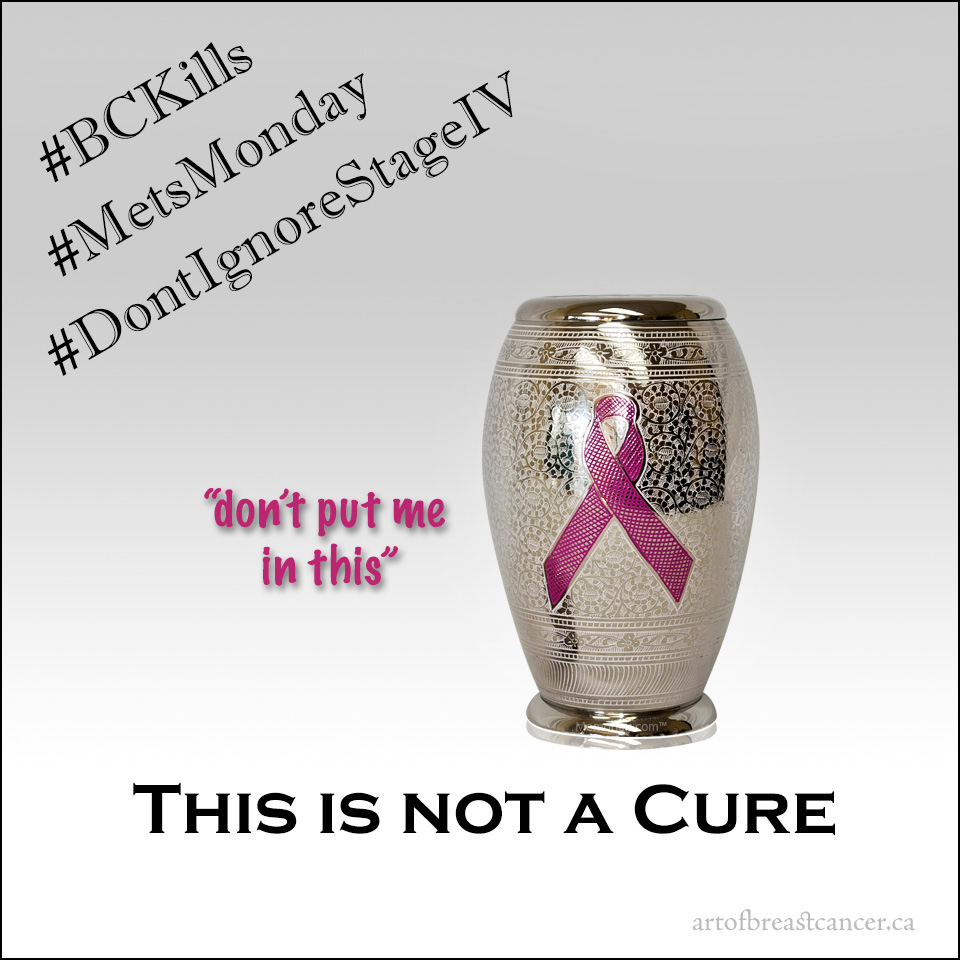

Images courtesy of Carolyn Frayn at artofbreastcancer.
Sometimes I forget that there are actually people out there who do not understand that metastatic breast cancer is usually fatal. Laurie Becklund’s video, in which she mentions how someone gave her a “get well” card upon hearing of her metastatic recurrence, reminded me of an upsetting incident that happened last summer. (For anyone who does not know, Becklund died Feb. 8.)
I’ve written often about the ever present fear of cancer, that I’ll never be “over” cancer, and how that sometimes that fear is a bit more pronounced. Last summer, after a “suspicious” mammogram that led to an MRI, and various other symptoms, I was in a state of higher anxiety about recurrence than usual. When discussing the fear, someone said to me that it would not be as difficult the second time round, because after all, I knew what to expect.
I was unable to respond. In the back of my mind, I was afraid I would sound like my usual self, always determined to see the bad side of a situation. Now I could kick myself for that. I think everyone views me that way anyway, even when I choose not to express my “negative” thoughts. But more importantly, I regret not taking the opportunity to explain what causes me fear. And yes, this person, given their profession, should’ve known better than to dismiss any fear.
It is so odd that anyone would think a second round of cancer would be easier, simply because a patient has been through it before, and knows what to expect. I want to say “yes, I HAVE done it before, I know what to expect, and that is precisely why I am so anxious—because it was horrible!!!!” I remember reading an article while in treatment, written by a caregiver, who said that over time, all the memories of chemo and its awful side effects fade. True, I don’t really “remember” how awful I felt, only because I’ve never felt so bad/sick/tired before or since. But the knowledge that it was the worst over-a-year-long experience of my life has not faded at all.
At any rate, recurrence will probably not be much like the first time round. I expect there to be variables. If it is a simple, early stage recurrence of the same cancer in the same place, I’d have a mastectomy—very different than the lumpectomy I had last time. That’s just for starters. There would be no radiation. And what drugs would get used—and would they impact me differently, given my body is not as healthy as it was going into cancer that first time? Those are just the thoughts off the top of my head.
The biggest issue is that recurrence can be in a different place, because the cancer would have metastasized. That is a completely different scenario. Metastasis is real possibility, and it troubles me that 1) some folks refuse to acknowledge or are simply ignorant of that and 2) treatment and outcomes for metastatic cancer are NOT comparable to the first cancer experience. Sometimes I wonder, with all the positive survivor culture that saturates everything, if some people mistakenly took home the message that breast cancer at least, never causes death.
For me, the fear, obviously, is death. Right now, even though I’ve had cancer, I can hang on to the idea that maybe I won’t get it again, and that I will reach an old age and die of something else. Metastatic cancer would put limits on that idea. Would I have to abandon the idea of reaching age 80, 70, 60, even 50?
Yes I’m aware of the anecdotes, of the many women who have lived well beyond that five year from metastatic diagnosis mark. And I am aware that many would prefer not to be viewed as a dead woman walking—would prefer to concentrate on living. I’m not discussing that, merely stating that I know such a diagnosis would severely limit the likelihood of reaching old age. Because I think there are so many who do NOT know this.
I do not know how I would handle a metastatic recurrence. One of the socially UNacceptable lessons I learned from cancer is that it is useless for me to say I’d know what I’d do or how I’d feel if a situation were different. I do know that I do not want to know.
I think this knowledge of limited life span should be enough for anyone to understand why a recurrence is such a huge fear, such a cause of anxiety. It should also explain why I cannot count on previous experience. The idea of “you’ve done cancer before, so you know you can do it again” concept does not apply to a metastatic recurrence scenario—at least for me.
Of course there are many other differences that I am thankfully only aware of because I read other bloggers who describe them. Differences like, frequency of doctor visits and scans, being in treatment permanently, switching to a new drug every time the current one stops working, and I’m sure there are more. How can these things even compare to that first cancer experience? For me, they do not.
Even worse, the incident last summer reinforced for me the awareness that most people do not even understand that treatment for Stage 4 (when a cancer has already metastasized by initial diagnosis—see note below) is vastly different for those of us who “caught it early”. The experience is different for ALL the “metsters”, regardless of if metastasis was found the first, second, or third time round. Thankfully I am not in that group, so I do not have the right to try and describe it. I’m guessing anyone who reads my piddlin’ blog already reads blogs by those who can articulate the experience. (Anyone who has other blogs or sites communicating the metastatic experience, feel free to leave links in comments, if you are so inclined).
I wish I’d brought up all these points to the person who tried to assure me that since I’d done cancer before, I knew what to expect, and that should reduce my anxiety. It only heightened my anxiety. That person is no longer in my life (for other reasons). I’ll make sure all those who do remain in my life, or enter it in the future, understand that the next time round, would not be the same for me, at least. Metastatic cancer is a completely different animal in CancerLand, and I’ll try to do my part to make that clear to those who just do not “get it”, to the best of my curmudgeonly ability.
Note: See here for explanation of difference between Stage 4 and metastatic breast cancer. Also find in this article information about how statistics and data do not accurately reflect metastatic recurrence. Another note about deaths not always being attributed to MBC: “Another quarter-million Americans are estimated to be waiting in the wings. I say “estimated” because no one is required to report a metastatic diagnosis. Death certificates normally report symptoms such as “respiratory failure,” not the actual disease. We are literally uncounted.” from As I Lay Dying by Becklund.
Addendum: I rarely write about MBC because I can only speak for myself, and only write from my POV–so I never want to come off as someone worried & whining about what MIGHT happen, when those with MBC are worried about what HAS happened. So I hope everyone with MBC who reads this understands that is the spirit behind the post.
I like to think of myself as a skeptic about damn near everything in life, but I just experienced a bit of synchronicity. No, the Cancer Curmudgeon is not going all woo woo, but this is an interesting little story. Take it how you will.
There has been quite the ripple in CancerLand about the win/lose language, and how it seems to blame those who die of breast cancer. I have a couple of views on the subject that could be considered offensive, and I’m considering a side topic of how the dominant culture controls language and attitudes, so maybe I’ll weigh in about all that later. At any rate, these two blog posts (Nancy’s Point and Regrounding—I hope these writers do not mind my putting links to their blog in my cranky blog) and article from JAMA are providing some interesting food for thought, for me anyway.
So about how cancer patients seem to be blamed for 1) getting cancer (oooo, sore subject for me) and for 2) dying from it. I have indeed seen phrases like “battled heart disease” or “battled Alzheimer’s” but not nearly to the degree I see “battled cancer”. For the most part, phrasing, especially by the media, carefully avoids saying a person lost their battle with, oh, say, a car, for instance.
I live and work at the beach, in Mid-Atlantic states where hurricanes and Nor’easters are more frequent than snow. The alarming increase of snow storms and the massive amounts of snow that has landed here last winter and now this one are just not normal. And I hate it (as I’ve whined on Facebook). This area does not have the money, equipment, and human power to deal with snow. And the snow is always preceded by ice. People love to retire to this area and make fun of us locals, pointing out how a couple of inches cripple the area. It makes me crazy (a rant for another day, not here on a cancer blog—for now, I recommend reading Celia Rivenbark’s “The Southerner Versus Snow”). That’s right, we shut down because we simply are not used to driving in this mess. I see the evidence on the side of the roads whenever I venture out.
I was reading the local news this morning to ascertain the danger of the roads, to strategize how to deal with the day. I came across a news blurb about a fatal car accident. Using the clipped, informative language of news blurbs, the piece explained how a man’s car slid off the road into a slushy area, and spun out of control, ran into an oncoming truck used for snow removal. The man died, the occupants of the snow removal truck were slightly injured. The last sentence got me: the police noted that it was likely that the “excessive” speed of the car was a factor in causing the accident. The journalist writing the article oh so carefully did not imply the accident was the fault of the dead man. He may have been speeding, may have been unsafe in dangerous driving conditions. He may have engaged in behaviors that caused his accident. Therefore he may have caused the accident which led to his own death. But he will not be blamed for it.
I’m not saying this man’s death is not sad and tragic—it is. I’m not saying that accidents don’t happen—especially car accidents—they do. Do we all do dumb things that are unsafe? Yes, and sometimes everything is ok, others, well, we call those occurrences accidents. Because even if we are doing unsafe things, we are not trying cause our own death. So my question is: if I drive recklessly, I can cause my death and it would be an accident, yet, I can do or not do any number of things that might have caused my cancer, it is no accident, and folks can pat themselves on the back and think they are safe from getting cancer, because, you know, they’re so healthy?
I dislike engaging in that “no one says xyz about this disease or thing” argument (for example, “no one sexualizes whatever cancer”, I do not like that line of thinking—a rant for another day). But I cannot help but wonder here if anyone other than the police will ask about this man “was he speeding?”, in those hushed, slightly accusatory tones I heard when folks would quiz me about what I did or didn’t do that may or may not have caused my cancer. Will anyone read the article and think, “hmm he brought it on himself, I’m better than that, that won’t happen to me”?
The issue of blame in cancer is one I’ve ranted about, re-posted, too often (and here it is again: Did You?). I’ll tackle it again. Maybe I wouldn’t have had these thoughts about this man and this accident had the blame issue not reared its ugly head again this week. I don’t know. It just seemed so unfair to read that careful language in a news article today, and know that the next celebrity who dies from cancer will be labeled as losing their battle.
File this under things that make you go hmmmm.

One thing that I think healthy people don’t completely “get” about illness is that it takes soooo much of a person’s TIME.
I’ve often said I felt like the year (and few months) of treatment was a “lost” year. I was in the throes of cancer treatments for both my 39th and 40th birthdays. I take the big picture view of how cancer cost me a year.
Lately I’ve been thinking of it in the day-to-day sense of time. The hours spent getting infused. The many, MANY hours in the waiting rooms. The lost day that was my surgery. My lumpectomy was scheduled for 10 AM; there was an emergency surgery, I did not go under until after 3 PM. That is a long time for me to fast. To say I get hangry is an understatement. As if having a disfiguring surgery were not horrible enough…shudder. It is hard for me to remember, much less write about, that terrible day when my nipple was removed.
My point (and I do have one…) is that what does not often get discussed is the sheer loss of hours involved in cancer, or any illness really. We humans often mutter, “where does the time/day go?!” as we run to the grocery store, work, whatever. Now, compound that with the time it takes to get to the medical or treatment centers. Add in the wait times. Add in treatment time. Those first 4 rounds of chemo (ugh, the Red Devil) were lost days. Then for me, the third or so day after when nausea would put me in bed all day. Then, there was the first infusion of Taxol—at least 6 hours, because it has to go in sooo slowly while the nurses watch for the allergic reaction (none for me, thank goodness). Then, what, 11 more of those infusions, I think? Too lazy to look up how many I had. Plus I had Herceptin with those. Then the 2 or 3 hours every 3 weeks of Herceptin for the rest of the year, PLUS add in radiation (thankfully short 15 minute appointments, 6 weeks, 5 days a week). All that time, Time, TIME! It is just gone.
True, I slept through every single infusion; I did not feel like doing anything anyway, so is it really lost? Well, yes, because if I had not been sick with cancer, I would not have felt too sick to do anything. I could’ve been doing something, anything, else—something fun! Or maybe I would’ve just been torturing myself with work.
Sure, these days I “waste” time looking at cat videos and other nonsense on the interwebz (especially when maybe I could be writing posts). But I can CHOOSE to do that. I had no choice in cancer. Well, I guess I could’ve elected to not treat, and maybe died, and then this whole pondering post about time would not matter. So am I wasting time these days? Or is it OK because spend those minutes laughing my head off?
I spent quite a bit of time traveling, hanging around in waiting areas of medical facilities this week—not for myself, but for my business, which is much more than a job, more than a source of income. I have chosen to help my client/patient/friend undertake treatment this year, and it will take sooo much of our time. We talk about all the wonderful things we plan to use our time for after she begins to improve. So we wait, we bide our time. We will use the waiting and infusing times to plan how to use our future time in the service of making ourselves happy.
And if some of the medical wait times are used to watch stupid pet videos, and it makes us happy—that time is not wasted either.
I’ve often said I learned all the “wrong” or unacceptable lessons in cancer (will write a post about it one of these days, when I stop goofing around watching cat videos). So I will not say this post is a lesson, it is more of a warning. To anyone lucky enough to be healthy (no cancer, no other illness), you may think you don’t have enough time in a day. You may think the cost of illness is health. But the cost is time as well.
“Dost thou love life? Then do not squander time, for that is the stuff life is made of.” – Benjamin Franklin
When people go on about “gifts” from cancer, I roll my eyes. More like curses, I think. One such curse is some occasional insomnia for me. You know, that wake up at 3 in the morning thing. Start worrying about stuff, mostly cancer, and cannot get back to sleep. This happened to me this morning. I did the one thing you’re not supposed to do–got out my phone and started goofing around, which pretty much guarantees I won’t get back to sleep.
So I got up at 5 AM, turned on the TV to see if I could find a nice boring infomercial that would lull me back to sleep. Instead I found delight: Foo Fighters on “Austin City Limits” on PBS!!
Let me back up a little bit. I knew the Foos were going to be on ACL, and knew that it was supposed to broadcast on PBS on Feb 7. PBS always gives a date and a time for programs with the note to check local listings. I LOVE living in Maryland, except for the state’s PBS station, MPT. MPT NEVER complies with the times/days PBS advertises. Well, of course, “Downton Abbey” is on at the same time as it is on other PBS stations, but I am sooooo over that show. When the Ken Burns cancer film shows in most areas of the US, I will likely not see it until a day or so after, and I will have to really look to see when it will screen on MPT. I’d checked my local listings last night, and ACL was not listed. It did not occur to me to check 5 frickin’ AM the next day for it. It was pure luck I had a sleepless night and got up to channel surf. Who the hell watches a show of raucous music at 5 AM? Well, me. With such recent artists featured on ACL—Nine Inch Nails, Beck, freakin’ Nick Cave—5 AM is NOT the time slot I thought to research.
All griping about my local PBS aside, what a wonderful morning. Yes, I am tired today—maybe I can grab a nap later. Yeah, waking up in the middle of the night sucks, worrying about cancer in such a way it prevents sleep sucks, but what a great outcome today! Today is great! (Cue Ice Cube’s “Today Was A Good Day” in the background.) I saw an awesome show, I was reminded of the power of live performances. Also, BTW, anyone who does not love Gary Clark, Jr. (the Foos special guest) is wrong!!!
So oh no, what??!!! I have to thank CANCER for the GIFT of insomnia??!!! Weeeeellll, I’m not gonna go THAT far. But I concede that the series of events led me to getting up early, and totally enjoying it.
Anyone who has read my older posts, the music related ones, knows that I 1) am a big rock and Grohl fan and 2) do not believe in having heroes. On the latter point—it isn’t fair to dehumanize someone with hero worship, they are merely fallible humans. That said, I will admit to being extremely grateful, indebted even, to Dave Grohl and his various music affiliations. Nirvana, Foo Fighters, wacky collaborations with Jack Black, any of those combinations have been a source of comfort in my post-cancer life. Of course I could’ve faced my post-treatment depression without him. But it’s been a hell of a lot easier with the existence of Dave Grohl.
In Grohl I trust.

Many bloggers I read here in CancerLand speak of how their mother and/or other relatives had breast cancer–or how there was NO cancer history at all, cementing their shock at their own diagnosis. I always viewed my own story as a bit odd: my maternal grandmother, her sister, and her youngest daughter (my aunt), all had breast cancer. Then me, too.
One would think, that with a mother, a younger sister, and an only daughter getting breast cancer within months of each other, my own mother would rocket into the doctor’s office, demand screenings. Nope. My mother refused my numerous requests that she at least get a mammogram. I use “refuse” and “request” to be polite. I’ll just say the conversations were NOT polite, and I eventually stopped bringing up the issue in the interest of saving myself a lot of fussin’ and fightin’. I think sometimes my mother thinks not getting tests equals no bad news–ignorance is bliss. I can understand that trap a little. There’ve been times I’ve wanted to delay my doctor visits, until it becomes the battle of which is worse: not knowing at all, or potentially facing bad news. But my mother takes the cake: at least a decade since her last mammogram. She is almost 70. Isn’t 60-something the average age of a breast cancer patient? Basically, she refused to heed the once a year, 1 in 8 message Pink shoves down throats. And the irony? I still have to explain my anti-Pink views every now and again. Oh, she approves the Pink message—just, not for herself. Her frame of mind is that classic: “breast cancer is very real threat, but it won’t happen to me”. Ah that denial, I once knew it well.
Needless to say, this personal situation drives me nuts, which is one reason I rarely share it.
In the past year, her diagnosis of having a hereditary kidney condition (that no other relatives we know of have–go figure), has opened her eyes. She finally relented and had a colonoscopy—only 15+ years after the recommended age one should start having them. Yes there were polyps, removed and proven benign. Then finally her GP twists her arm enough to get a mammogram. And yes, there was an area of concern, and she was called to schedule a sonogram.
I pause here to say for all the stereotypical “I’m turning into my mother” things I notice about myself each day, how we approach medical issues is the one place we will always be vastly different. She is from the old school, revere the doctor’s word as near deity-like; I challenge everything. I prefer to attend doctor visits alone—cancer was awful in that necessity of always have an escort to help write down/ask questions/don’t drive after treatment. I’m a royal impatient bitch in waiting rooms, so I really don’t like company. Mom likes to have someone with her. Mom usually thinks all is well; I’m a typical post-cancer person—convinced each scratch is a sign of recurrence.
The other difference is I generally mean it when I say, “no don’t come with me”. Mom will say those things and really mean, “please escort me”! (Typical for her age and upbringing.)
Long story short, I took her for her word, did not go with her, and yes experienced the guilt only mothers can force on their daughters afterward. I am further frustrated because I know I would’ve advocated for her harder. The radiologist told her he didn’t think there is cause for concern at present—come back in 6 months. She is relieved and thinks all will be fine. And maybe it will be.
But, given my nature, I have doubts. Just to review if you missed the first paragraphs—imagine my mother as a dot in the center of a triangle. The 3 points of the triangle are occupied with her mother, her sister, and me, her daughter. We all had some serious breast cancer. If you were a gambling sort, what are the odds, hmmm?
Obviously, I’m not inclined to think all will be well even if two of those triangle points were removed. My own cancer was a story of falling into the smaller percentage: (false negative mammogram, E/P negative and HER2+, 1 in 233, NOT 1 in 8….). Of course I am pressing the panic button. Of course I expect bad news in the next 6 months.
But what can I do? The doctors, with more knowledge, think it is not time to panic. The media is full of stories of over-diagnosis, over-screening, false alarms. Who am I to disagree?
I do not know how to be a cancer mentor, as I mentioned in a previous post. I am not the one who will tell you or anyone: “hey it’ll be OK, just fight, be positive, and things will work out”. I will never join a local or online group as a breast cancer survivor that newly diagnosed women can turn to, to comfort and share knowledge. I’m an idiot that barely handled my cancer my own self. It is all I can do, when others around me begin to spiral, to not follow them down the drain (talking about even more folks I know than my own mother).
I’m sure most cancer patients have at least one or many people in their circle saying, “don’t worry, it will be fine”. For me, the problem was I ONLY had those types around me, to the point that every single time I expressed fear or other so-called negative feelings, I was shut down. The result of that for me was that I felt dismissed; it impacted me to the point it reverberates even today. That’s kind of what this entire blog is about: reassuring myself that those feelings are common, normal. And when the kind folks who comment on my blog posts comfort me or share their own feelings of “negativity”—well, that is another reason I keep this blog. This can be a safe place to vent, without the fear of being shut down and told to think positive, it will be OK. I do not know that it will be OK, so I will never say that. I will just try NOT to feed anyone’s panic.
I realize most people in my life need the “it will be OK” thing said to them. I do not know I can bring myself to do that every time. All I can do is try to keep myself from piling on. My stern message to myself: “don’t spread the dread”.
It’s all about the context.
One of the things I see running around the internet, especially Tumblr, is a set of pictures from “Orange Is the New Black”. It is the scene in which Piper gives a mini-rant to Pennsatucky about how she doesn’t believe we get cancer to learn life lessons, kids don’t die because more angels are needed—that whole thing. When I see the photoset, captioned especially with the cancer quote, on Tumblr, often the post is reblogged with a “yes” kind of fist pump note. I know those posting it are agreeing with that cancer doesn’t give life lessons bit, and I do too.
But I do not reblog it, even though I want to, because the photoset is taken out of context.
Like most people, I binge-watched both seasons of OITNB, so I have no idea what events happen in which episode, and my timeline memory of the tiny details is a little off. But I do know that after this scene occurs, one character tells Piper she is not a nice person; that she is, in fact, mean. That scene stands out, but I think there are a few other scenes that imply the same thing—that Piper is regarded by the other prisoners as less than an upstanding, good prison (or elsewhere) citizen. True for me, Piper is not the most likeable one on the show.
I’m not going to get into an analysis of the show—the issues of privilege, and the high school level irony that this main character in prison with so-called worse criminals is not considered a “good” person. I’m not a TV/film critic. But I do find it interesting that this piece of entertainment/art chooses this less sympathetic character to give the “no life lessons” speech.
Yeah, yeah, it’s just a “stupid” TV show. As someone pointed out to me the other day, it is silly so much chatter is going on about the Oscar® snubs of POC/women, of “Selma”, when so many world atrocities are not getting news coverage or social media chatter. On the surface that’s true. But dig deeper. Those silly awards snubs reflect a deeper problem in American society. I have always been of the opinion that TV/film/music reflect society’s ills, and it is easy to dismiss “silly entertainment issues” when we don’t want to confront the not so silly issues brought up by entertainment/art. (To be clear, I don’t think OITNB is “stupid” hence the quotes; actually I love it. I use the quotes to indicate that some people would dismiss it as such.) Storytelling, whether it be through poetry/rap, books, films, and yes, even blogs, is how we make sense of the world.
So Piper, the mean person, the person other prisoners do NOT think of as a “good” person, doesn’t think we get cancer to learn life lessons. I agreed with her whole speech in that scene, even though I too, do not think she is a good person, and heck, watch the show mostly because of the other characters. Ugh, what does THAT mean? BTW, I’m not just now thinking about all this, I contemplated it last summer when I binge-watched the show, but I am pushed to write this after seeing the photo set pop up on my dash for the millionth time the other day.
Well, as usual, I cannot even answer my own questions—I’m just throwing them out there, like I often do.
How I interpret this OITNB treatment of Piper is that this is the way society in general regards someone who would say “we don’t get cancer to learn lessons”. Others recoil from that person, and consider them “mean”. True, it is other deeds or words that contribute to the meanness, but the no life lessons point of view seems to be in keeping with the overall character type. Whether the story writers are doing this to point out that society does this, or because they truly agree with the other characters and are using them to articulate their view that people like Piper are “mean”, I do not know, or care very much.
Here in CancerLand, we KNOW that there is no one right way to “do” cancer, that we are allowed to feel and think as we will. But the sad fact is that it is hard to go against the socially accepted single story. The dancing mastectomy woman, and the woman who threw a goodbye party for her breasts, will always be lauded and rewarded for their so-called positive attitudes and actions. Anyone who expresses sadness, fear, anger, etc.—well, we won’t be punished exactly, but getting called “mean”, or asked why we do not choose to be positive, that is the most common outcome (oh man, the concept of choice in beliefs and feelings is a whole can of worms for a post). We can spout “there is no one right way to do anything” quotes all day (and I do, all over my blog and Facebook), but maybe society in general has not yet attained our level of understanding. (That does NOT mean we should not keep trying to blog our way to understanding, however.) So when social media crowns a new she-ro and points to her celebrations as a THE way to do cancer, well, it creates another hard-to-achieve standard that I am not interested in pursuing—but will have to put up with ignorant folks looking at me like I should at least try. The idea that women with breast cancer must put on the happy face and not let anyone see the pain and fear is again perpetuated. And in televised fictions, the no life lessons woman will be considered mean.
As it may be clear, or rather, unclear, I’m thinking about a hundred million things again, and better end this post before it becomes another unwieldy ramble. Hopefully, I get time to write about the issues bothering me so, that I’ve hinted at here today.
Until then…
When I re-post old posts, I feel like I’m giving out stale pieces of bread. But, I mostly feel the same way about the subject as when I wrote it–so does that make the post still “fresh”? Has it not passed the sell-by date? OK, enough food analogies (I like to cook and eat, so sue me).
Anyway there are usually multiple reasons I re-post. I read other blogs or articles that cause me to think, then I realize, I’ve covered this before. I might again. But for now, the re-post will have to do.
When I was first diagnosed a few days before my 39th birthday, I concentrated on just the big picture of breast cancer, and I did not really pay attention to issues of age…at first. I was lucky to be treated at a facility that, despite its location in a small-town and rural area, was evolved enough to have a resource for young adults with cancer. A special support group was started for us by my friend, diagnosed a few years earlier with ovarian and uterine cancer. Joining support groups is so the opposite of my personality, but I am so glad I joined this one. It helped offset the annoyance I still felt going into the infusion room and seeing the looks of surprise given by my fellow patients as they watched me, not my mother, sit in that chair each time (even though I was the bald one, go figure).
As I progressed through treatment and began interacting with the others in our support group, I have researched a few resources outside of our little local circle for “young adults with cancer”. There are some cool things out there, like Huffington Post’s Generation Why blog, Stupid Cancer/I’m Too Young For This! Foundation, and First Descent.
But I wouldn’t be the Cancer Curmudgeon if I did not have a complaint. Generation Why is a play on “generation y”; naturally I am “generation x”. First Descent and events produced by Stupid Cancer are for anyone with cancer ages 13-39. Since I was going through treatment the entire time I was 39, and I worked while in treatment, I did not have much left-over energy or vacation time for anything like that. Hell, even the SCAR Project, which I admire greatly, had a limit of age 35 for participants. So does that mean, since I am 41, I am no longer allowed to be a sexual being, upset at the scar and lack of nipple that cancer left me? I do not think this, but it seems that “society”, or certain organizations, or who knows else, is putting these parameters in place, once again trying to fit cancer experiences into these little boxes.
Cancer sucks no matter what number of years you’ve walked this earth. Maybe people should not be reduced to age brackets when it comes to cancer. At 41 I should be at a certain place in a career, married with 2 kids? Nope, I don’t fit the “profile”. No kids…so the worries of informing my kids, raising kids, and worrying about their future without me does not apply. But I am single and would like to find a husband, and hell yeah, I am worried that my “damaged goods” are going to impact my chances of finding a one, a problem I see discussed in articles targeted to those in their 20s and 30s. In addition, I am certainly nowhere near retirement, in fact, am still searching for my “perfect” job. In short, I know what my particular challenges are, and there may be someone out there in the same or a similar boat, or maybe not. I’m sure lots of patients cannot imagine facing my set of circumstances, the same way I am baffled when I read other bloggers’ posts of trying to go through college while in chemo, some without family support.
Look, I am not poo-pooing these resources I’ve mentioned, I am grateful they exist. I sort it out as I research & read, and just try to take what applies to me and move on. I know that the medical community and these various organizations have to create these age brackets in order to do the testing, compile data, and create their target markets. I especially would like the medical testing industry to expand their vision to include testing and results for each and every age bracket, so treatment can be improved and prevention discovered. It’s all about the stats and the odds, I know.
I just want everyone, especially the number-crunchers, to remember that the one common thread in cancer patients no matter the age is that we all want to survive and live well, and that there is a person behind each number or stat.
When I began blogging, I did not have a well-formed idea of what I wished to achieve. I merely started one as a way to create an identity to communicate with other bloggers. I’m not sure I ever set out to give advice to the newly diagnosed, and I hope I never did such a thing. I do know that as time passed, and the memories of treatment started to grow smaller in the rear view mirror (thank goodness), I became less inclined to say this or that thing did or did not help/work for me during diagnosis and treatment. When another woman in the support group would describe a problem, even one I’d faced, I was just not convinced I had anything of value to say that would help her (yes, the group was comprised of only females, not because males were not welcome, but because they never joined).
It’s not that I did not appreciate advice given to me in my first awful whirlwind days of diagnosis. Some things worked, other tidbits flamed out horribly. Heck, right now, I can only think of advice that didn’t work: get a wig, nope, rarely if ever wore it; chew ice during infusion to prevent mouth sores, no I wound up hating ice; buy button up shirts for after surgery, but while I had pain, I was still able to pull shirts over my head. No big deal; that is the way it goes. Part of my reticence has to do with realizing that I did not have it as bad or difficult as others. I engage in discounting, I talked about this very early on in my blogging days: see Could’ve Been Worse.
This history of “not so bad”, combined with 1) my tendency to push the panic button and expect the worst, 2) my view that it is impossible to know what anyone will feel/think/do until they are absolutely put into a certain situation and 3) my view of my cancer experience (diagnosis up to present day) as one in which I repeatedly ram my head into a Pink wall, makes me feel not so qualified to give any advice. I can tell anyone who’ll listen what I did about xyz, and if it worked for me or not, but…take it with a grain of salt. It may or may not work for you, I have no idea. I wish I could help, but I probably can’t.
In short, I am NOT the person to be a mentor to new patients, and have never signed up with any organization to be such a mentor. And never will. And again, if I’ve given advice on this blog, I’m sorry and please ignore it! Don’t ever listen to me if I ever start in with “take it from me, I did blah blah blah during cancer, and it was awesome/horrible….” I’m not saying ignore all advice; indeed, there are many bloggers or personalities in CancerLand who are good at this. By all means, follow their tips if you are so inclined.
That said, I am now going to say there is a piece of advice that has been popping up in the past couple of weeks in various online articles I read about cancer that I whole-heartedly, strenuously, emphatically, disagree with. I point out that I’ve only seen it in online articles because the funny thing is that the advice is…..newly diagnosed cancer patients should stay off the internet.
NO NO NO NO NO NO NO NO NO NO. The internet abounds with worst-case scenarios, and a panic button pusher like myself doesn’t need the help of the internet to imagine them. But I am still glad that I ignored that advice (because yeah, I was definitely told to not go to the internet). The problem was that I did not find and absorb the info that I know about now, and that is a great regret. Off the top of my head, issues like the is DCIS really cancer debate, mammography failures, making medical professionals inform women about their breast density, anything about HER2+ cancer, to name a few, I wish I knew about in the early doctor visits, so I could’ve asked better questions. The knowledge that I’ve gained from other blogs makes my head spin, and I often feel like I’m playing catch up when I get to the oncologist’s office.
The sites I found in those early days were not totally useless—in fact, they were helpful, although a little too positive and Pink. And certainly in the days after treatment, the internet again provided the solace I needed from the Pink. So when anyone says “stay off the internet” as an important piece of advice to the newly diagnosed—I just…NO.
Look, I’m sure there are a few folks who heeded that advice and it worked for them. But I do not think it is a good piece of general advice—it needs to be highly specific to the individual, and maybe most individuals don’t need this little tidbit. Furthermore, I don’t think “the internet” is the real issue. Perhaps the advice should be amended to: be careful of ingesting misinformation. Yes, one is more likely to run into misinformation on the internet, because of the sheer amount of INFORMATION there. But misinformation is insidious, and can be present the old fashioned way, in brochures, and from the mouths and minds of other people (the ones typing the misinformation on the internet).
The internet, specifically social media, can be a wonderful tool, and has been for me (and I barely use it compared to most folks in CancerLand social media). The trick is to find reputable sites, authors, and info, and to always check with one’s own personal medical team. And yes, to even challenge that medical team too.
And sigh, I dip my toe into the celebrity cancer patients issue here. Yes, it was Joan Lunden’s recent tips that pushed me to write this—sort of. As I’m sure most know, stay off the internet was one of ‘em. But here’s the thing: when I read her tips, it was the third time in less than two weeks I’d read “stay off the internet”, which was what really made me say enough is enough already.
Ah, there’s the rub. It amazes me that her tips cause a fuss, when cancer patients giving advice are everywhere. What makes her insights worthy? Because she is a celebrity—especially one of those trusted news-y types that Americans get their info from? Please. Those fake morning and evening tabloid-y shows are worthless when it comes to health info. Her tips, especially the stay off the internet one, are not groundbreaking, original stuff. Yes, I’m a bit biased. I was not a fan before her cancer news. I’m sorry she got it, but it doesn’t make her any more special than the rest of us—and by no means an expert at being a patient.
Look, like most folks, I’m just trying to muddle along, doing the best I can with the cards I was dealt by life. I was not dealt a winning hand, I was dealt cancer. Some things I do OK, others times I’ve fucked up beyond belief. I’m just a human, with all the failings and contradictions that come with being one. I’m gonna continue to seek out those sources I trust, use the advice that works for me, and trust myself to know when to do what I think is best for myself.
 anotheronewiththecancer