One Way to Talk Back

OK, I’m sure we’ve all seen the return of that damn No Bra Day/Set the Ta-Tas Free Day graphic on our feeds. A week ago I re-shared my old How About a “What Cancer Really Does to Breasts Day”?  post because I’m just so sick of it! This sparked a chit chat on Twitter with my friend Annie @barbieslosingit. The chatter grew and here’s an idea:

bcrcsummary2016b

Use #BreastCancerRealityCheck on October 1, Saturday, and let’s get it trending. How often do we roll our eyes and talk about how people just “don’t get it”? Well, let’s make them get it! We CAN talk back to hit back at all these silly memes and games.  So LET’S!


Addendum: WE HEARD YOU! No, we do NOT wish to hijack September, the month devoted to other cancers (such as ovarian). The pink ribbon bully already does that! So let’s use the first day of Pinktober to get the REAL truth about breast cancer out!!

Special thanks to @barbieslosingit and @bbccww for all their efforts with this!!

Just Got Fooled Again

Well hoo-ray for The Who, always singing how they won’t get fooled again—but I did. After all this time I’ve spent in CancerLand, and all this time I’ve spent being a Curmudgeon and skeptic (that would be my whole life), one would think this ol’ Cancer Curmudgeon would not get suckered into a Breast Cancer Awareness marketing trap. But I did! I guess my defenses are not October-ready yet. (Although this heat and beach traffic has made me more than ready for Labor Day, actually. But I digress.)

Weight Watchers is partnering with American Cancer Society for a Pinktober event/stunt/thing, and it is everything that is wrong with the notion of corporate giving. I stumbled upon it via a Facebook post, and no, it was not an ad or even a sponsored post. I was hooked in by the opening question, did I experience weight gain after breast cancer. Well, YES! I’ve spoken about that before. The post went on to talk about Weight Watchers and American Cancer Society partnering on something called Project L.I.F.T. So I clicked to the article.

Now, I have to pause here to explain my state of mind as I clicked. First, I had an expectation, likely an unreasonable one. I know that expectations are the source of disappointment and suffering, yet I still have them, crazy me. Second, I confess (again, see linked post) that I know very little about any weight loss programs out there, especially the ones where one has to sign up and pay a fee, including Weight Watchers—so I was totally blind about what exactly their service is and how much it costs. As mentioned before, I was very thin growing up and could eat whatever I wanted. It has been in my cancer-induced, post-menopausal life that I’ve had to really think about what I consume. These days I really understand the jokes and memes about just looking at a piece of cheesecake and gaining weight from that act. In short, so much of this is all new to me.

So I read the article and clicked onto the website(s) to see if I could get maybe a free month’s worth of whatever services WW offers. Nope. This annoyed me. Now, some of you might be saying, the weekly fees of WW are not that much, surely if I were serious about my health I’d choose to spend my slim spare income (very slim) on WW, than say, a Netflix plan. True, but I’d counter with—how I spend my money is no one’s business, and also, if the WW fees are indeed so reasonable, would it kill them to offer a free month to breast cancer patients to get them to try it? My guess is that one month is not enough to see meaningful results, one has to stick with the program for much longer, like 6 months or a year. A year of those “small” weekly fees adds up, BTW.

At any rate, my expectation was probably out of whack.

As I continued to peruse both the article and the website, I began to realize that the “free resources” WW offers to inspire and guide breast cancer patients are really just more of the same old rah-rahing thing.

From what I could tell from the Yahoo press release, the “offers” were repetitive. The article mentioned at least twice the content for breast cancer “survivors” to help us understand why we gained and how losing will help us prevent more cancer. OK, so why does that piss me off? Because the losing=prevention of recurrence is too close to the blame game and is out there enough. I don’t need “special content” to tell me about it. Also, I’m not sure the “why” of the weight gain really matters—at least to me. I suspect some of the reasons will not apply to me, since I was E/P negative. And even if I’m wrong, so what? A mental health professional once told me she was not interested in that clichéd psychotherapy thing of going back to one’s childhood to unlock the why behind people’s current mental health issues. Why bother? She used a tennis analogy. So what if a rising tennis star has some bad serve habit instilled by her old coach for whatever reason? The point is to eradicate the bad habit—no matter how it got instilled—in order to improve her game to win. Same with mental health. I know why I have some bad mental habits, but since I cannot change the past, they do not matter. To move forward, I need to learn how to change some ruts my mind goes into. Same with my weight. I actually suspect I know why I gained some weight post-cancer treatment: I was so glad food tasted GOOD again. During that first round of the Red Devil, all I ate was mushy peas from an imitation English pub in my American beach resort area (I know, it is weird, but they were kind of the only thing I didn’t hate). Needless to say, my weight plummeted while in chemo. Now that I can have rare steaks, sushi, and whatever again—and I don’t hate the taste—I tend to just eat! It is certainly tied to my fear of recurrence. And yes, a bit tied to my thoughts of—well, I didn’t have to watch my weight before, but I did tend to make healthier choices—but forcing myself to eat yogurt and whatnot did not “save” me, so what the hell?! Bring on the chocolate cheesecake!

OK, I’ll stop, I’ve written that post before.

Another aspect that bothered me about the WW partnership was all the “celebrating” of survivors. Again, this was repeated twice, to make it seem like more stuff is being offered. Selected women will be featured in their October magazine. OK, so how does that help me lose weight? I know, I know, I should be happy that all breast cancer survivors are being honored because some “good” patient representative is in a magazine. But I’m not. Other patients do not represent me. And after all this time, this blog gives a smorgasbord of examples of how I am so NOT a “good” example patient. I’ll never be a representative, and I rub my hands together gleefully at my badness.

Finally, we have the shopping and showing aspect, which has always bothered me in ALL cancer/disease-of-the-month/issue-of-the-moment walks/runs/whatever awareness-raising event.  The press release talks about the exclusive products for sale. So instead of something free—which is what I wanted, free assistance in losing weight—no, I have an opportunity to SPEND. Uh, no.

And it isn’t just an exclusive product to have—no, the product is to wear, especially during the on the ground presence WW will have at the walks taking place in October. Go back and read my post from last year, Supporting The Show? This is not just about doing something good, this is about WW being SEEN doing something good, and getting their minions, whoops, I mean customers, to be seen as proof of goodness. Breast cancer patients need to lose weight—yes, I concede that point—so they become the precious commodity/resource (to corporations) of all: COSTUMERS. I actually counted the links in the Yahoo press release posted breastcancer.org, because I guess I’m just that petty. One for WW itself, one for WW’s Project L.I.F.T. itself (which is what this whole party is about, right?), two for Making Strides Walk (the WW page), and four for the WW shop. Guess I know what is most important here.

Now, it may seem like I’m picking on WW in this post. Maybe I am, but I see this as a microcosm of all the corporate philanthropic efforts toward breast cancer. Always the one/two punch: one-breast cancer patients and their loved ones (and potential future patients) are customers eager to shop in hopes to somehow buy karma so they don’t get breast cancer, and two-everyone, the corporations and the customers get to show off how much they care about this issue. Because doing something good doesn’t count unless everyone and their brother knows about it (yes, sarcasm).

Perhaps this post is a result of me being mad at myself mostly. I’ve seen this stuff a million times in my life—background noise before I got cancer, and infuriating examples I examined as I entered the cancer social media world. I’m angry because my worries about my weight made me a bit vulnerable to one of these campaigns that I’ve seen and scrolled by with an eye roll oh so many times. I got suckered. I got fooled, when I really do know better.

Won’t get fooled again.

My Oncologist Can Beat Up Your Oncologist – The Disease Olympics Part 3

Conclusion, see Part 1, Part 2.

So this is what happened early 2013 or late 2012, can’t remember exactly. Point is, it was a long time ago, when I was still in my post-treatment, semi-depressed, white-hot angry about cancer culture phase, and was new to cancer social media. I’m admitting here I’ve held onto this negativity. Continue reading “My Oncologist Can Beat Up Your Oncologist – The Disease Olympics Part 3”

Greener Grass – The Disease Olympics Part 2

OK, Part 2 has 2 heads, how appropriate. See Part 1 here.

Where to start?! I’ll just plunge in with inter-disease races first then move on to the intra-cancer comparisons. Please note, that while this post is going to be critical of how other illness advocates present their message, I am so NOT saying their messages are not valid. Indeed they are valid, but the lack of knowledge and understanding is distracting for me, so I’m calling it out.
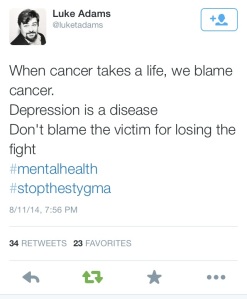
tumblr_na66sksUrN1qg3yejo1_1280My annoyance with the disease comparisons spiked over a year ago (or 2 years?) when I saw this screen grab of a tweet from a comedian I’d never really heard of. It set me off because of the fight language and the blame issue. Puh-leeze. I’ve written enough about how people with cancer are blamed, and so have others (see Blaming the Cancer Patient). My first thought was, has he never spoken to a lung cancer patient? What is the first thing lung cancer patients hear? “Oh did you smoke?” News alert! That is blaming at its finest, most insidious! And we blame cancer when someone dies do we? Um, no. If that were true the headlines would always read: “Cancer Kills Another Pop Star”, rather than the one we nearly ALWAYS see: “So and So Lost Their Battle with Cancer.” Language, word choice and placement matter greatly. But perhaps I’m being too harsh on this guy. Maybe it’s only when we live here in CancerLand that we notice these subtle language gymnastics.

My frustration with the mental illness awareness campaigns intensified even more when “Supernatural” star Jared Padalecki, in a “People” magazine interview promoting his new charity, said, “If somebody has cancer, they’re not embarrassed to have cancer – they know it’s not their fault. They know it’s a struggle. But, for some reason, if someone says they’re depressed, they assume that people are going to look at them like they have three heads.” Again with this bizarre notion that cancer patients are universally supported and never blamed, do not suffer from feelings of self-blame. Again I wonder if Padalecki even knows any lung cancer patients, who are notoriously blamed for their predicament.

At the bottom of this post I include a few links to articles about cancer patients and guilt/self-blame—it isn’t just me who blamed myself. As I noted in my “Did You?” post ages ago, we are bombarded with headlines on magazines, or just any media at all with quotes like: “eat this magic food to prevent these kinds of cancers”, or “50% of all cancers are preventable by modifying diet and exercise,” (it is Otis Brawley, Chief Medical Officer of the American Cancer Society who often says something like that). Cancer patients “know it’s not their fault”????!!! Really????!!! I guess big stars live in a bubble and don’t read headlines on magazines in grocery check-out lines. Because it was those headlines while waiting in lines that really contributed to some of my post-treatment depression, my constant self blame.

Look, I agree, mental illness has a stigma. In writing this post I pondered whether to reveal the fact I’ve been on medication before and after my own cancer diagnosis for mild depression—I’ve been on it for years. I figured people would think 1) that my depression is why I’m a Curmudgeon (no, I’m medicated and still like this) and 2) I’m trying to validate my stance by saying I’m part of the mental illness community. I’m not; I’m merely trying to consider this from all angles.

But here is what I suspect is going on, and I might be 100% wrong. The messages of “if we have not been personally touched by cancer we know someone who has” have convinced society that everyone “knows” cancer. That really isn’t the same thing—a lesson that crashed down on my head soon after my own diagnosis. For me, and I suspect many others, cancer is nothing like the way it is shown in media fiction and PSAs. But now the general public is convinced that cancer patients are never blamed because they are not blamed in the TV ads—and so there is a bizarre disconnect from reality. But that disconnect doesn’t seem to stop spokespersons for other causes from using these falsehoods as a frame of reference to push their own agendas. They buy into the notion that the cancer patient is universally supported by the races and loved ones. They know nothing of the Institutional Knowledge I think comes to a cancer patient who has done a little time in cancer social media circles.

This frame of reference is used to the extreme every February, women’s heart disease awareness month. Sure, the stat about heart disease being more deadly than breast cancer is bandied about all year long, but February is intense. Breast cancer patients and the general population don’t even have time to recover from Pinktober shoving breast cancer down our throats when heart disease spokespeople begin over-using the phrase “breast cancer” all over again. I’ve long suspected the tide is turning in the perceived support for rah-rah Pinktober—there are more and more critiques and complaints about it each year.  What does this do to people’s minds, their subconscious? Are they hearing the warnings about heart problems or are they hearing that damned phrase “breast cancer” and turning their mind off? Breast cancer awareness suffers from over-exposure, and this is made worse when advocates for other health issues use that over-exposure to sell their own cause. Gee, thanks a lot.

Still, advocates for heart illness awareness have a point. Breast cancer has wrongfully become a bigger monster in the minds of women than heart disease. Breast cancer organizations AND the medical industry both are directly to blame for this. Early this year I wrote about a new cancer center built in my area dedicated to women’s health, but the advertising was all about breast health. Breast cancer is a proxy for women’s health. No mention of the more deadly heart disease in the magazine article/free advertising I read about the new center. No wonder heart disease advocates are frustrated. Cancer is the boogeyman the health industry uses on us, to the detriment of education about other, more pressing disasters.

Full disclosure, my maternal grandmother was diagnosed with breast cancer as she was hospitalized while dying of heart disease. She was not treated for her cancer, obviously. Both my mother and her sister (the aunt who was diagnosed with breast cancer 2 months before I was) were on blood pressure and other heart-related medications at an age younger than I am now—I am currently not. I always figured heart-blood things were going to be my future. Cancer was not even in my peripheral vision. Just another reason why I always say I was blindsided or sucker punched by breast cancer. So in many ways, my personal story is the opposite of what is considered “the norm”.

Again, I think the heart disease advocates’ message is valid, I’m just frustrated with the way they choose to present it—by using breast cancer. I was told on Twitter just the other day that saying heart disease kills more people does not diminish the breast cancer issue, it is merely an attempt to bring awareness. But the truth is, saying one thing is worse than another is inherently making a competitive comparison. Is heart disease worse in this particular competition, due to its higher body count? Yes. But it still causes me to wince—because as the previous paragraph describes, cancer seems to be the bigger problem for me at this stage of my life.

Please note I’m not taking sides here—everyone is to blame. This situation is just beyond fucked up. And no, I don’t have a solution to offer except: stop using cancer/breast cancer as a tool in your campaigns. The assumptions made about what it’s really like to have cancer are not always accurate. And using breast cancer to make a point, as a frame of reference may not result in directing attention where it needs to go–in the instance of this tired Curmudgeon, I merely stop listening altogether; I wonder how many others do too.

I get tired of seeing graphics created by a variety of organizations saying their disease-afflicted body part is just as important as “boobs” (I hate that word, see Some Word Problems), that their disease is not pink. (Thank you to @bccww for helping me find some of these things and helping with this post!) I know some folks have gotten riled up about it on Facebook. I see both sides of the argument. The advocates for other diseases see all the attention breast cancer gets and are motivated to both strike out at it and use it to get attention for their own cause. Advocates for other kinds of cancer use the tactic too, with the ever-present “Not all cancers are pink”, featuring a ribbon of some other color, associated with the cancer being represented. What everyone fails to realize in these moments is that many breast cancer patients hate Pink, does not recognize those who say repeatedly, cancer is not pink, or the color pink is not the actual cure. I hate the color divides. Sigh.

And with this I turn to the intra-cancer comparisons.

That Pancreatic Cancer Action PSA is a shining example of how frustrating the whole “this kind of cancer is easy, mine is much worse” scenario is. The best response to the whole ad was I Hate Breast Cancer’s line:  “If you’re going to wish for breast cancer, make sure you put in a special request for the non-metastatic kind.”

Because guess what, so many people think breast cancer is all solved, never causes death anymore! And yes, I realize the metsters will point out breast cancer is NOT deadly, only metastatic breast cancer is—I’ll deal with one downmanship within breast cancer patients in the next post.

Like the mental illness, heart disease, and all other health issue campaigns, advocates for other cancers have swallowed the Pink Kool-Aid and concluded that all of us with breast cancer are wearing pink feather boas and having some kind of party—or so it seems to me when I see crap like this. I guess this makes it easier to use breast cancer as a scapegoat (see What Is It About Breast Cancer That makes It Everyone’s Scapegoat?

I’ve written about this issue a few times before: Does Breast Cancer Owe It To Other Cancers, First Ribbon Problems, and Want Attention? Just Say Breast Cancer. I’ve probably said most of what I think in those posts, but here is just a little more.

The biggest divide I perceive is between lung cancer and breast cancer—again because of the higher body count lung cancer causes. I once read an article by a woman who had both cancers and unequivocally claimed lung was worse because of the stigma associated with it (I cannot locate it or I’d link it here). She claimed she was never blamed or asked behavioral questions about her breast cancer. Well bully for her, I did not have the same experience. Even with that sentence I see I still have resentment toward her and her article, when it really should be aimed at the public—for asking stupid questions out of fear, out of a need to have imaginary control over their own cancer risks (again, read Did You?—I said all I need to say there). But I remain frustrated at the reinforcement of the idea that no breast cancer patient ever has had to put up with some blame, yes, even when it is significantly less than lung cancer patients. I don’t like anything that does not give a full and clear picture of the truth.

Some time ago I read another piece about the lung cancer stigma, and it was fantastic. It posed the question if lung cancer patients who had smoked deserved less compassion than those who had not, a very scary question and response. I agreed with the author on so many fronts except maybe one. She was a big supporter of all pink races and activities and was not suggesting that breast cancer awareness should tone it down. I’m not so sure about that. I’ve said it before and say it again: awareness is a two-way street. Are the pink-crazed party, oops, I mean, race, organizers at all aware of the fallout they’ve created? The animosity?

I’m not “picking on” lung cancer, I just know it has the higher body count. There is quite a bit of bad blood between breast cancer and gynecological cancers too. A local breast cancer ONLY support organization is called Women Supporting Women. (Disclosure–yes they were good to me upon my own diagnosis, although ultimately I got more support from the center at which I was treated, near my work, not my home.) WSW was founded by a breast cancer survivor for women with breast cancer. They took a beating on Facebook some months ago–several people piping up and asking why there was not a race for kidney, pancreatic, etc, cancer. Their answer was that breast cancer was what they were founded for. I get that, but their name is misleading–at the very least include the gynecological cancers! But I don’t sense change coming anytime soon.

I’ve had people tell me quite bluntly: “If I get to pick, Id (sic) rather get boob cancer. You can live without those and people tread(sic) you with love, caring and compassion when you get that cancer.” People get very angry when breast cancer patients, with our perceived advantages, complain, when we bite the hand that feeds. I used to think yes, breast cancer patients have an obligation to advocate for other kinds of cancer because of the bullying of the Pink ribbon. But these days I don’t think so. Too many have bought into the ideas of breast cancer, and think we are ungrateful (see Burden of Gratitude), and I’m not sure their minds can be changed. I’m sure to get flak for this post too, and I can direct people to all the older posts I’ve written, explaining my ambivalence about this topic, but it will be to no avail. So I ask my questions and expect no answers or solutions.

Breast cancer patients contribute to the misconceptions at times, too. There was an awful piece in HuffPo a couple of years ago—I will not link to it because I am aware that the author of the piece was sorry about the insult to other cancer patients. She did claim however, that some cancers, such as thyroid, are easier than others in terms of treatment and survival. Needless to say the thyroid cancer community roared back in the comments to the point that it became just piling on, with later comments not contributing new insights, just being nasty. Her overall piece, a list of truths or realities one only gets upon actually getting cancer, was quite good—it was a shame the Cancer Olympics got in the way–and yes she put it there.

I’ve also read MANY times breast cancer patients, soooo angry about the sexualization of breast cancer, ask, how about we treat other cancers the same way? It is a tone deaf question, and a foolish one. Many patients with other cancers, lacking a good prognosis due to lack of research, from a lack of—you guessed it—funds from silly sexy breast cancer awareness campaigns, would be oh so glad to have a butt cancer campaign, or whatever, to get the same “status” breast cancer occupies. As much as I hate the sexualization, this is a bad strategy in my book. Again, I explained all of this in Burden of Gratitude. When I see that kind “let’s sexualize prostate cancer” crap I groan–this is exactly why I hate comparing cancer.

Ultimately we all suffer from a common disease: The Grass Is Always Greener On the Other Side of the Fence Disease. Mental Illness patients look to cancer and think all cancer patients get tons of support and no blame—they only see the green grass of having cancer. Heart disease advocates see a disease with a lower incident rate yet higher funding income and just see our green grass. Patients with any other kind of cancer that isn’t breast see our green grass—or pink as the case may be. We breast cancer patients wonder about the greener pastures over on other sides of fences too. None of us completely see the brown, dead grass patches on those other sides. And I think those brown patches are spreading, maybe they’ll be harder to miss.

I’ve written this before but it bears repeating: the high or low body count doesn’t matter to the one doing the dying, or to the ones that love them. I think often of the example of Beastie Boys’ Adam Yauch, who died not long after I completed treatment, of salivary gland cancer. It’s an extremely rare cancer, so it won’t be labeled an epidemic, people won’t make signs and t-shirts exclusively for it; it will merely be lumped into the fights for “all cancers”. But how is that rarity a comfort to his family, to his fans? His death at age 47—a number I’m fast approaching—was still horrible. We can argue about which disease community has it the worst all damn day. The answer will always be not one community—no, it will be the dead, regardless of the cause, and their loved ones. They have it the worst. There’s no competition.

The blame or guilt of cancer patient links as referred to above:

http://well.blogs.nytimes.com/2012/06/14/life-interrupted-feeling-guilty-about-cancer/?_r=0

http://www.cancer.net/coping-and-emotions/managing-emotions/coping-guilt

http://www.huffingtonpost.com/barbara-jacoby/stop-making-cancer-patien_b_6169134.html

https://vimeo.com/60463850

Part 3 is on the way, about how horrible we breast cancer patients can get toward one another.


Frame of Reference—The Disease Olympics Part 1

I first remember hearing the phase “the Cancer/Disease Olympics” during that fracas involving Pancreatic Cancer Action’s “I wish I had breast cancer” PSA back in 2014. I wrote “Want Attention? Just Say Breast Cancer” in response; and included in that blog post is a link that will take you to the video, and more commentary (it reflects my own views; I urge you to research other views your own self). I remember that whole episode got really nasty; I even heard a few people sent death wishes/threats to the pancreatic patient who uttered the line. She did die not long after that, if I remember correctly. Just proves how quickly things get out of hand  especially when a subject raises passions.

And what subject is that? Disease/Cancer comparison and competition. I think the “official” definition of Disease Olympics is the competition for limited funding between advocates for diseases: to “win” increased funding for one disease means funding for another decreases. But I think in a more general way Disease Olympics can refer to the game of “who has it worse”, and research funding is just a piece, a large piece, of that picture. I’ve been sitting on a post about all this since early 2013. Two things happened back then: 1) A breast cancer patient I followed on one social media outlet wrote something so upsetting about being competitive with her cancer that I took a hard look at myself and have been doing so ever since, and 2) Journeying Beyond Breast Cancer wrote a wonderful piece asking Is There a Hierarchy Among Cancer Survivors  (read it now, especially the comments, which are the crux of the discussion!). I kept writing about these incidents off and on, and it has now grown to three parts—this is the first part. I’ve been sitting on the post not only because it grew so unwieldy, but also because it is an ugly subject and I have some ugly confessions to make. I want to be completely honest, and as awful as this topic is, avoiding it won’t make it better—not saying conversation about it will either, but, I’m trying anyway.

The more I wrote about it, the more I realized that the comparisons are present even when those doing the comparing don’t think they are doing it, or rather they don’t know or understanding exactly the things they are comparing. For me the worst compare/compete stories are within the breast cancer community. That’s the third part. Slightly less awful are the comparisons/competitions between cancers—as the Pancreatic Cancer Action story shows—and between cancer and other diseases. That’s part two, and it will not be easy to write or read either. But before I started going into all those areas I had to write about a realization I had while considering comparison from as many angles as I could.

I cannot condone the competitive aspect at all. But when it comes to comparison, I do pause. Comparison can be useful, if careful. The most obvious example, at least in my experience, is the fact I tended to seek out other cancer patients with the most similarities—as in those HER2+, since I seemed to be an oddball in an estrogen-based cancer world there for a while. That was the biggest issue for me. Other aspects, like finding others at Stage 3, others who had a lumpectomy, not a single or double mastectomy, others who did not reconstruct, others NOT BRCA positive, and of course, others in my age range—all those things I sought out as well. All those aspects have become less and less important as I’ve progressed away from my diagnosis date. Views and attitudes about positivity and the bullshit around cancer have become waaaaay more important to me. It was just in that first rush of dealing with treatment, of trying to grasp what the hell was going on, that I desired to find people with the most similarities. I still have a habit even now of paying more attention to such silly aspects; it is not that I do not care about, say, Triple Negative cancer, it is more like—cancer is so damn complex, it’s hard to wrap my head around it all sometimes. The bottom line however, is to not let those details cloud the bigger picture, the commonality we share.

That may sound a little hippy-dippy, airy-fairy coming from a Curmudgeon, but it is true!

I will go so far as to say my cancer experience has helped me in my current line of work. As I’ve mentioned here on this blog and other places, I am a pet sitter, but that job turned into caring for a primary client with Chronic Lyme. So I’ve wandered into so home health care tasks in my job. Things like hooking up IVs, administering medicines, keeping a strict schedule (know that old nugget about nurses waking you up in the hospital to give you meds? well, I understand the need to adhere to a schedule no matter what now), paying close attention to dietary restrictions—heck, even cooking—I do all these things now. And yes, they are easier to do BECAUSE I went through the cancer experience. In short, I now appreciate the damn infusion machines that I hated so during chemo. Having to set the drip rate on an IV manually, using my eyes and the metronome app, well, it got tricky for an impatient brat like me. Argh, medicines requiring a slow drip rate are THE WORST!

It wasn’t that I relied on my cancer experience to say, “Oh, I’ve experienced that, no big deal!” That would be awfully dismissive. No, it was more like, “Yeah, that happened to me, it sucked, now how can I apply my gained knowledge here?” Having the frame of reference of major illness and the operations of medical industries has helped: I was surprised and pleased to find the infectious disease center provided materials similar to what I was given at the start of chemo. Was I troubled by just being in a medical facility, by having these upsetting memories? Sure, but at the same time, I was entering into the role of caretaker in another frightening illness situation. Having that frame of reference, experiences to extrapolate from, it was only helpful. Being able to say, “oh yeah this is like that was for me,” made me more efficient, and not too rattled.

It is so NOT about one upmanship.

So is there an undercurrent of one upmanship, or maybe one downmanship (since it’s not about who is better, but who has it worse, right?) in diseases and patients? If so, can it be resolved? No, but I still think it should be discussed.

Has using comparisons ever been helpful for you, to help you understand parts of your illness?

Word

Since I’ve often spoken of my love of certain kinds of music, including hip hop, it would be understandable if you saw the title of this post and thought I meant it in some lame kind of “word to you mother” way (see post about Vanilla Ice).

But no, I do not. Continue reading “Word”

This Is So NOT My Fight Song

“Rap music is really good when you’re traumatized” –Kim Gordon, formerly of Sonic Youth, author of “Girl In A Band”

I begin this post with an apology of sorts. I am not trying to make fun of or otherwise criticize anyone’s music preferences. I’ve been on the receiving end of that and know what it is like. But at the same time, I care very passionately about music, as a simple poke around this blog will show. I mean, hello, I got the Red Hot Chili Peppers’ band logo as a tattoo instead of nipple reconstruction (see page)! So, my preferences are going to come out. And so will my dislikes—which is putting it mildly.

Continue reading “This Is So NOT My Fight Song”

Another 15 Random Curmudgeonly Facts

Answering Nancy’s Point’s hopefully-soon-to-be-annual call for 15 random facts about bloggers! Had to look up what I wrote last year to see what the heck I said then. OK, here goes!

  1. I don’t think I’ve ever shared this here, but my name is Wendi Dennis, and I live (and am from) America’s Coolest Small Town (2014), Berlin, Maryland. It’s about 15 minutes from the beach—Ocean City, Maryland—hence, all the beach pictures I put on various Curmudgeon social media platforms.
  2. That said, being from Maryland, famous for Maryland crabs, I LOVE crab meat; but admit to not liking the typical steamed crab feast involving the picking of the meat out of the little buggers. Too much work when I’m too hungry—and I have no patience anyway.
  3. However, when I buy the crab meat already picked, I make a hell of a crab cake. Old Bay seasoning is important.
  4. I will one day get around to putting the info from random fact #1 on an about page on this blog. One day, when I stop procrastinating, or stop getting distracted by furry animals and shiny objects.
  5. I love artichokes, but up until a few days ago I only had them already prepared—as in the hearts from a package or salad bar somewhere. I roasted a fresh one the other day. It did not go so well. I need practice.
  6. I am addicted to iced mochas (or just mochas in the winter). I’m not fighting the addiction, I submit to it with pleasure.
  7. When asked I say my favorite color is green, yet I buy mostly black clothes and bright blue things. Hmmm.
  8. I’m kind of afraid of cows, which is not a great thing living in an area that has some farms with, you know, cows.
  9. I love to read, but never seem to have time. Or I fall asleep as soon as I sit down to read. Audible is the best thing for me these days. Currently listening to “My Southern Journey: True Stories from the Heart of the South” by Rick Bragg. Love it.
  10. One of Bragg’s essays in the book is in praise of sitting on the porch. He didn’t specify screened in or not, but I love sitting on screened in porches too, just to watch the world.
  11. I somehow manage to get syrup all over myself every time I eat pancakes. So I rarely eat them, though I do like them. If I go out for breakfast and have them, I want to go home and shower and change all my clothes, because I’m convinced I’m covered in syrup, whether I am or not! I call this syrup paranoia.
  12. Syrup Paranoia is an excellent rock band name (remember when Dave Barry’s columns would say this or that dumb phrase would be a great rock band name?). Who wants to join my band, Syrup Paranoia?
  13. As I mentioned on Facebook when I shared Nancy’s post the other day, the small c made a comment about loving clowns that made me remember a random fact about myself—I am afraid of clowns.
  14. Oddly enough, my grandmother gave me a toy clown doll when I was little and I loved it. Not sure what made me change!
  15. In my random 15 last year I said I don’t feel grown up. I still don’t. A year did NOT make any change in me, in spite of the fact I have gone through “the change” (as women in my below-the-Mason-Dixon-line call menopause).

Well that’s all I can think of for now! Hope I did not infect anyone with my syrup paranoia.

The “Now That You’re Over 40” Speech

I didn’t really start getting the “now that you’re over 40” speech until I was 41. When I turned 40 I was still getting Herceptin every 3 weeks. After that was over, I had to take a break from medical offices for just a little bit. But then the annual stuff came up–gyno, primary care for allergy meds, and the straw that broke the camel’s back–the optometrist.

I mean, I LIKE the optometrist and all, but for some reason his over 40 speech just sent me over the edge. I’d already had some random discussions with the other docs. But in early 2014 when I went to see if I needed new glasses/contacts, yep, it was announced I needed reading glasses. I’ve been horribly near-sighted since the 4th grade. But I’d noticed that books were creeping to arm’s length from me. Argh! It’s no big deal–at least according to mister eye expert. Just go to the dollar store, get the lowest (+1.00) strength, get a few because I’m bound to lose them anyway. Um what?! Not only am I told I’m getting old enough to need reading glasses, I’m getting so old I’ll start losing things?! Well, yes, it’s true, but that is a chemobrain thing, uh, right? Or is he not even aware of chemobrain (probably) and simply thinking I’m old and losing it? And while I’m at it, is that optometrist dude older than me–because all docs are older than me, just like they’ve always been, right?! OMG, no, some are younger than me, I am now suspecting, and it frightens me.

A few of my reading glasses--no, I haven't lost any, just, as a pet/house sitter, I keep spare pairs in a few homes. So these are just the ones on hand at the moment.
A few of my reading glasses–no, I haven’t lost any, just, as a pet/house sitter, I keep spare pairs in a few homes. So these are just the ones on hand at the moment.

So I got over myself, bought a few pairs of glasses, moved up to the +1.25 strength because the cute ones are never available in +1.00, put on some librarian-style cardigans and started hitting the early bird dinner specials while peering dramatically over the tops of my new reading glasses.

Psyche! No I certainly did not do that–well, the peering dramatically thing, I do that, I’m doing it now as I type and look up to scowl at various loud, distracting environmental noises.

Humorous anecdotes aside (read this HuffPo piece for laughs and background), aging as a diagnosed-with-cancer-in-my-30s person has sucked. Driving away from the optical center that day I could only grimly think, good thing I’ve had breast cancer already, so I won’t get “the now that you’re over 40 get a mammogram” speech.


I’ve written about age issues before in The Age Divisions, and I’m tackling it again. As I noted in that old post, being in my 40s with cancer is just weird. The average age of a breast cancer patient is 60 something (I’ve seen it put down as 61, 62, and 63, and I’m not interested in getting into a cite-sourcing nitpick session). It seems that since moving to the social media section of CancerLand, Town of Breast, I run into a variety of ages: 20s, 30s, 40s, 50s, etc. These brackets all have their unique challenges. But it seems the 35 to 40 range is some line drawn in the sand. It’s why I dislike the much-loved SCAR Project, because in my view, it seems to portray women under 35 as somehow more tragic for losing their breasts–our youth-worship culture at work there, I guess. And a few other media outlets have focused this same way too; in a laudable effort to bring attention to the fact cancer does strike women younger than average, they seem only interested in the heart string-tugging young women (read 35 or well under) who lose their breasts. On top of that, I do NOT have the same issues as others in my 40 something age bracket, being an unmarried straight woman who does not have, and never wanted, children. I don’t even bother reading articles targeted at the “younger” breast cancer patient anymore; there isn’t anything there for me.

I remember the early days of my treatment, having just lost my hair, just turned 39, and feeling like hell. I was shopping for chemo clothes one day (you know, button up shirts for surgery, easy access to the port, I was always a pullover knit person) and saw a bunch of young women, teens to early 20s, I don’t remember. No, they didn’t look at me funny or anything, but I remember being sad, angry, and yes, envious. Maybe up until then I was living in a sort of arrested development state–still thinking I was young, going out to bars or whatever, still–not invincible, exactly–but I just did not see myself in the settled life. But at that moment I guess I sort of confronted my mortality, and realized I’d entered some strange area of not only being older, but ill. Let me put it this way, a gulf between my old, seeing-myself-as-young view, and the new view of myself, just turned into a chasm that could not be bridged ever again. I was bitter as I observed those girls, wishing for my old days as relatively carefree, with life ahead of me. At that moment, it became about looking at life behind me too.

The odd fallout of the merging of aging and cancer continues today. I just never know if something is normal aging or not. That twinge–was that just a normal “oh my back” thing (see HuffPo piece linked above), or is that mets? I have CRS (can’t remember shit), is that chemobrain or normal aging? Or a byproduct of info overload due to our 21st century life?


Why am I bringing this up now, 2 years after the incident with the optometrist described at the start of this post? I guess because I notice the media chatter about it more now.

What really got me going was a story about some young woman shamed in her high school for not wearing a bra. She took a stand on how young women should not be objectified or denied education just to “keep boys comfortable”. A noble purpose to be sure, but I struggled to empathize. I almost never wear a bra because after cancer and surgery I just can’t stand the constriction, or the cloth touching me, or something. Bras now just bug me, and I used to wear pretty bras all the time. No one gives a shit about my braless state. Why? Well, #1, I wear baggy old concert t-shirts so I doubt people notice and, #2 if they do, I’m an old woman and no one cares–if they even bother to look. It was freeing and sad at the same time. But then, I never turned heads even when young–but the story of being an unpretty cancer patient is a tale for later.

What else has got me meditating on aging more of late? Just this week, Rose McGowan hotly defended Renee Zellweger’s aging appearance in a film trailer, because an actress is not allowed to age. I’m sure everyone has seen Amy Shumer’s “Last Fuckable Day”. Remember that Diane Keaton/Jack Nicholson movie “Something’s Gotta Give”? Came out the same time as a “Lord of the Rings” movie? Which was the bigger fantasy film? Hint: not the one with hobbits, wizards, and a ring of power. It’s not just onscreen either. As a former Tom Hiddleston fan, I’ve watched the recent Hiddleswift mess with some disgust. I’m annoyed not just by the slut-shaming of Swift and weird threats to Hiddleston (booing him at ComicCon), but by the naive defenders of Hiddleston as well. Reading all the hand-wring snippets and analysis of it, some pointed out the anger was about a perceived classic-type actor not getting a “serious” artist girlfriend (like another stage actor or documentary film maker), but instead doing the cliched date-a-pop-princess route. Maybe, but in my view it is an even more basic cliched behavior: he went for the nubile glam-blonde nearly a decade younger in age (no offense to Swift, despite my dislike for her music, I respect her business sense, she sells her product/brand and has the dollar bills, good for her, wish I’d been so talented/rich). While some of his more shrill fans, reacting to critiques of their age difference, pointed to the male-celebs-usually-marry/date-women-a-decade-younger-so-stop-hating-on-him defense, it actually exasperated me more (hmmm, what a flawed argument they made). Yes, seems the dynamic, at least in her “squad”, is male-partner-is-decade-older. Big deal, Hollywood celeb culture is merely mirroring centuries of alleged normalcy: young, child-bearing age women married to an older man who’s finally settling down. Sure, normal (as in non-celebs) women are marrying/having children later, but not by much, and maybe celebs are just a bit behind. Because, hey, we have a sell-by date don’t we, or at least our ovaries do?

Ah, the sell-by date, of course that brings me to menopause. When I was first diagnosed, I was assured by the oncology team and gynecologist that I could stay on birth control pills for dysmenorrhea–ugh, didn’t want that on top of chemo side effects–as my cancer was E/P negative. But after treatment ended, I was lightly pressured by the oncology doctors to stop taking them–to reduce risk of a new, different estrogen-related cancer. My gynecologist didn’t think it was such a good idea; but I quit anyway. I had some minor discomfort, indeed some hot flashes, but it seems to be over now. I’m not sure when my gynecologist would’ve had the “now that your over x age” conversation with me on ceasing the pills; I had to look up the fact the average for menopause is 48 to 50 years of age. I’m fairly certain I’m in the post-menopause stage, and I’m not yet 45. So is this another consequence of my cancer, early menopause? Not that I ever wanted kids, but there is something very…FINAL…about being, just, done.

My transition during menopause was smooth, and I am not even one bit guilty about that. I’m taking the dysmenorrhea-and-cancer shit show as my get-out-of-menopause-horror-free card. Can’t say I love the weight gain much, which started in earnest not long after my final period, well over a year ago. Growing up I was super-skinny. Too bad I was unpretty to go with that good fortune. I didn’t think it was great at the time–people loved to grasp my wrist, finger meeting thumb, to yell, “you’re so skinny, put some meat on those bones.” I could eat anything, and it just never stuck. Oh, if there were one childhood attribute I could’ve kept into aging, it would be that. Having to make calorie/sugar/fat content conscious choices now is something I’m still learning.

Of course, not that it matters; I’m old, I’m unpretty, no one is looking. Still, it’d be nice to be comfortable in my clothes, to wear whatever I want.


Can the issues of age divisions in breast cancer, aging, and the sexualization of the disease be separated? I think not. Remember that time silly Miley Cyrus told Matt Lauer that she “heard” people stop having sex/being sexual at age 40? (Still rolling my eyes over that one.) I’m sure there are many examples of young people showing off their cluelessness about aging and sexuality, but that’s such a stellar example. A similar incident happened in CancerLand, Town of Breast, some time after the Miley-Matt show that immediately reminded me of it. Some British personality had a BRCA+ prompted prophylactic mastectomy. She threw herself a “goodbye boobs” party which induced some groans on social media; I’m sure I was groaning too. Sure everyone has the right to “do” cancer as they wish (maybe), but when celebs do things like that, it tends to reinforce the irritating idea that breast cancer is a pink sexy times party. A minor fracas in reactions broke out and I had the misfortune to read bits from some young breast cancer patients that implied maybe breast cancer patients in their 50s and 60s had forgotten what it’s like to be young, could not possibly imagine what cancer is like while in one’s 20s or 30s, and were in need of the reminder that women are sexual beings. I’m not sure what annoyed me more; the naive idea that older women are no longer sexual as they age, or the fact that once again, those in their 40s were forgotten. I mean, was I really thinking that at least breast cancer patients in their 50s in 60s were noticed in this analysis, even if it was in such a stupid derogatory way? And all of the sniping lost the larger point: no one can imagine what cancer is like for anyone else for a million reasons, age being the least pertinent, because we are all individuals, duh. My sense of alienation in CancerLand grew 3 sizes around then.


One of the Dumb Shit Said to Cancer Patients quips I hated early on were the unwitting lines from seniors looking at me as some young whippersnapper: “don’t get old, it sucks.” I would give a withering look and coldly say something along the lines of getting old being a privilege I hoped to have in spite of having cancer–unfair since they did not know I had cancer, but that was my angry-at-the-world state of mind then. Yeah, that was a conversation stopper. Now that I’m past the white-hot-just-out-of-treatment stage, I get the larger meaning: growing old ain’t for the weak of heart (figuratively and literally). Aging among my peers in real life is weird because, yes, the non-motherhood status, and oh yeah, all that cancer. It is weird in CancerLand because the few friends I’ve made here are all over the map in terms of age, type of cancer, stage, and yes, parental status again. I just cannot seem to figure out where I fit.

This overly long post is a bit of a ramble, and I know it is because I am still unsettled on this issue, and likely will be for a long while. I cannot reach conclusions here.

Just muddling along, as I so often do here in CancerLand. I doubt I will ever figure it all out, but I keep trying. This issue ain’t over for me.

Institutional Knowledge

I’ve been trying to put my finger on the word or phrase to describe the accumulation of common, shared knowledge that comes to a cancer patient participating in one or more social media platforms. I hesitate to use “institutional” when it comes to breast cancer, because it implies the normalcy, the rite-of-passage vibe that surrounds breast cancer, and I hate that—I do not want breast cancer to be thought of as “normal”, as just another step in a woman’s life. It should not be a step for anyone. But institutional knowledge seems the best fit.

Continue reading “Institutional Knowledge”