Something I Can Use

I know some of my views are unpleasant. I know I say thoughts maybe best left unsaid. And here I go again.

I have yet to become enamored of Twitter, maybe that will change, but it does lead me to articles I would not have found on my own. Nancy’s Point tweeted a HuffPo essay that I would’ve missed, because I’ve avoided HuffPo lately since every time I go there I just get pissed off. I re-tweeted it (because I’d rather mooch other tweets than compose my own I guess) and posted it in other various places. I’d read the post and agreed with it without giving much thought to the title: “Nobody Shaved Their Head For Me”. Even after reading it a couple of times I’m still not sure if the author even wanted any commiserating head-shaving; what struck me was the truthfulness of the main thrust of it: that big push of support in the beginning, and then the “aren’t you done with cancer yet” crap when treatment is maybe only partly over, and how that makes some friends fall away. Mets patients must drive certain people nuts, since they will never “be all done with cancer”. (Mets patients—fire away with this idea in the comments, of course.)

My own worst story in the “be all done with treatment” comment department came from a former co-worker during a lunch event. I was in the middle of Herceptin, maybe a week out from finishing radiation. She said something like “but you’re all better right, you’re all done, right?”, in her usual hyper, brusque manner. I remember saying no, and muttering something about being HER2+ and the length of treatment for it. But here’s the catch. Her own father was in his final weeks after a couple of years with Stage 4 cancer, so I assumed she understood a little about how cancer lingers. But then I think, perhaps she resented me for being only Stage 3, and for the fact I was expected to live. I cannot say this woman was a friend, but this scenario does show the complications when you have cancer, your friend doesn’t but has a parent dying of it. And so there is another dimension in the discussion of How Friends Fall Short In Supporting Us Cancer Patients. Too heavy for me to get into right now, maybe, but would love to hear thoughts!

But I digress, getting back to that HuffPo essay title. My buddy Greg commented that he never wanted anyone to shave their heads for him, although he agreed with the main thrust of the piece. This got me thinking, and remembering some stupid tidbit about Miley Cyrus shaving her head for cancer patients—I’ve no idea if it was for a charity or what. I did not comment on it then because it seemed beneath notice, but this essay title dredged up some thoughts I had about it.

Well, if you know the Cancer Curmudgeon, you can guess the verdict. I think it all a bit silly.

Sigh, yeah, I know it is a well-intentioned activity, and maybe if it is done as an event or project that raises money, that’s great (if the money goes to reputable groups, that is) and if folks become aware of some of the Crap That Comes With Cancer, well, I’ll never object to that! But the bottom line is that cancer is to be faced by the patient alone, and head-shaving in solidarity just does not impress me. Is being bald the worst part of cancer? For this breast cancer patient, is it worse than the loss of breasts?

No. Not for me. The loss of the hair in my nose I found to be far worse, and I won’t even go into the loss of other hair today. The nausea, constipation, radiation burn—a hundred times worse that being bald, and I had to do that alone, no solidarity opportunities. The surgery, the loss of a chunk of my breast including the nipple—a million times worse than being bald, and I did that alone, no one could do that for, or with me. No, I do NOT want anyone to go through any of that with me; I don’t wish the horrors of cancer on anyone. But at the same time, I don’t want anyone to think they understand surgery or the rest of these horrors of cancer by participating in a mere head shaving. That is why I find the whole thing so ridiculous. Sorry to point out the wedge between the sick and the well, but unfortunately, the sick do have to go where the well cannot follow sometimes

I prefer what is tangible, immediate, and practical. Yes, bringing food, providing a shoulder to cry on, taking care of housework and/or kids, these are practical, useful, solid supports. What else folks? Leave me comments. I had a great deal of support for which I am grateful, and it benefited me greatly, especially financially—VERY needed. No one shaved their head for me either, but someone did give me a ginormous bottle of powdered laxative (she is also a retired infusion nurse, so she knew what was needed, and she gave me the Neulasta shots, saving me from yet another visit to the money sucking cancer center—bonus! Told you I was lucky!). Now THAT is practical, useful shit. Pun intended. And yes, preferable to a damn head shaving.

source: rantingravingblog

These examples are what one person can do for one cancer patient. What about bigger ideas, for the community of cancer patients? I pose this question because I suddenly remember that National Cancer Survivor Day happened last month. I did not even know the day existed until I saw it on blogs…the day of! And from what I read, seems most were unimpressed with it. I’m still unclear as to what is supposed to happen that day. I see words like “gather to commemorate” and “honor their strength and courage”. I shrug, I guess it is fine to be honored, but I really need things like a better health care system, outrage at the high prices of medicine, and I need people to not just assume insurance takes care of it all—I’m sure many cancer patients know what it is like to battle the company when they tell you they won’t cover a procedure, many days after it already happened. I’m not prepared to argue the ins and outs of insurance and the Patient Protection and Affordable Care Act, because I’m not that smart about it. Those first two words are so important. I AM prepared to tell you what it is like to get rejected by insurance companies for having a pre-existing condition known as cancer. I AM prepared to tell you that if I get bad news in a few weeks at my six month check-up, it will be disastrous for me, and I can tell you all about that kind of fear. I AM prepared to tell you what it feels like to be an unprotected patient. Heavy issues like that cannot be solved with a feel-good activity like head-shaving.

A few other unpleasant opinions that resulted from my exposure to the interwebs yesterday: The comments on the piece. Oh yeah, these are why I stopped visiting HuffPo. I want to believe that comments sections are a great place for discussion, to see ways of looking at issues I have not considered. I’m really naïve for being a self-professed curmudgeon.

Wow, cancer patients versus other cancer patients. This is a sore spot that I will avoid now but am confronting in a future post. For now, suffice to say that there is no right way to do cancer, and patients who’ve found cancer to be a gift and are coping without this supposed whining—great for you, but some of us cope this way, some of us hope that by talking about the negatives we can improve them. You don’t have to read our “whining” posts, much less comment, why waste your time? I doubt the woman who wrote the HuffPo piece is going to suddenly have a change of view because of such tsk-tsking and “be positive” finger wagging. One way does not work for everyone (click here).

And wow, a non-cancerous person who pointed out that the patients’ friends are new to the whole “how to handle my friend with cancer” thing too. Well, yeah, but is that not why essays like this are good? So the conversation can get started, so these interactions can be improved when other young people get cancer? Isn’t talking about it best? Shouldn’t that be part of any friendship, why should cancer, or any tragedy—like miscarriage, death of parent/spouse, loss of job, paralyzing accident—be a changing factor? This is precisely why I liked the post so much!

Look, it may be difficult for those friends, but they still have health, which the patient has just lost. I get that it is hard to know what to do. I once WAS such an acquaintance that did not know how to handle cancer patients’ pain. But I learned the lesson the hard way (yeah, yeah, I know I say I did not “learn” anything from cancer, I changed my mind, so shoot me).  But my sympathy can only go so far; I reserve it for the cancer patient, now that I’m on the other side (in the land of the sick). And the cancer patient who wrote the piece IS telling us what patients need from friends—that is the whole point!!! Rather than going on the defensive, maybe listen instead? Better to listen to what she says than learn it the hard way, like I did, by actually getting cancer.

Having essays like this, starting conversations about this, should change and improve future cancer patients’ experiences. But no. Instead I see that usual reaction: cancer patients should just be grateful to survive, should stop complaining about cancer, and cancer patients are not allowed to want more, to want better.

To the supporting friends I say treasure your health, and please stop judging how the sick handle being sick.

Oh, And Another Thing: Stop Using Fear of Breast Cancer to Further Your Agenda

This is what I get for posting pre-coffee. I got up, walked dogs and wrote a post in my head while doing that, typed and posted, THEN wandered over to the coffee maker, having forgotten to include a big point in that previous post.

The worst thing about the “Time” magazine post had to be the damn title: “More Breast-Feeding Could Save Billions and Prevent Thousands of Breast Cancer Cases”. Those last 6 words. I mentioned in the first of this unintentionally ongoing series of posts that I follow news and blogs to keep up with health and breast cancer issues. Putting words like “prevent” and “breast cancer” in a title will guarantee not only I, but many women will read an article. And the article is not even about breast cancer, really. The whole point is to get folks to see the importance of breast feeding. I mean, I could care less about breast feeding issues since I never wanted kids, and for years even I’ve received the message loud and clear: breast feeding is the best thing to do in the whole world. Think pink ribbon awareness is achieved, maybe even over saturated? So is this issue. When a childless curmudgeon such as myself gets it, much like the NFL draped in pink, it is a signal the target market has “got it”. My guess is that since the breast feeding community still puts the message out there so much is that certain demographics are not being reached. Just like with pink ribbon marketing—the white woman of a certain income level (former income level in my case) has the message, and repeating it over and over to that group does not translate into getting the message to the other demographics—so change the tactics, OK? No I don’t know how to do that, if I did, I’d be doing it.

Now, don’t comment to me about breast feeding and getting the message to whatever group is not yet doing it. That ain’t my ax to grind today, or any day, so telling me problems with breast feeding awareness will fall on deaf ears.

What is pissing me off is that once again, the media AND advocates for one issue are taking breast cancer fear and using it to further their own agenda. Want attention for your cause? Figure out a way to drag breast cancer in your sound bite. The words will get in the headline or title of the article, and certainly in the tags, and presto! Instant readership. And hell, you’ll even get someone like me, who does not give a damn about your issue, to write not one, not two, but three posts about your issue—yes I realize all my ranting is just feeding the mess. I’ve talked about this before in Does Breast Cancer Owe It to Other Cancers?, advocates for other health issues cleverly realize that Breast Cancer Pink is the Big Deal. Want attention? Just say any magic words that include “breast cancer”. “Heart disease kills more women than breast cancer.” “Breast feeding prevents breast cancer.” The result is immediate attention for your personal cause.

Those of us who criticize Komen and Big Pink for breast cancer fear mongering to sell unnecessary procedures and extra mammograms (hmph, mammograms, snort of derision), just look what Komen and Pink have launched. Now everyone is doing the fear mongering dance. Everyone screams “breast cancer” to get attention even when what they have to say has little to do with breast cancer, and the public will continue to tire of hearing about breast cancer. And the problems of breast cancer will continue to go overexposed and unsolved.

In the previous post I called upon those doctors, Dr. Kathleen Marinelli, MD and Dr. Melissa C. Bartick, quoted in the piece to come up with a way to expand this “prevention method” for women who do not want children. Perhaps that is unfair for me to ask that, since their fields of expertise are Perinatal Medicine & Neonatal Medicine and Research, respectively, and I see no mention of Oncology in relation to their names according to good ol’ Google. I lay the blame not only at the feet of “Time” magazine and all media, but also at the feet of health professionals who sensationalize their health issue by using breast cancer fear as a selling tool. Don’t talk about breast cancer unless you’re giving me something I, Jane Q. Breast Cancer Patient, can use. And no, breast feeding to prevent breast cancer is not useful.

Part 2—In Which I Do Not Cool Down Later

I suppose normal people get mad about something, and then cool down about an issue as more time passes. Not so for the curmudgeon. I wrote the previous post in a fit of white hot anger. I went off. I blew a gasket. And a million other clichés anyone can think of. One would think that after 12 hours have passed, my hot head would’ve cooled down. Nope. If anything, my head is hotter.

I wrote from my narrow minded own point of view. That “Time” post contained some—for lack of a better word, triggers—for me. I get so tired every Mother’s Day, the women who’ve chosen to not have children write blog posts or news articles defending their decision. Well, I like reading these pieces, it makes me feel like less of a freak for my own stance. I just hate the way these things pop up every May in an almost defensive “I chose not to have children and that’s ok, I’m not just some sad, unfulfilled woman crying this whole day” way that irks me. I used to think not having kids was a normal, logical choice for myself. With each passing year, I feel more and more as if I’m viewed as some kind of radical, sticking my middle finger up at society by not procreating. Well, yeah, I often am sticking up my middle finger, but in lots of ways for lots of reasons, not child related!

The other trigger is the focus on estrogen positive cancers, ignoring HER2 positives. I actually understand that a bit; only 20% are HER2 positive, so naturally most conversations or information about breast cancer will be about the majority, as maybe it should be. Come to think of it, I marvel at the invention of Herceptin. I cannot believe Big Pharma went out to make a drug for such a small part of a lucrative market (gonna have to read up on the history of that drug). But hey, that drug is the third top seller of all cancer drugs (see here), so I guess I shouldn’t feel bad for the poor ol’ drug companies (YES, being VERY sarcastic). I imagine the sophisticated marketing plan discussion for the drug boiled down to “hey we are only going to be able to get a portion of these desperate women (read breast cancer patients), I know, let’s charge the shit out the women who want this drug!”

But this morning I put myself in the shoes of women who had kids and got hit by cancer…especially estrogen positive cancer. Or wanted kids, and have been denied the chance to have them because of cancer. Or are indeed estrogen positive and chose not to have kids. How do these women feel? If any of these women interpreted the “Time” post the way I did, (that having a baby and breastfeeding it for a year is a way to prevent breast cancer, and if you got breast cancer because you didn’t do this you deserve it, and you’ve put a burden on public health), what must these women feel? If you are such a woman, reading this, I welcome comments (to me, to others, have a conversation here if you want, let loose, I LOVE that). I hesitate to speak for any such woman. I’ve done so before (here), in putting myself in the shoes of those who get so-called unnecessary mastectomies, because I can understand it, although I got the “approved” lumpectomy instead. (Still cannot believe I did that, I fall into so many small percentages regarding cancer, I don’t think the “low probability of breast cancer returning in same or other breast” as doctors like to yammer on about can actually apply to me. I had less than half a percent of a chance of getting cancer before 40 and I did, so you over there with your low stats bullshit, bite me.)

So thoughts on this topic—let ‘em rip, because I want to know. And thanks Cancer In My Thirties, for making me view it another way!

In the meantime, my challenge to the two doctors (Dr. Kathleen Marinelli, MD and Dr. Melissa C. Bartick, MD) quoted in the “Time” post regarding how breast cancer can be prevented by breast feeding: Good job on finding a prevention that many of us are so desperate for. Now, figure out a way to take that knowledge and turn it into another preventative method. Not every woman is cut out to be a mother, and they should not feel like not fulfilling their biological imperative will kill them.

Vanilla Ice Lives Rent Free In My Brain Even Under Pressure

source: icanhascheezburger

This post is a bit of a goof, some will find it funny like I do, but I promise it is all true…for better or worse! This IS my life and how I live it. 

In the summer of 1989, I had just graduated high school and was trying to enjoy some free time NOT learning anything before going to college. But when I saw “Indiana Jones and the Holy Grail” that summer, I inadvertently learned a lesson I did not know would help me later in life when I got cancer. There is a scene in which Indy asks his father about the clues the father collected all his life to identify the location of the Holy Grail. Indy is shocked that his father, the foremost Grail expert in the world, cannot remember any of the details written in this book of collected clues, which of course has fallen into enemy hands. The senior Dr. Jones says something like “that’s why I wrote it down in the book, so I wouldn’t have to remember!”

For the already scattered mind, chemo brain is a bitch. By nature, before cancer, I was always dealing with a short attention span (think that stupid t-shirt that says something like “I do not have ADD….oh look a bunny,” yeah, I’m actually like that). Things like having a crawl on the bottom of the screen telling one news story while a talking head yammers on about something else, or OMG, the interwebz and its constant distractions, just don’t help. I’m sure many people, who’ve never even had to deal with cancer, get overwhelmed or over-saturated at least, with too much information to clog up the mind, because we are just having so much useless crapola fired at us all the time.

Post chemo, it’s like my brain is a net with very large holes, and only the really big tuna stays in there. Even worse, I suspect it erased some items that were formerly ensconced in my brain, and had been for years. I recently had lunch with a friend, a good friend, I was her maid of honor in fact…and she began recounting a certain drama that unfolded during her wedding back in 2000. Once she began giving me the details, sentence by sentence, I started to remember the drama, I remember calming her down during it, but I could not provide any of the details of it myself while we had this conversation. With each new detail she revealed, I went “oh yeah, that did happen,” like a lunatic or someone who just agrees a lot.

So I’ve adopted the methods of the senior Dr. Jones, and I write new pieces (of important) information down. My only obstacle nowadays is, of course, where did I write it down? Computer? Phone? Sticky note stuck to who knows what? Well, practice makes perfect, and I am perfecting the art of herding all of my Things Not To Forget notes into corrals of like items, where I can find them again later. And I’m still learning to never fall for it when I say to myself, “oh I’ll remember that!” I cannot even guess how many times I thought “I need milk, I’m going to the store, and will get it then, I’ll remember, no need to put it on the list.” Only to get to the store, buy ONLY the items on my list, get back home, and rediscover I have no milk. Then I kick myself, remembering and realizing the exact moment I should’ve written it down. I confess, I still sometimes fall into the “oh I’ll remember something so important, no need to write it down” trap, and get a cruel reminder each time: no, I won’t.

But I think I also subconsciously developed a system of retaining, examining, and then deleting information. For example, I recently signed up for a few breast cancer studies via Dr. Susan Loves’ Army of Women. I went through steps, including answering a set of questions to make sure I matched the criteria some weeks ago, and yesterday went to get the blood drawn for the study. I was asked many questions by those at the facility about the test (mostly to make sure that neither I nor my insurance would be billed for the procedure). As I struggled to answer the questions, I realized I had mentally discarded the info having to do with how I qualified for the study. Once I qualified, I thought I no longer needed it, I did not allow it clutter up my brain. I did not say this to the person asking questions, but quietly congratulated myself for only allowing just the necessary items to be in my brain (the info I was being asked was not really that needed–they just needed to stick me with a needle and fill tubes with my blood for pete’s sake), so I can at least try to function without being overwhelmed each day.

Here’s the catch, and the story behind the title of this post: I seem only able to delete certain pieces of information. How do I know this? Because anytime I hear the opening bars to that slightly-different-from-the-superior-Queen/Bowie-song, out of my mouth flies these words:

All right stop, Collaborate and listen
Ice is back with my brand new invention
Something grabs a hold of me tightly
Then I flow like a harpoon daily and nightly
Will it ever stop? Yo — I don’t know

Now, if ever there was an example of retaining unnecessary information, this is it. I’d even go so far as to say that I wish I could delete all song lyrics just to make room for important things, especially health info, so I would not have to repeatedly look up, well, most everything. I’m a major music fan, so maybe deleting all song lyrics from my brain is drastic; but good grief, Vanilla Ice’s “Ice Ice Baby” is one I retain? Really?! My inner punk rock girl is embarrassed. But on the other hand, the good news is I still know all of “London Calling”  by The Clash as well.

A few years ago, Vanilla Ice was on MTV or VH-1, and he symbolically smashed a copy of the video for “Ice Ice Baby” so it would never be shown again. He shouldn’t have wasted his energy. His legacy, in the form of this ridiculous song, lives on in my chemo addled brain. Cancer took so much from me, but this, THIS, I still have. What will happen if I am lucky enough to avoid more cancer? In another 40 years, will I be in a senior home, possibly with memory loss resulting from old age, maybe even dementia, singing this song? Will I maybe not really have dementia, but the nursing home staff will think I do, simply because I can recite those lyrics? Can’t say I’d blame them, if I went around saying “All right stop, Collaborate and listen,” I’d think me demented too.

BTW, I should now mention that the reason why this music snob-alterna-grunge-girl knows “Ice Ice Baby”. My friend, the one mentioned above whose wedding I’ve forgotten much of, is still a big fan and loved, Loved, LOVED that song. Sometimes you learn stuff you’d rather not!

So perhaps I should find peace with this stupidly selective memory of mine. So what if I cannot remember every day/time of my cancer appointments, I can look it up. I was advised at diagnosis to keep a binder of all my cancer-related info, and I did. Lists of family history, of all drugs, dates of treatment, it’s all in the in the binder. I don’t carry it everywhere with me (trying to NOT be a cancer patient, even when others expect me to be one). So what if I don’t always get it right at the grocery store, I can go back and get what I forgot. I know the words to hundreds (dare I say more) of songs and I can sing along, and for me that is the best way I know how to keep the horror of cancer at bay.

And I wonder
When I sing along with you
If everything could ever feel this real forever
If anything could ever be this good again

“Everlong” by the Foo Fighters, lyrics by Dave Grohl, see more on him here

Breast Cancer Riot

random find

“Takes a teen age riot to get me out of bed right now”

-From “Teenage Riot” by Sonic Youth, song released in 1988

A/N I started this post a couple of weeks ago and life kept interfering. But I kept randomly adding stuff to and it became a long beast. What got me to finish was a bit of strange synchronicity. I based the title on that song that imagines king slacker J Masics of Dinosaur Jr. as an alterna-president. Last Saturday night I was delighted when Masics and Kim Gordon of Sonic Youth made an unannounced appearance on SNL, in the very tasteful goodbye performance of a departing cast member. It reminded me, hey I need to finish that thing I started.

Reflecting on a few posts regarding the fall-out from that infamous 64%, I started thinking about the challenges of getting the public (as in, those who are lucky enough to not have cancer) to understand some truths about breast cancer, which have been made pretty and untrue by the pink machine, and the media’s inability to get facts right. Dissatisfaction with pink is starting to spread, but the truth is not out there, no matter what Agent Mulder thinks. It is often acknowledged that most people do not want to hear the unpleasant and/or abstract truths. In some comments on other blogs I seem to remember (not sure where, sorry!), someone suggested anarchy (cue the Sex Pistols song getting stuck in my head) as a method for making people pay attention, or hell, even just stopping traffic at an intersection. But anarchy, rioting, and heaven forbid, stopping traffic, would just be viewed as an unpleasant interruption in the public’s daily lives, thus making the masses even more unwilling to hear an unpleasant truth.

Still, I think it is worth it to at least stage a mini or pseudo riot. Maybe a mini riot is what it takes to make the facts more clear. There is so much misinformation out there, it is overwhelming. But driving me craziest lately is the misinformation/misdirection that early detection is somehow equal to prevention. (Yes I’ve already ranted about it before, not just a breast cancer issue). Mammography, a detection tool, is sold as the best defense in that “war” on breast cancer. And people believe it. To paraphrase the late Barbara Brenner in “Pink Ribbons, Inc.”: selling mammography was done too well, so that some women got cancer and confusedly said “but I got my mammogram,” upon hearing their diagnosis, like that mammogram should have protected them against cancer.

There is much animosity toward Komen, and I certainly agree with it, but they aren’t the only culprits. Take the Keep A Breast Foundation….please! They are the ones behind the “I ♥ boobies” bracelets, and according to their website, their whole mission is about education and awareness. This is the great fallacy of most of these organizations. Educate and make me aware of what exactly? That breast cancer exists, that many people will get it? What all these cutesy slogans and stupid products sell is that early detection is the only way to protect oneself. But they fail, egregiously, in telling the public that if that sacred and revered tool—mammogram—actually detects cancer, it is quite likely that breasts will be removed either completely or partially. So much for keeping any breasts. If you’re going to call your organization keep a breast, the singular goal should be research into how to prevent the ways in which tumors get in there and cause, duh, the loss of breasts.

And then there is the Save the Ta-tas stickers and foundation. Yeah, yeah I know, “save the ta-tas” is just a slogan to bring awareness to breast cancer, proceeds go to research that saved your life so stop your whining, you ungrateful breast cancer patient, blah blah blah. But that is NOT what the slogan says. The sticker says only that ta-tas are to be saved, not lives. Always read exactly what something says. When it came to naming their organization, they chose poorly.

A quick (not in depth) look at the Save the Ta-tas Foundation website shows a few admirable points—they donate from gross not profit, and understand they are a marketing or brand organization, not scientists. So on that score, the money goes through a series of hoops and winds up going to the Concern Foundation which disseminates the money to various researchers. Or at least, I went through a series of mouse clicks to try to follow the money (these things are always better at asking the reader for money than telling them what happens to it once pried out of donor hands). The best I can tell (this is lots of clicking; the url says savethetatas, but the actual page isn’t specific about breasts, or perhaps that was a few more clicks away), the grant recipients work on all kinds of cancer, and not strictly in preventative measures, but all kinds of treatments. That is a good thing—all stages and preventative measures should be researched on all kinds of cancers (silly me, I want all cancer cured and prevented…I want the world and I want it now). But how does it save any ta-tas, specifically? I keep reading about the increase in preventative mastectomy, so looks like even less tat-tas are getting saved than ever, even with the alleged progress in science. Save the Ta-tas, you FAILED. It isn’t the truth that bothers me, it was the being lied to in the first place.

I recently complained about a couple of editorials implying that the National Breast Cancer Coalition’s 2020 Deadline should focus on non-breast cancer disease, and whadya know, if I’m reading the Save the Ta-tas Foundation site right, here is one way breast cancer and the pink ribbon is helping other cancer issues: money from ta-ta t-shirt sales goes to this Concern Foundation, and I cannot see that the money is specifically earmarked for breast research; so I assume it is funneled into all the cancer projects. So pink is helping other cancers by the sexualization of breast cancer. While organizations devoted to raising awareness about various other cancers may be trying to imitate the success of pink, they lack the thing that makes selling breast cancer awareness so successful: paraphrasing Brenner in “Pink Ribbons, Inc.” again, with breast cancer, society gets to talk about boobies. I hope folks who defend Brinker, saying CEOs work so hard, remember that she has what all corporations need in the first place, desirable product.

Before anyone begins to howl at me for picking on Save the Ta-tas and Keep a Breast, and for not doing my homework: yeah, kind of the point. Those “save the ta-tas” stickers and boobies bracelets are everywhere. Don’t get so well-known and expect all love, no haters. I’ve always hated them and it was torture to visit their sites; I’d studiously avoided them prior to this. I picked on those two because of the offensiveness of the products, and the visibility. But they are hardly the only ones I could pick on. There are tons of examples of pink deception. My favorite local example? A car wash that advertised one October that in honor of breast cancer awareness month, all ladies got $2 off the price of a car wash; no mention that the $2 would go to any particular organization to help anyone with actual breast cancer; also kind of a nice “fuck you” to men with breast cancer, huh? I don’t have to point out the numerous problems with this do I? And as for not doing lots of hard research on the organizations I picked on, again, that’s the point. I only did what any cancer industry consumer can do, and probably more than most consumers bother to do. No, most folks just buy the pink plastic crap, utilize the service that purports to support breast cancer charity, and blindly think they are helping.

So, getting back to the proposal of this post–why isn’t there more active rioting against the pink. Or at the very least, a cohesive movement that gives a disgruntled soul like myself an alternate to pink. I have a secret fantasy every time I see one of those “save the ta-tas” stickers on a car. I wanna grab a sticky note and write “how about saving my life? –signed, a breast cancer patient who lost part of her breast”, and I could then stick it to the car. I think this comes from spending too much time on funny websites featuring notes people leave on cars admonishing the cars’ owners for offenses like bad parking, blocking other cars in, etc. I don’t think it is illegal exactly, but one could probably get into some sort of trouble for touching other people’s cars, if caught. Or maybe in light of the 64% increase in salary, I can go around to those Walk/Race for the Cure posters, and write on my sticky notes, “salary” and stick it over the word “cure”, that would be ok, right?

asspark

I wanna rebel against pink culture, in a way other than ranting in (ahem) my overly wordy posts that are too exasperating to read. I want something as attention-getting as those ta-ta stickers. I want to get the truth out there. And it needs to be short phrases (not a talent I possess), able to change minds in a split second, because no one bothers to read/listen long enough to get the whole story, or if they do, they are unlikely to pay enough attention to get the facts.

In “The Birdcage”, Senator Kevin Keeley (Gene Hackman), said to his wife, “Louise, people in this country aren’t interested in details. They don’t even trust details. The only thing they trust is headlines.” That says it all, doesn’t it? Seventeen years later and the line is still very true. People misconstrue words or fail to listen completely all the time. Flashback to the 80s with me won’t you? Remember when Regan wanted to use “Born In the USA” on the campaign trail until he got clued in that with the song The Boss was not exactly giving a proper salute to the red, white, and blue?  R. E. M.’s first ever Top 40 hit had the lyric “This one goes out to the one I love,” and girls were so busy cooing over that line they failed to hear the next one in which Michael Stipe called his lover “a simple prop to occupy my time”. Yikes, Michael (don’t hate on me, I love that band, seeing them live was one of the best days of my life).

Is it any wonder one of the biggest songs of the 90s, “Baby Got Back”, was much more straightforward? “I like big butts and I cannot lie”. Thank you Sir Mix-A-Lot, for giving us the clearest, most honest song of all time! (For the record I’m not being my usual sarcastic self here—I actually think it is a clever song, despite the objectifying.)

So, short of getting Sir Mix-A-Lot’s help in designing a slogan, song, or campaign, what can be done?

Pretty sure my sticky note idea is not the solution. As stated earlier in this over-long post, I think the time is ripe to motivate the growing numbers of those disenchanted by pink.

“I wanna keep my breasts, Mammogram is a lie/You other sisters can’t deny…”

I Got The Female Trouble

The time has come for the ol’ Cancer Curmudgeon to explain that blog title and name. It will be a nice, amusing (to me) diversion from the rant-y posts I’ve been drafting, and certainly a diversion from spending my internet & computer time obsessive-compulsively changing passwords to all my freakin’ accounts, after being repeatedly “compromised” this week.

Some time ago when I joined Twitter I got a couple of random comments about calling myself a curmudgeon, because curmudgeons are usually—but not by definition—grumpy old men…and I am a grumpy middle-aged woman.  I realize it might even be therapeutic for myself to get it down on paper (or electronic document, as it were).

Part 1 – anotheronewiththecancer

I’m from south of the Mason Dixon line, but it is barely THE SOUTH. However, as mentioned in past posts, some leaves and branches of the family tree floated on the wind here from THE SOUTH, and this particular, peculiar area in which I live does have some, ahem, tendencies, the quirky dialect being one. When I was young, I remember hearing old timers talking about how so and so got “the cancer”. I used to think it was a stupid way to talk. I wanted everyone to talk like people on TV, not sound so hick. Last summer, to get myself out of my post-treatment funk, I read a lot of essays by North Carolinian humorist Celia Rivenbark. I am always delighted by her numerous explanations of Southernisms, including how everyone she knows calls it “The Cancer”. Of course, she also mentions in a few essays that one must always call Kmart “The Kmart”, as she says, “out of respect”. Come to think of it, I’m pretty sure I’ve uttered the words “I’m going to the Kmart,” my own self (yeah, bad grammar, but common here). At any rate, while I knew intellectually that other regions called it “The Cancer” it was nice to see it discussed as a more widespread phenomenon.

I knew when I was diagnosed that people in town would talk about how so and so’s (insert random relative) granddaughter/niece/cousin had got “The Cancer”. No one would use my name, because here, who you are is defined by “your people”. Therefore one is always referred to not by name but by their relation to some other name: as in Jim-Bob’s niece, or Anna Mae’s granddaughter. Since so many in my family, in my town, have cancer or died of cancer, I simply became — another one who got “The Cancer”.

Part 1.5 – title of this post, female trouble

Another little quirk that I used to think (when I was little) was just in my family, but learned as I grew up was a Southern habit, is the way women gather to whisper about gynecological troubles. Of course, things are different now; we are encouraged to scream about breast cancer from the rooftops these days. But I am sure there is a certain type of woman, and there are less of them now, that still enjoys this activity the same way I remember the women in my family enjoying it. I cannot describe this bizarre quirk well, since I avoided these types of talks. The best descriptions are in Florence King’s “Confessions of a Failed Southern Lady” and “Southern Ladies and Gentlemen”. For the uninitiated, the best I can muster in the form of a description is this: having some kind of gynecological problem makes one a lady, and this is the ultimate expression of womanhood. Think of it as how in olden times (which I believe took place before the good ole days), women were expected to be weak of constitution, always fainting, never robust. That’s the gist. King describes it much better.

Let me pause here to say that while I am not a tomboy, I’m not very girlie-girl either. Oh on occasion I enjoy wearing dresses and such. And I almost always step out of the house with at least foundation make-up on, if not lipstick (I think some definitions of lady require the wearing of lipstick, not sure where I read that, and I cheat with tinted lip balm). But at my core, I dislike the stuff socially associated with womanhood. The color pink is a big one, I’ve always preferred green. I don’t like Lifetime television, and I loathe rom-com movies. Conformity ain’t my best thing, I just never realized how bad that was until I didn’t want to join in rah-rah pink-hood.

I hated, Hated, HATED those whispering clusters of women, who relished discussing gynecological ailments. I’m not sure if it’s a result of being taught in school by feminist hippies, watching Mr. Spock on “The Star Trak” (according to the aforementioned Rivenbark, we always have to say “Star Trak”, not Trek, and that is exactly how my grandmother said it) or just what, but I always used proper, scientific, anatomical language when speaking of breasts, uteruses and other organs. I still do, though no one in my family listens to me. It seems the women in my family were ALWAYS having female trouble: breast cancer, miscarriages, hysterectomies and the like. I got my own first taste in my late teens, getting a diagnosis of dysmenorrhea, which luckily I was able to control, eventually. Of course, not before the elder females in the family had their fun discussing it in those whispering circles, much to my horror and disgust, ooo-ing and ahh-ing over my paleness—obvious evidence of my femininity (and being drained of blood). Ugh, gag me. Isn’t cramping, excessive bleeding, and vomiting fun?

And then I wound up getting one of the Big Mamas of all Female Trouble—breast cancer. For two seconds I entertained the notion that breast cancer must be my comeuppance for scoffing at all those circles of whispering women. Of course, as a rational, logical being (thanks Mr. Nimoy!) I reject the notion, but I cannot deny the irony, or the notion the universe has a sick sense of humor.

The bottom line, calling my blog anotheronewiththecancer is just my way of ceasing the struggle against my lineage. I may not have turned into a full-on pseudo southern lady like most of my family, but so much of cancer science has to do with family history, that the blog name is sort of me coming to grips with the fact that no matter how much I tried to make myself different from my family background, it caught up with me anyway.

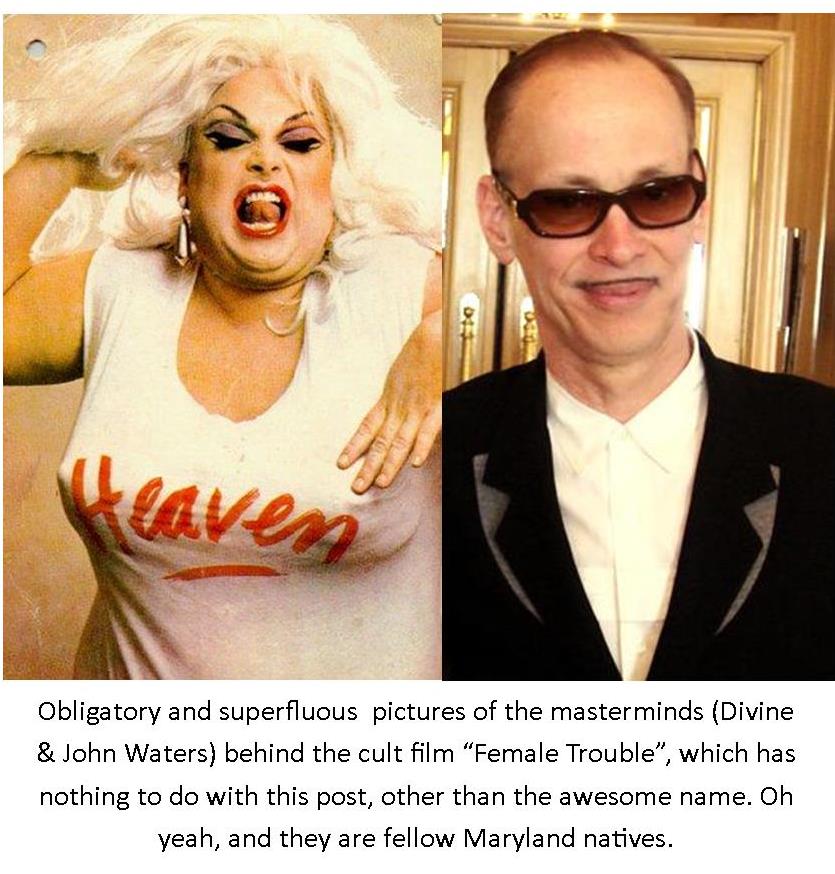
waters

Part 2 – The Cancer Curmudgeon

Well, shit, if Beyonce can just go and start up an alter ego and name it Sasha Fierce, I can have an alter ego too! The name must be part of her whole female empowerment shtick, I mean there must be more to female power than flashing boobs and booty rather than intelligence. Whoops did I just say that. Yes, still sarcastic.

Anyway, developing this name is a way to create a therapeutic device as I start my post-cancer, post-previous-job life.

Why Cancer Curmudgeon? Well, the alliteration is awesome, obviously. But more accurately, it has to do with treasured books by American author, journalist, founder of the Fund for Animals, and cat Dad, Cleveland Amory. Amory wrote a series of books about his cat called Polar Bear, including one titled “The Cat and the Curmudgeon.” To say Amory was an outspoken animal rights activist is mild. He once suggested on national TV that a hunt club should be formed in order to hunt and kill other hunters for sport, claiming it would only be humane, as there is an overpopulation of hunters. Satirical and extreme to absurdity, I love that. And yes, he got into hot water over the comments.

Amory would continue to be a curmudgeon for the cause for the rest of his life (and I wonder if just for the sheer fun of being a curmudgeon). Being an animal and pop culture lover, I loved his Polar Bear book series. One image I’ll never forget (although I cannot name which book it is in) is his description of an attempt to walk Polar Bear on a leash in a park. Mainly the cat just sat there, annoyed, while Amory orbited around him, leash in hand. Apparently, Polar Bear was a curmudgeon as well.

So yes, I am a bit of a curmudgeon, a malcontent, a borderline misanthrope (might be why I spend most of my time with animals). Mostly I am like Sheldon on “The Big Bang Theory”, forever pointing out to Penny that her check engine light is on. I perceive things in cancer world that seem not quite right, such as the twisting of stats, the use of pink to sell plastic crap (without transparency as to if the corporation is actually donating anything and if so, what the money is being used for), the sexualization of breast cancer, the blurring of the line between early detection and prevention (my personal white whale). I cannot help myself, I must speak up about it. And like Sheldon, who cannot conceive of a world in which anyone would not get her car fixed when there is obviously a problem, I wish to correct the problems—starting with talking about them, even if the problems are hard to talk about. Of course, not everyone would agree that the things I just listed are indeed problems, or worse, some will just not see them at all, citing that the overall greater good is worth a few problems. I disagree. If that makes me a curmudgeon, well, looks like I chose my name wisely.

FEAR

I’m sure anyone remotely interested in breast cancer has seen and read The New York Times Magazine. Heck, I reblogged it as a part of ihatebreastcancer’s blog and additional comments. It’s like a reader’s digest version of nearly every article or criticism of breast cancer awareness/marketing/issues I’ve read in the past two years, and I am sure anyone reading this blog is familiar with nearly everything in the article—before even reading it. But that is because we seek out info about breast cancer more than the average Jane. Perhaps the good news here is that this piece is in a non-cancer oriented magazine, so maybe more people will learn some truths about the pink machine. It is odd this is published in April not October. Not complaining mind you, for many of us breast cancer is an every-damn-day-of-the-year-not-just-in-October deal. I admit I am a little worried that a piece challenging the common perceptions of breast cancer is released nearly half a year away from the signature month when the media generally toes the proverbial line. I hope this magazine/article is remembered when October comes and we are drowning in pink, but I am sure pink events and products were in planning stages by November 1 of last year, and it is already too late to turn it around this year. Maybe next year.

I wasn’t going to write about it, figuring everyone else already has, and mostly I agreed with the article. But I had a hard time with the idea of “distorted fears of middle-aged women”.

To be fair, this article is the not the first time I’ve read someone comment that the pink marketing is selling fear to women, scaring them into getting mammograms, interpreting/presenting the stats to make it seems as if getting breast cancer is nearly inevitable if you’re a woman (1 in 8 was really picked on in one book I read), but it really bothered me this time around.

The author admits the fear is legitimate. And I agree that the fear is manipulated for profit. We’re taught to fear cancer so we get mammograms, but reassured that if does happen, it can be treated (thanks, awareness funding from drug companies! YES I’M BEING SARCASTIC)…so I guess fear marketing only goes so far. After all, pink never mentions metastatic cancer, and we should not fear death, cancer patients don’t die, we lose our battle (YES I’M BEING SARCASTIC, read my earlier post The D Word).

But here is the thing: I was not afraid before I got cancer. The pink awareness marketing may drive women to getting mammograms, may intimidate with the stats, but I thought when it happened to me, I’d be much older. I suspect that is the case with many young women with cancer, and I think some women of any age, without cancer, think it will not happen to them ever. They might recite the “1 in 8”, but assume they’ll be one of the other 7. So how real is the fear?

When my aunt was diagnosed in 2010 at age 50, I dutifully went for my annual, asked for a mammogram. The doctor did not detect anything in August. The mammogram performed in September was negative. By October 25, 2010 I had Stage 3 breast cancer. Color me shocked. When my nipple inverted, right after my “all clear”, that was when I had fear, and anger, of course, because the industry system—the pink message—failed me. Some would say that I should be grateful that I was not so full of fear prior to cancer, because detecting my cancer a bit earlier may not have changed treatment much—most likely I’d have still had my nipple removed—but I would like to have avoided the chemo or radiation if an earlier detection made it possible. I am not sure how I feel about all this.

So I ask myself what the hell am I so afraid of right now?

  • Recurrence, duh.
  • Another failed mammogram—misdiagnosis  
  • I’m afraid of wine, of all delicious foods, because I want them, and they allegedly cause cancer and every other health problem.
  • I’m afraid that as a dog walker who walks by pesticide treated lawns several times a day that I am causing a return of cancer, or a new cancer, in myself. I guess I could control that by quitting my job, but then how would I pay for cancer? Which leads to…
  • I’m afraid that if/when cancer comes back, I will not be able to afford treatment, so I will likely die, and there seems little I can do about that. You could say I should not have quit my job which had better insurance (co-pays are sometimes more than twice as much with my new government plan), but honestly, I am not sure I would have survived if I’d stayed in that job, it stressed me so much. 
  • I’m afraid my friends and family will get cancer. Hell, I’m afraid anyone else will—especially young women. Because there is so little REAL investigation into prevention, and the cause still seems to be mostly unknown.  And I blog and fuss and try to learn to be a health advocate because I actively do not want another young woman to go through what I went through, but I know I can’t prevent it. This is helplessness as fear.

Is shock at getting unexpected cancer worse than being afraid prior to getting it? I cannot ever know the answer to that question. I just don’t want ANYONE else to feel that shock, because it does not eliminate the fear that comes after. I mean, now I just have both fear and shock (and oh yeah, anger), and I’m not sure I like that. I don’t know if that is better or worse.

So what about all this alleged fear-mongering perpetrated by pink medical industry? Yes, I do think it is wrong when done just to drive profits. But from where I’m standing, the fear is reasonable….because I got cancer. And others under the age 40, with little to no risk factors will get it too. And no one knows which one of these young women will “get lucky”, because we have no prevention, no understanding of causes. These women should be afraid but they just don’t know it yet. I just don’t know how else to say it.

Does Breast Cancer Owe It to Other Cancers?

A/N This is a potentially offensive post, please follow my train of thought to the end, I am trying NOT to be a jackass, and failing. This is just how I am seeing this issue at the moment. I beg you to change my mind in the comments.

Here is yet another criticism of that 2020 deadline, Can Setting a Deadline Put an End to Breast Cancer?  by Geoffrey Kabat. I’ve already blogged about this issue, when that editorial in “Nature” appeared few months ago.

Honestly, I have a few problems with the 2020 Deadline myself, even more now than when I originally wrote about it. My biggest problem is one of the main issues confronted by these editorials: that discovery cannot be forced; it will not answer to a deadline. I agree with this, and even the idea that setting a goal that has a real chance of NOT being met is a bit risky.

But what irks me is in both of these pieces, there is this suggestion, no, AN EXPECTATION that breast cancer activists, advocates, organizations should focus on other cancer problems, not just breast cancer. These activists/organizations have done such a good job of creating awareness (really?), the energy should be applied to other cancers, so the thinking, I assume, must go.

Is it really the best solution for National Breast Cancer Coalition, or any other organization DEDICATED to breast cancer, to handle other cancer problems? I mean, National BREAST CANCER Coalition, see? BREAST CANCER right there in the name. There probably are already some organizations taking on other cancers in baby steps now; goodness knows the damn ribbons for all other diseases exist (stop reducing diseases to ribbons!), and I suspect these groups have adopted some tactics of breast cancer awareness. If so, let us hope these groups learn from pink marketing’s mistakes before they go too far. The deadline has a focus of ending breast cancer, misguided or not, but that is because the whole point of the organization is…wait for it…BREAST CANCER. That is why it formed. Its objective, according to an old address by its president Frances Visco, is to end breast cancer and cease to exist because it would no longer be needed. Why would anyone think it should do other work—to self-perpetuate?

It’s just that the logic demanding breast cancer organizations (which were formed for WHAT disease, again? yes I’m being sarcastic) work on other cancers is flat out faulty. Go with my flow here for a second. This author points out lung cancer kills more women, and says a breast cancer organization should do something about it. This implies breast cancer is just a women’s problem, breast cancer organizations are just women’s organizations. Well, no, men get it too, and a breast cancer organization is about all breast cancer no matter what the sex of the body it’s in; and the breast cancer organization is not focusing on all health issues suffered by women (because it was formed to focus on what disease again? Say it all together now: BREAST CANCER). Yes the opposite is true; breast cancer can be under the umbrella of women’s health. So when he says “The exclusive focus on breast cancer skews one’s perspective by blotting out other opportunities,” does he really mean we should get rid of some breast cancer organizations, and pay less attention to breast cancer because other diseases kill more women, and are therefore more important? Because that is kind of what it sounds like, and that would be incredibly stupid.

Also, I am a little confused and bewildered at the author’s suggestions that breast cancer organizations work specifically on lung and cervical cancers. According to the information in his editorial, the causes of these two are known and preventions available. The reason the 2020 project is in place is to find the cause(s) and some preventions for breast cancer. That would mean, work on breast cancer is far behind the work on these other two cancers. So, is he suggesting breast cancer organizations work on these projects because, what, it’s easier? And what, just say to future breast cancer patients, sorry you’re SOL, it was easier to sell what we already had or knew, because we did not want to invest in even trying to make a discovery?

Perhaps the bug up everyone’s ass is jealousy because of all the attention breast cancer has amassed over the past few decades. I KNOW lung cancer AND heart disease kills more women. Not this article, but plenty of other articles about heart disease always seem to start off with a sentence about how heart disease kills more women than breast cancer, as if the authors are personally offended that breast cancer gets more attention than their cause (read this fabulous rant by a blogger on Tumblr). I know everyone has their own agenda, their own pet cause because it is something that impacts them, and each individual is entitled to their viewpoint and their cause. But picking on breast cancer is just getting tiresome.

Breast cancer organizations are most likely run/staffed/founded by those with personal knowledge of it, which is why they work on it (duh, it is what they know best), rather than, say, heart disease. I blog about breast cancer because I had it. When I get heart disease, I’ll blog about that too. It is the nature of the beast. Should diseases that kill more people get more attention? Maybe, but how does that make those diseases more important, more devastating, than a rare disease to someone who has had loved ones die from said rare disease? Who the hell goes around saying “my disease is more important than your disease because it kills more people”? Breast cancer patients, imagine saying to your ovarian cancer friends “breast cancer is more important because more women have it?” How much of an asshole would you have to be to say that? But it seems OK to imply these other diseases are more important than breast cancer for the same reason. Breast cancer may be viewed as a big ol’ pink bully in disease world, but it is starting to be the one bullied. Apparently payback is a bitch.

color pink

The blessing and the curse of pink marketing is that it made breast cancer seem like the most important and desirable cause in the world; getting a lot of money and research which resulted in treatments that saved lives, including my own, for which I am grateful. But the fact is, pink dollars didn’t stop breast cancer from happening to women, it didn’t even really slow it down, just stopped some of the dying. But not all of the dying. Breast cancer patients still get mets and die, no matter how much pink marketing pretends this doesn’t happen (remember, cancer patients don’t die, they lose their battle). In short, pink has not been a blinding success. So when advocates for other health causes complain about how much attention breast cancer gets, I suggest taking a long hard look at that, and understand there is a dirty underside to pink that needs exposure. And there are plenty of bloggers exposing it, it wouldn’t be hard to learn the truth.

Back to the question at hand, do breast cancer organizations owe it to other disease problems? I’m certainly not suggesting here that breast cancer groups should just turn up their noses and say “not my problem” about other cancers. There are more breast cancer survivors because incidence has not decreased like the death rate. I may feel a personal obligation to advocating, yelling, on behalf of those causes, but I don’t think an organization devoted to a certain focus should split that focus; that is unfair to the people the organization set out to serve. It is difficult to say which is the more compassionate choice here, if there is one. And yes I do realize that new organizations for unrepresented causes/diseases cannot just be created with the snap of fingers. I don’t have the answer; I’m only asking the question. It will take many minds to come up with the solution.

In Case You Have Not Been Here

My Wife Fights With Breast Cancer

Cancer patients more into social media than I probably know this from Facebook. I saw it via Tumblr several weeks ago but could not look at those pictures, it reminded me too much of my own bald head. I finally got courage to look today but found the about page too. Yes the pictures are important but I was really impressed with the about page, especially this quote:

“Sadly, most people do not want to hear these realities and at certain points we felt our support fading away.”

Says quite a lot, doesn’t it?

Failure of Awareness

tumblr_mlvrwnC1d11r8dxjoo1_500

So I found this on my Tumblr dash. Hopefully I followed the thread correctly (I’m still not a blogging expert) and went to the source who posted the graphic AND this caption: “Saw this somewhere else and felt the need to post it cause no one else ever really tells you this stuff”. There were many more comments, but I had to cut them out to get this (not very clear) screenshot.

Unless it is fake, or contains misinformation, the blog is run by a 14 year old black girl (I am not using the PC African American because I’ve no idea if she is American). I have sent her(?) a message via Tumblr but do not expect a reply; and am cautious in believing the blog is real, as I was one of those fools that messaged back and forth with the Goldbergs on Tumblr, only to learn that the blog was run by a woman who only pretended to have terminal cancer, just for attention.

The post has been liked and/or reblogged over 75,000 times, so lots of people (hopefully most are real people with real blogs), all ages, nationalities, genders, agree. All these people think no one tells them this stuff, so they are trying to get it out there. Where the fuck did all of the awareness dollars go, if so many people think this information is not out there enough?

Is it because of pink over saturation that people no longer notice facts unless they are presented in some non-pink, non-October way? Is it the fact that pink marketing has targeted a very select group—(usually) white women of a certain age who buy products—and left all other demographics out cold? Is the fact that the message of pink marketing only includes very select facts about breast cancer, selling their target audience/customers a message on which The New York Times Magazine article (not even linking it here, I know everyone has read it) commented “…well-meaning awareness has ultimately made women less conscious of the facts…”? Is it some insidious combination of all of the above?

I mostly agreed with The New York Times Magazine article; it was basically a condensed version of tons of other pieces I’ve read since getting breast cancer my own damn self. The main part I did not agree with had to do with fear, and I may or may not post about that later. But I will tackle a little bit of it here, because apparently it is a factor.

According to the article young girls are getting “I (heart) boobies” bracelets, taught SBE, and Dr. Susan Love says, right in this article, “…but educating kids earlier — that bothers me. Here you are, especially in high school or junior high, just getting to know to your body. To do this search-and-destroy mission where your job is to find cancer that’s lurking even though the chance is minuscule to none. . . . It doesn’t serve anyone. And I don’t think it empowers girls. It scares them.”

Yeah, they are scared, they see lots of pink and boobies crap talking about cancer, and they probably have someone in their life with cancer. But getting no real information, they get on the internet for info that maybe does not give the whole story, presented in a kicky graphic (have no idea who created the graphic or if it was produced using pink dollars). Is this preferable?

Yes I agree that awareness has reached an over-saturation level in some demographics, because I am in that target customer group, so I’m sick of awareness too, but I’m not sure everyone got the real or whole story. In fact, maybe no one ever gets the real story until they do get breast cancer, or someone close to them gets it.

Can awareness campaigns please start putting the real facts out there, and do away with boobies and pink ribbons? I think people can handle it now, we don’t need to see half naked women to understand cancer anymore. Grow up media and marketing.