How to Swindle a Breast Cancer Patient

Last September in my gynecologist’s office, a conversation went sort of like this:

Her: Did you do the BRCA testing?

Me: Yes, it was negative.

Her: Good.

Me: Why? I still got cancer!

Her: Yes, but it is good to have all the information.

It is true; I dutifully did the BRCA test as soon as I started treatment, at the urging of practically everyone I came into contact with in those first confusing weeks after diagnoses. With such strong family history (my aunt, my maternal grandmother, her sister, other assorted relatives, all had breast cancer), I was SURE I would get a positive result. I reasoned that with these positive results, the discussion could then proceed to having prophylactic bilateral mastectomy, as well as an oophorectomy, regardless of how my chemotherapy worked in the effort to shrink a tumor. (An explanation-my tumor was large and my breast small, chemo had been strongly suggested as the first piece of treatment, otherwise, surgery would have been difficult in terms of having to remove so much skin and tissue.) I wanted to get all my strategizing done; I wanted the results before I had to plan surgery, so I would know what I was facing, the most effective way of scheduling the surgeries, etc.

Incredibly the results were negative. I remember the testing coordinator saying that some women are relieved for a positive result, because then they “knew” and the “decision” was easier. With my negative, I could still do the bilateral mastectomy if I wanted, it just wasn’t as urgent, but you know, I could do it for prophylactic reasons. I did not think that way at all; I was glad it was negative, and I ultimately went with a lumpectomy, because I responded to chemo so well that my tumor was undefinable by the time I reached the surgery phase of my treatment plan.

I forgot about the BRCA testing, or shoved it to the back of my mind as I finished all the rest of treatment, and did not really think about it again until the conversation happened with my gynecologist. That conversation about the testing really bugged me. I do not have children and will not have them, so even if I had the mutation, I would not pass it on (I’m an only child), so why did I do it? Then last week, I read Five Lessons I Didn’t Learn from Breast Cancer (and One Big One I Did) by Shelley Lewis, who has graciously allowed me to include this reference to her book for this post. Ms. Lewis includes a section raising some questions about the true number of women, specifically breast cancer patients, actually impacted by this mutation. Her book inspired me to do a little research on my own.

At first all I found were the usual things, that a woman with one of the mutations is anywhere from 40% to 70% more likely to get breast and/or ovarian cancer, get it earlier, get a recurrence, and more likely to not survive. However, according to the Komen website, in the U.S., only one in 400 to 800 people in the general population actually carry a BRCA mutation, AND they state quite plainly that like all gene mutations, it is rare. Then, on the National Cancer Institute website, I found this little nugget: “Although such cancer susceptibility genes are very important, highly penetrant germline mutations are estimated to account for only 5% to 10% of breast cancers overall.”  Ooooookkkaaaayy, what about the other 90% of us? Well, the Cleveland Clinic states “(m)ost breast cancer is actually considered sporadic (occurring by chance). BRCA gene mutations are actually responsible for an extremely small number of breast cancer cases. So the chance to have a BRCA mutation is low, but when there is a mutation, the chance to develop certain cancers is high. Other causes of breast cancer include lifestyle and environment. Most breast cancer patients will never know the true cause of their disease,(emphasis mine). Once again, the question of how the hell did I get cancer goes unanswered (not that I really expect one).

Along with these interesting tidbits, I learned from the National Cancer Institute that the mutation is responsible for disease in 45% of families with multiple instances of breast cancer, such as my family, so I guess we fall into that 55%? Furthermore, it is possible my test results were a “false negative”, and there is no way to determine if it could be a true negative, or if it is some other gene mutation not detectable. Argh, I already got one false negative in my breast cancer case, please don’t let this be another!

So, this gene mutation seems to take up quite a bit of space in conversations about breast cancer, yet it only accounts for 10% as a cause? I find this odd, since it seems that most of what I find about breast cancer tends to cater to the larger percentages in the disease—the estrogen positive, the over 60 years old, etc., all those categories I don’t fall into (see my earlier complaint about that). What is with the push to get all patients to do the test? Is it to encourage more surgery? Oh right, it is to line the pockets of the company that does the test. And I know there is enough ill will from some breast cancer bloggers toward Myriad about the fact that this company is the only one that can do the test; I’m not even going to dip my toe into that issue.

I regret that I even bothered getting the test. I would not discourage anyone from getting it, but I don’t encourage it either.
Why I Write (Right) Now

Most other breast cancer blogs I follow seem to seem to be written by bloggers currently in treatment, and once the blogger gets several months out from treatment, they move forward on to other endeavors, quit blogging, and I assume they have moved on from cancer.

I wish to clarify something; yes I am about a year out from treatment and am just now starting to blog about cancer. Because of this, it may seem I am not moving forward, and that may be so, but it is a little simpler than that.

The truth of it is, I just did not have time for it while going through treatment. I worked part time while going through chemo, approximately 4 to 5 months. About a week after my lumpectomy, I returned to work full-time, while still in treatment with radiation and infusions of Herceptin. And I worked for a non-profit arts organization, so full-time often exceeded the average 40-hour-per-work-week. I spent a lot of time interacting with the public, and writing on a computer. Plus, I did some pet care on the side for friends! So, on my downtime, I did not really do anything other than rest.

Realizing I was miserable in that job almost a year ago, I left it to turn the pet care lark into a real business, one that I could control, and take a little time to recover from all that my body endured in the previous year. It has been great, and I’ve finally had time to reflect on all the emotions I experienced while in treatment. Like many cancer patients, I did not feel the full extent of anger until after treatment, and I guess that is what is happening now, and I am getting it out of my system along with all the emotions I pushed down while I was trying to “do cancer right”.

Yes, I know I come off as negative quite a bit, but not all of the emotions or negativity is not “fresh”, and writing it all out is quite therapeutic. Will I ever get to a point in which I no longer need to blog? I hope so, and I hope not. As stated in a previous post, I hope my posts are helpful to those with similar feelings about cancer, and if so, I hope that I can continue to be helpful, whether as an advocate or blogger or whatever. I will move forward from cancer, but I vow to use the memory of the experience to help others as much as I can.

Why I Do this Blogging Thing

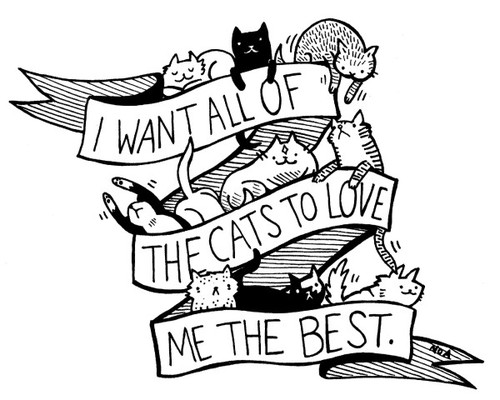
Image(Source: nationofamanda)

This picture kind of sums up why I started blogging. Growing up in a rural area during the 80s, before the interwebs, it was tough to be a goth kid into stuff like the Cure, R.E.M., Husker Du, and that stuff (remember, this is before Nirvana got all over MTV and changed everything—and certainly before you could just download songs to a phone—I mean I had to go to an actual store and try to buy often-unavailable CDs—the horror, the horror). Most of the time I thought no one felt like I did, or had similar thoughts, or anything! I realize most teens feel that, even today, but the internet makes it so much easier to find the like-minded. It does not matter how stupid, silly, weird, or possibly embarrassing a secret thought might be, at least one other person with the same thought can be found via the internet.

Just like this silly picture above. I am a crazy-cat-lady-in-training, (possibly also a crazy-dog-lady too), and yes, the thought “I want all the cats to like me best” crossed my mind ages ago. And whaddya know, someone else had the same thought!

So, as I progressed in my cancer treatment, I began to feel more and more discontent with the “save the ta-tas” style of advice or conversations available to me in real life. Eventually, I found a support group comprised of women who shared some of my discontent. But it was hard to get started in the group….I was too sick and tired with treatment and work to attend much at first. My guess is there are others with a similar outlook who might be relieved to see that someone else in the world thinks the same thoughts. I know I wish I’d found some blogs I now read a bit earlier, it would have saved me some angst!

So this blog is for you, fellow cancer malcontent, where ever you are!

The Age Divisions

When I was first diagnosed a few days before my 39th birthday, I concentrated on just the big picture of breast cancer, and I did not really pay attention to issues of age…at first. I was lucky to be treated at a facility that, despite its location in a small-town and rural area, was evolved enough to have a resource for young adults with cancer. A special support group was started for us by my friend, diagnosed a few years earlier with ovarian and uterine cancer. Joining support groups is so the opposite of my personality, but I am so glad I joined this one. It helped offset the annoyance I still felt going into the infusion room and seeing the looks of surprise given by my fellow patients as they watched me, not my mother, sit in that chair each time (even though I was the bald one, go figure).

As I progressed through treatment and began interacting with the others in our support group, I have researched a few resources outside of our little local circle for “young adults with cancer”. There are some cool things out there, like Huffington Post’s Generation Why blog, Stupid Cancer/I’m Too Young For This! Foundation, and First Descent.

But I wouldn’t be the Cancer Curmudgeon if I did not have a complaint. Generation Why is a play on “generation y”; naturally I am “generation x”. First Descent and events produced by Stupid Cancer are for anyone with cancer ages 13-39. Since I was going through treatment the entire time I was 39, and I worked while in treatment, I did not have much left-over energy or vacation time for anything like that. Hell, even the SCAR Project, which I admire greatly, had a limit of age 35 for participants. So does that mean, since I am 41, I am no longer allowed to be a sexual being, upset at the scar and lack of nipple that cancer left me? I do not think this, but it seems that “society”, or certain organizations, or who knows else, is putting these parameters in place, once again trying to fit cancer experiences into these little boxes.

Cancer sucks no matter what number of years you’ve walked this earth. Maybe people should not be reduced to age brackets when it comes to cancer. At 41 I should be at a certain place in a career, married with 2 kids? Nope, I don’t fit the “profile”. No kids…so the worries of informing my kids, raising kids, and worrying about their future without me does not apply. But I am single and would like to find a husband, and hell yeah, I am worried that my “damaged goods” are going to impact my chances of finding a one, a problem I see discussed in articles targeted to those in their 20s and 30s. In addition, I am certainly nowhere near retirement, in fact, am still searching for my “perfect” job. In short, I know what my particular challenges are, and there may be someone out there in the same or a similar boat, or maybe not. I’m sure lots of patients cannot imagine facing my set of circumstances, the same way I am baffled when I read other bloggers’ posts of trying to go through college while in chemo, some without family support.

Look, I am not poo-pooing these resources I’ve mentioned, I am grateful they exist. I sort it out as I research & read, and just try to take what applies to me and move on. I know that the medical community and these various organizations have to create these age brackets in order to do the testing, compile data, and create their target markets. I especially would like the medical testing industry to expand their vision to include testing and results for each and every age bracket, so treatment can be improved and prevention discovered. It’s all about the stats and the odds, I know.

I just want everyone, especially the number-crunchers, to remember that the one common thread in cancer patients no matter the age is that we all want to survive and live well, and that there is a person behind each number or stat.

WHAT DO I CALL MYSELF?

Early on in my post diagnoses life, I began to refer to myself as a patient, and I still do despite being about a year out of my last infusion of Herceptin (my last cancer related treatment). I rejected the word survivor at first because it just seemed like another one of those words in the pink package, along with “hope” and “battle” and “lost her fight with cancer”. These little euphemisms make me cringe. As I became more educated in the ways of the world of cancer, I learned that “survivor” makes those with Stage IV annoyed, and rightfully so. Now I am even more determined to avoid the word in reference to myself.

I was re-reading Barbara Ehrenreich’s “Welcome to Cancerland” for fact checking today and about half way through I re-read her passage about the language of cancer, derived from AIDS movement, pointing out that “patient” and “victim” have an “aura of self-pity and passivity” (hmmm, passive is exactly how I view that word “hope” so popular in breast cancer culture, but that is another post).

OK I might have a bit of self-pity because cancer landed on me, but that did not stop me from taking my medicines, actively monitoring my treatment regime, and doing many other things to make sure the tumor went away. But the truth is, I don’t take credit for it; the drugs, the surgery, the radiation did the “fighting” for me. I was OK delegating that task to modern medicine, while I advocated for myself as a patient and battled the insurance company. I’m never going to say that having cancer did not totally suck, and I will never stop being angry that I got it, even as I move on with my life. For me, it has less to do with self-pity and more to do with being realistic, but hey that’s just me.

I would not classify myself as passive. There are indeed passive patients, and in the beginning I’m sure I was, just going to and from whatever tests and whatnot that seemed to be scheduled without my input. But I learned to take control, to be an active patient. I did simple things, like scheduling chemo infusions in the afternoon so I could at least have lunch before going to get poisoned (I could never eat after infusion). When I was done at  5 pm, great! I could just go to bed. But even while the good medical professionals at my cancer center use the “survivor” style language, they still treat all patients like “passive patients”, not “strong survivors”. Even now, a year out of treatment, I still define myself as a patient because of this. I still have to haul my ass in there every six months, and at the end of the meeting with the oncologist, I am handed a list of appointments to attend at the next six month mark. These appointments are made for me, without anyone bothering to ask me if any days or times are convenient. I am a patient and I am to show up at the appointed time, that’s that.

Well no, it isn’t. Since I am self-employed running a pet sitting business, I tend to need a bit of flexibility in my appointments. I cannot just drop a scheduled check-in with a pet, because that is a payment I would miss out on. So I tell this to the medical appointment makers as I once again change my appointment. “Hey, y’all wanna get paid? Then stop making appointments at times I need to work.” I know my medical team cares for me, but this is still a business, with a financial transaction, and, man, bring up the subject of money, especially the threat of non-payment, people get real accommodating! But I know that in six months it will be forgotten, that I will again be handed a list of new appointments, because, hey, I am still their patient, no matter what I call myself.

My occupational hazard is to describe my status in pet care terms. When I was at the treatment center every week or everyday during chemo and radiation, I compared it to being “crated”, like a puppy being trained not to chew the furniture while the humans are away. Once I graduated to my every-third-week Herceptin infusions, I considered myself on the “short leash” with a gentle lead, perhaps. Now that I only go in every six months, I see myself as on the extendable leash; able to explore more of the world outside of cancer, but they keep reeling me back in.*

So I shall continue to refer to myself as a patient until the cancer center lets me off their leash, or at least until I think of some better word. What I will do in the meantime, as a non-passive, non-self-pitying person who had cancer, is use the anger to become an advocate to push medical science to find out the causes of cancer, to develop better methods of detection and treatment, and to be the one in the dark corner in the pink world where I whisper to others with breast cancer, “If you don’t have anything cheery and pink to say, come sit next to me.”

*Note: No medical tools or infusion machines were chewed or harmed during my internment in cancer world (i.e. when they had me crated).

What is it about breast cancer….

http://achemicalworld.tumblr.com/post/11735006987/what-is-it-about-breast-cancer-that-makes-it-everyones

Love this, from another blog I follow on Tumblr. I “get” why other cancer patients get sick of the pink ribbon, but I hope these folks do not think just because I have “that special cancer” that I’m automatically pro-pink. There is a lot to be desired about pink October, and it just makes me sick to even see the ribbons most of the time. There is a lot of anger out there, I hope corporations that use the pink start to wake up before it bites everyone in the ass.

Breast Cancer patients with low self body image

Breast Cancer patients with low self body image

Interesting Article

Interesting Article

More unnecessary cancer hype

So found this on Huffington Post. People will see “unnecessary breast cancer treatment” and not make it to the third paragraph which states “(m)ammograms are still worthwhile,” as well as the rest of the article which essentially says science does not know how to determine which cancers will progress into a threat. So…why did the study not go ahead and figure out how to tell when a cancer needs to be treated or not? I mean is the current method, wait and see if it spreads around, wrecking women’s breasts, so more mastectomies can be done, or if patients die? But as offensively pointed out in this post, screening is “only worthwhile if it finds cancers destined to cause death”. I mean, WTF? I’m still alive (hurray!), but I’d rather not have had the cancer at all, if you don’t mind!

I’m not exactly a big fan of mammography, being someone who got a false negative on her very first mammogram. I cannot believe that a false alarm is as bad as cancer…at least there is relief at the end of a false alarm. I live with the fear and stress of recurrence everyday…and this is after the stress and fear of having and being treated for cancer.

And I just love the last paragraph-yes, science needs to better define what treatment is really needed, or better yet, better DEFINE PREVENTION, where is the funding for that!

Ramblings On That Word Awareness

Seeing the success of Breast Cancer Awareness Month, so many other diseases are using the word “awareness” to bring attention to “their cause disease”. But the word is overused and has lost meaning.  My knee-jerk, smart ass response these days is, ”I can’t get any more aware, thank you”. In articles and online discussions I often see the comment when the NFL is wearing pink, or when you can buy pink kitchen appliances, or when you see (name random thing) pink, we’ve reached our awareness saturation point (in terms of breast cancer). I’m inclined to agree, especially since when the comment comes from someone with whom agree on the point of being sick of all things pink.

But maybe this view is wrong. Awareness may be at saturation point in the target audience for breast cancer cause marketing, which is middle class white women with the money to spend on any product with a little pink slathered on is. Are poor and non-white women being reached? I know that special education and outreach programs exist to remedy this, but I cannot see results beneath all the pink (and white). Unless the target audience can see themselves getting cancer, they will never really be “aware”. Where is the pinkification of products preferred by African-American women, by Latina women, or affordable to the poor?

Which leads to another, larger point—I was “aware” of the pinkness and assorted hoopla each October prior to my own diagnoses, but as someone under 40, I didn’t really see myself as the target…I did not see myself getting cancer. I was aware I could get it, aware of my risk factors, etc. I’m sure some would point out to me that awareness led me to get a mammogram that caught my cancer and saved my life, except in my case, that is not true (see my about page).

So I’m aware, you’re aware, she’s aware, he’s aware. Big whoop. What is being done about it? I modestly propose a change of focus and title for all these disease campaigns. Cancer is too complex for a cure, I get it, I read The Emperor of All Maladies. How about something like stop X cancer from killing people? Or better yet, dare I ask…Prevent ALL Cancer?