Heartstrings

My cancer “story” is not cute, nor triumphant (arguably, I mean, I AM alive still), and it does not tug any heartstrings. I put story in scare quotes because lately I’ve been so very tired of every single cliché in cancer—even clichés I use, like “tell your story”. I don’t really object to the phrase, I just hear it too much. Anyway, enough of that ramble.

I’m responding to the Dog Day picture posted by Komen, of dogs wearing bras with balloons in them—you know, for “the cause”, for “awareness”. I and so many cancer bloggers I read objected vehemently to the photo. How can those of us objecting to the sexualization of breast cancer combat this?

Well, for years bloggers have been combating this by writing about the other side—the one that includes pictures of ugly scars, stories of failed treatment/surgery, stories of recurrence or metastasis, stories of the lovely side effects of treatment (hemorrhoids + diarrhea, anyone? no? just me?). But the mainstream media (I swear, I’m not Sarah Palin the way I go on about the mainstream media, there is just no other way to phrase it) prefers the pretty boas on women who kicked cancer’s ass. That does not represent me.

But neither do some of the stories that tell the other side.

I “only” had a lumpectomy, luckily because my 5×6 cm tumor was shrunk by chemo (I’ve had an ugly post about breast cancer competition stories in the works for ages, and one day I’ll calm down enough to finish and post). So I have no traumatic surgery photos to post. In fact, the photos on this blog show a masterfully completed surgery with a neat and tidy scar, covered with a tattoo I got in “triumph”. I have no photos of my hairless self, pics of me in chemo. I didn’t want to document or remember any of that. I was photographed when my hair first started coming back for a work event; I felt I could not object to the photo being taken since it was publicity for the event. These days I wish I’d refused, that the photo did not exist.

I mean, I do have my original images of my first mammogram, that show a big white blob in the left breast, with no matching white blob in the right. It could be a cautionary image-story of how a tumor fools a radiologist into believing a woman just has dense breasts. But it isn’t impressive, eye-catching stuff.

I did not have as hard a time with side effects as other patients I’ve met in real life and online. I won’t say I “breezed through” treatment. Indeed, the fight with the nurse practitioner over whether I had shingles or Staph was a pain in the ass. Especially being put on meds I did not need and did not solve the problem, and the tenacity I had to use after chemo and surgery to get a correct diagnosis. But that is a minor speed bump compared to horrible stories I read.

Lots of metastatic stories I read bring up the fear of dying before seeing children grow up, go to college, get married, have grandchildren. I don’t have kids and never wanted them. So my story is not poignant, would not work in one of those ads designed to make people reach for tissues and credit cards. My story has no such tragic element.

Furthermore, I’ve made no grand contribution to society. Other than my parents and a few random relatives and friends, I’ve made no mark on the world. I’m just a smartass more interested in pets than people. My personality and my story will not send the masses to wipe tears and open checkbooks. My story and (lack of) pictures cannot combat and get attention for breast cancer awareness the way images of women doffing bras for the cause, funny dogs in bras, women pulling a warrior pose, and mothers afraid of not seeing their children grow up, can to get the public eye.

Of course, I am doing the thing I hate most: comparing cancers, getting into the cancer Olympics, who has it worse bullshit. I don’t have it bad—I participate in discounting, I “only” had stage 3, I “just” had a few side effects. Again, that comparison, who-has-it-worse, crap is a story for not just one, but two, future painful posts.

So why participate in all the “tell your cancer story” activity? I’ve admitted a few times here on this blog and other social media that at this point, this blog is mostly for self-therapy. And to lend a digital hand to others who have had or currently have cancer, who have similar crotchety views like mine—to let them know they are not alone—the way I felt in that post-treatment depression period. I’ve given up trying to convince those without cancer and those that embrace Pink-rah-rah-fight-like-a-girl stuff around to my way of thinking.

But then I think, perhaps the blandness, the ordinary-ness, of my story is in fact what is so horrific about it. Sure I had some family history—certainly not as much history as others I know of. I was just going along in my life, figuring cancer was a likely eventuality for me, although I expected blood pressure/cholesterol/heart disease issues first—that was the more common family history. Cancer would be my post-retirement issue.

I wonder what the non-cancer general public thinks when they see the trying-to-make-you-cry cancer ads. Do they hug their children, pause in momentary gratitude, and then move on, figuring “it won’t happen to me“? I mean, I sure thought that way. Even now, 5 years later, I’m still vaguely surprised I had cancer—that it happened to me. Shocking getting-cancer-young stories always happened to somebody else.

If I knew of a way to post a picture or to distill my cancer experience into a pithy quip or soundbite that would gather attention, that would combat the clichéd ads and pictures already creeping in before October, I would do it. But, I don’t believe in creating some pink boxing glove inspirational image, I have no tragic pictures or stories. All I have is an ordinary tale: I got cancer when I did not expect it; I elected to get treated; and now, so far so good. No heartstrings can be tugged—and I’m not the type that likes that kind of thing anyway.

Of course, it isn’t really that simple.

Cancer continues to have a profound impact on my life. Some of it is still physical; the tiredness unnatural for one in her 40s, the remnants of brain fog, the pain and tenderness to the point of abhorring touch on the breast that had cancer—and of course that dip where the nipple used to be. Much of the remaining impact is mental and emotional, and altered views—I won’t say cancer lessons. They are lessons, just not socially acceptable lessons—again, blog posts for future days.

I’m just so tired of cancer culture, especially breast cancer culture. And I’ve only loathed it for 5 years; I know there are other bloggers out there who’ve been criticizing this mess far longer—and so much of the culture remains unchanged.

At this point, my cancer experience is not one of inspiration, not one to tug any heartstrings—it just a story of weariness. It is not good copy for ads that get attention and money.
My Different Cure Campaign This October

(This post is a bit of a goof, more about music than cancer. Don’t take me too seriously.)

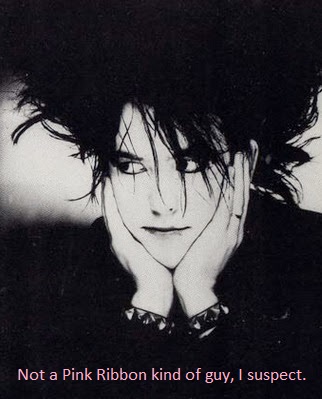
A few days ago I ran across a cartoon on Facebook—which I immediately shared on my Curmudgeon page—featuring several wild-haired characters stretching under a banner that said “Race for The Cure”. The one “normal” looking person says something like, “so this race isn’t to fight cancer?” The joke of the cartoon refers to the doom and gloom, post-punk, goth band The Cure, whose lead vocalist, Robert Smith, had the recognizable wild hair imitated in the cartoon. I found the cartoon hilarious because when I first got cancer and phrases about racing, biking, whatnot for “the cure” infiltrated my life, I had to actively remind myself “the cure” was about cancer, not The Cure—the band I sooooo loved in my goth-teen phase. (And yes, I still listen to those great albums.)

robertthen1

As litigious as Komen has proven itself, I’m a little amazed they have not gone after a band calling itself The Cure. Never mind the fact The Cure put out their first record in the late 70s, well before Komen existed, would that matter? Komen seems to think they own the words, and indeed have trademarked the phrase. Ugh, I hope I’m not giving them any ideas. Let this be a warning Komen, if you ever go after The Cure I will not rest until I see your utter annihilation. Yes, I love that old band that much.

My biggest form of therapy in this post-treatment life has been music, as I’ve mentioned in several posts. I’m lucky that deep in the heart of Pinktober, The Rock And Roll Hall of Fame announces their nominees for the following year’s induction ceremony. It gives me a much needed distraction when even my beloved Halloween pumpkins have been painted dreadful pink (see this old post). Yes, it’s silly an old alterna-girl should care if a band that was not “popular” back in the day should get into an institution; I mean punk/indie music was about rebelling against institutionalized rock. I wrote about this a couple of years ago in the post I’m In Love With That Song.

So this is my plea to those who vote or have a hand in the nominees  for The Rock and Roll Hall of Fame for this October. (Questlove? Maybe you can do this for me?) Please nominate The Cure again. As a breast Cancer Curmudgeon, I am so sick of the rah-rah, the pink madness of the month and everything associated with Komen’s greedy possession of the phrase The Cure. That is not to say I don’t want a cure for cancer—don’t be absurd, of course I do. I’m just still stuck in this place I’ve been all summer where practically ANY word or phrase in the world of cancer drives me nuts (empowered, powerful, journey, fight, battle, just…ALL OF IT). Please let me have The Cure, the band, back. I want to talk about The Cure again and mean music, not overused phrases.

Robert Smith and the gang may not be the cure I need if I get a recurrence, but they are a Cure for the nonsense I can barely tolerate in CancerLand these days.

My t-shirt from when I saw The Cure in concert in 1996

Take It Easy, Man

This post is in praise of the nameless cancer patients who don’t have the energy to do much of anything during or even after treatment.

Feel-good stories run rampant on the internet, local news, and fake news shows like those idiot magazine and morning shows. A special subdivision of feel-good stories are the stereotypical cancer stories. You know the type: the cancer patient finishing school, running a race, or doing some event or another, all while juggling treatment and the rest of life. Sometimes these exceptional cancer achievers are featured in ads for various cancer non-profit organizations, and I’m again reminded of the saying I encountered when I first moved to CancerLand: “only the positive stories make it to the podium”. Lots of folks like to post these stories, calling them powerful or inspiring.

Looking back on my days of treatment, I am glad I was not very connected with social media. I was lucky to be surrounded by people who encouraged me to listen to my body; if I was tired, take a rest, don’t push myself. I look at all these stories of someone putting off chemo to run a marathon and think, “I could never do that”. Or I see the governor of my home state posing with his bald head on the steps of some government building proclaiming how great he feels and I think, “well, it has just begun for him, the fatigue and other side effects are cumulative, ask him again in a few months”. Then I feel guilty for being so self-absorbed, for being tired, for comparing myself to others. Even now, nearly 5 years out from diagnosis, when I am done with my work day, I sit down and almost immediately nod off. (This is why I get so behind in reading and writing.)

It is natural to compare ourselves to figures we see in the media. Reams have been written about this topic, how young girls and women see images, cartoons or real starlets, and are set up trying to reach an unachievable standard. I enjoy seeing the attempts to counter the impact on the internet, campaigns about self-acceptance. Too bad that was not around when I was young. These images still impact me as I’ve aged; I mean I know that beauty product being shilled by the actress decades older than I—yet her face has less lines than mine—won’t really help me, but I consider buying it anyway. My point is, any media-anointed she-ro, whether a cancer patient or otherwise, is meant to inspire others to be more like the she-ro, and if that is unachievable, well, I don’t know about other folks, but sometimes I just wind up feeling like crap.

I’m a big fan of the Coen brothers’ “The Big Lebowski”, and The Dude. While I’ve never decided to follow Dudeism (the sort of philosophy posing as a religion, or vice versa, based on the character), I cannot help but think some of its ideals should be embraced by cancer patients. Dudeists are trying to reach their version of Nirvana, which is just taking it easy, man. Take a nap! Abide!

No this isn’t some Dudeism recruitment post—as I said I don’t really embrace it all myself. But I do think there is some wisdom in taking it easy. This is in no way meant to knock those cancer patients who push themselves, run races, execute events, and all that. All I want to do is say hey, if you are tired and need a nap, for goodness’ sake, take it!

Media appointed cancer s/heroes create a standard or ideal that it is not necessary to reach, no matter how many times those less-than-supportive types around us might think. While, again, I was lucky to be surrounded mostly by folks who told me to rest when tired, I did encounter many folks (and still do) who see the image of the smiling, kick-ass woman (an image I have long fought, see Take the Mythical Image of the Strong Warrior Breast Cancer Survivor and Bury Her Once & For All) so omnipresent in breast cancer culture, and wonder why I’m not wearing a feather boa and marching. No thanks, I will put on my bathrobe, pour myself a beverage, and have a seat while pondering if the rug really ties a room together.

And I raise that beverage in honor of all the other cancer patients who also decide to take it easy, man. We may not get on TV, won’t get any media praise, but we are doing cancer right for ourselves.

The Dude

Burden of Gratitude

Long before I got cancer, I worked with a woman really into positive energy, healthy eating, and so on. She and I, along with other co-workers, started reading “Simple Abundance”. One daily task suggested by the book was to make a list of 5 or10 things one is grateful for. I found this very easy—I still do it in a limited way. Not a day goes by that I do not think of at least one thing for which I’m grateful, unconsciously, for half a second. It’s just habit.

Shocking, coming from a self-professed Cancer Curmudgeon, I know. But it IS true, I am able to do those cliché things each day—stop and smell roses, focus and be present for a few moments—all that crap. It just so happens my being in the present moment tends to have loud guitar soundtrack, which I’m sure is not what most would consider a peaceful moment—but hey, it works for me. That is a post for another time. The point is, as much so-called negative energy I send out via this blog (I don’t think I do, I’ve merely been accused of this), I’m much more balanced than I seem.

As I’ve said MANY times in various posts, including my About section, I AM grateful to be alive, for the treatment that stopped my cancer, for having an easier time of it than so many I seem to know, to still be in the 70% that has not yet had a metastatic recurrence. See what I did there? Put a positive spin on a terrible stat; see I can do it too!

I am even begrudgingly grateful for all the Pink cult mess that made the research and development for Herceptin possible. I’m all too AWARE (I hate that word) that having the “popular” cancer, the better funded cancer, improves my survival odds.

And there it is: this is where gratitude begins to feel like a burden.

I’ve had a few lightning bolt moments of being struck by this feeling of gratitude as burden over the past few years since I started this blog. I remember watching Lisa Bonchek Adams, Gayle Sulik, and Dr. Love on Al Jazeera a couple of years ago, and seeing the few tweets popping up along the bottom of the screen about the oversaturation of Pink. A few tweets seemed fed up with the ribbon on everything, but the ones that bothered me were the tweets that spoke of the success of the ribbons (a show discussing them is proof of their effectiveness!). The implied message was, don’t knock the ribbon, it worked because now we are aware and anything that brings more awareness is therefore good. There was also the misguided belief that Pink on everything has solely been responsible for breast cancer patients not having to suffer in silence anymore (see Breast Cancer Action’s history lesson).

I get lightning bolt moments of the burden anytime I scroll through comments on ANY criticism of Pink crap and/or sexy awareness ads. It is inevitable that at least one person will angrily comment about the lack of gratitude the breast cancer patient writer is expressing in the critique. The appearance of such a comment is more predictable than the best weather/economy/whatever forecast. And I’m not even going to go into some of the blog posts and articles that have appeared tsk-tsk-ing those of us who criticize Pink. I guess it is just a backlash to the backlash. Again, there is the message, said directly or implied, that anything that brings awareness is inherently good.

(Gonna pause right here and say awareness is not enough, I don’t want to go into that issue here, many others have, and I said my piece about it in Some Word Problems last year.)

But a really major lightning bolt moment is an article in an Australian publication from about a year ago, that I can no longer access, but I’d made notes to myself on it in an earlier draft of this post. The article was about the competition for funding and attention between the different cancers, and how breast cancer gets the most money BY FAR, although it was not nearly as lethal as other cancers. A woman interviewed worked for a breast cancer charity and recounted a story about an interaction she had with some big executive. He told her point blank that his business partnered with her organization because of the body part. He said something kind of crass, like if his wife got breast cancer it would be really hitting where he lives (sorry, cannot remember exact quote, just remember the “where he lives” part).

How many other partnerships were forged for the same reason? Probably more than I want to know.

Yes, I know I’ve benefited, directly and indirectly, from money funneled into breast cancer organizations because of this mentality. Whether it was an executive motivated by selfishness (I am GRATEFUL I am NOT his wife), or one of the local boobs and brews events, I’ve had the best/latest treatment, and received some useful care packages bought with funds raised by things like this. I repeat I AM GRATEFUL for all of this.

But how do I reconcile my gratitude for my benefits with my disgust with the methods used to buy them?

As I’ve mentioned in other posts, sometimes my blog is just me trying to work through my thoughts and emotions about cancer. I have not been able to work through this. I cannot reconcile my gratitude with disgust. The only way I’m dealing with it right now is by knowing that I am capable of experiencing numerous contrasting feelings at once.

When I started writing this post, I wondered if anyone else found gratitude to be a burden. I mindlessly Googled around one afternoon. I ran into the usual stuff—blogs from the self-help set, a quote or two from a historic figure. I stumbled on a HuffPo piece from a literature lecturer about gratitude being used almost as a weapon of sorts in some Austen novels. This analysis of a couple of novels actually made sense to me, in a VERY loose way. I don’t think the “you complaining breast cancer patients should just be grateful” finger-waggers are exactly viewing us as inferior, lower-class people (such as in the Austen stories, where the poor, unmarried girl has to benefit from the charity of society people to catch a husband and the stability of marriage).

But there IS a whiff of superiority in the attitudes and tones in these comments. Sometimes I get the impression the obligation of gratitude is being wielded like a ruler in the hands of an old timey teacher. And that ruler is being used to thwack the fingers of naughty breast cancer patients daring to challenge the status quo. And I don’t mean just patients who are blogging and writing articles. I mean anyone who has ever dared to grumble quietly among friends and family, and received that rebuke of ” be grateful” in return.

Perhaps it’s all in my mind. It does seem linked to the subtle, indirect blame ALL cancer patients get. Like: “you didn’t eat right/live healthy/think about sunbeams all day, so now you have cancer and you should just be grateful some smart people invented treatments no matter how those treatments were developed and you have no right to complain about anything because at least you are alive for one more day, and that should be good enough for you.” (Not going down the blame road today, either—see my old post Did You?)

The feeling of gratitude should NOT be a burden; that’s not what all the self-help mumbo jumbo is about. Gratitude is supposed to help one on the path to happiness. Well, that’s not happening here for me. What should I do about that? I mean, besides trying to work it out here on this blog?

I still do not really know. But I do know this: I felt increasingly disturbed by the Pink (by that I mean the be a happy warrior rah rah stuff, the sexualization, the pinkwashing, all of it) as I began treatment and hit a zenith right after treatment ended. I felt this disturbance before I ever found others with the same thoughts via social media. Every single day tons of women get this diagnosis. Some of them will go all in to embrace the Pink. But MANY others will have an experience similar to mine.

I don’t want my experience for these future breast cancer patients. Just because it “worked so far” (again, that is debatable, since, you know, there is still all this cancer out here), does NOT mean it will continue to work. Some would say, if it ain’t broke don’t fix it.

But guess what? It is broken. When gratitude makes me feel like shit, something is definitely broken.

You Need To

I’ve been having a hard time writing lately; I’ve been mentally blocked. I’m even having a hard time reading some of my favorite blogs. I’m chalking it up to a temporary fatigue not just with cancer, but with the way damn near every issue is discussed. I hit a boiling point the other day that made me immediately start laughing. And I realized I am just sick of EVERYthing.

What caused this?

Well, I’ve griped here on this blog about some of my dislikes with certain words and phrases in CancerLand (see Some Word Problems). I know many others agree with my thoughts on some of these major language gripes—you know, “fight, battle, awareness…” all those. They are so overused! The word awareness is now meaningless to me. I’m sure I’ll delve into that subject (again) in some future post.

But I’ve found lately nearly all kinds of words are so overused that I’m reacting like I’m hearing nails on a chalkboard. I’ve been reluctant to complain about them because I know most everyone else uses these words, and are OK with them. But I’m gonna go out on a limb and say I’m sick of these words anyway. I’m not criticizing anyone for using them; this my fault for being too immersed in media. I’m not suggesting anyone amend how they speak or write, on the contrary, I’ve used these words myself, and only want to change my own habits. And I’m just trying to clear the cobwebs out of my mind with a few random rants.

Words/phrases that I’m not going to gripe about in this particular post—but will likely confront later—are common and simple, like “powerful/empowering”. So tired of those two being used to describe stuff. And “journey”—ugh, that one makes me nuts. The incident that made me laugh as I mentioned in the first paragraph? I ran across a blog about weight loss and the author said something like: why does my weight loss program have to be called a “journey”? And then I knew that “journey” was not just overused in CancerLand (stuff like “your cancer journey” has always made me retch). It seems society just uses words like “journey” or “struggle” for anything these days. And clearly I’m not the only one disliking it.

Like I said, I don’t want to concentrate on ALL the little words driving me crazy in this post—I’m sure more posts about one word/phrase at a time will pop up here and there in the future. What is driving me most crazy today is this one: “you need to….”

Whenever I’m told I need to do something, that pretty much guarantees I won’t do it. And yes, I’ve said the need to phrase myself on this blog (Somebody Needs to Buy These Media People a Dictionary—and I stand by the thoughts in that ancient post), so obviously I’m just as guilty of trying to modify others’ behavior to suit me.

What irks me about being told I need to do something—and yes, I’ve been told in my comments I need to rethink my points—is that I view it a shortsighted, and illogical as an argument. And even if the argument made is valid, the rudeness of the need to phrase undercuts the strength of the argument. When I was told I need to think or educate myself about an issue in an old comment, I was annoyed because it was such a poor argument. I had indeed reviewed/thought about the issues brought up by the angry comments. My mistake was poor writing, and not making myself clear to show that I’d considering many angles of the issue. That is a sticking point for me in fact—I try to see ALL sides of an issue, but sometimes that is a bad thing, it paralyzes me into not taking a stand or making a decision (that’s a post for another day).

I’ve seen the need to phrase used and the one using it is quite right, but the rudeness of the phrase, the smug superiority I perceive when I read or hear the phrase, undercuts the point. I remember a rant blog post making the rounds last Pinktober asking why other cancers are not sexualized like breast cancer. A VERY angry reaction by a patient with a rarer cancer included the directive “you need to think about…” It undercut her rant for me totally. I happened to agree—comparing illnesses, comparing how cancers are “sold” is a bad move. When discussing the sexualization of breast cancer, those of us criticizing should keep in mind the dirty benefits reaped from the campaigns (awareness begets funding—this is a post for another day, again), and bring the fact that breast cancer is the most “popular” (read: funded) cancer into the discussion. But being told we NEED TO do it just rankles.

I started writing this over 30 minutes ago and could not remember what set me off. I mean, the need to phrase is so damn overused! I researched and again it was a rant I agreed with—but the “you need to” command at the end ruined it for me. A woman had written about how racism, fat shaming, and income inequality were health issues. Someone had pointed out that fat leads to strokes in a comment to her. You know those types of comments—I see them in EVERY post written about weight. Turns out the woman had a hole in her heart that led to her weight gain, strokes and other illness. If she’d had money to be tested earlier, all those issues would’ve been prevented. It was a great lesson; I was on board with her 100%. But her directive that her commenter NEEDED to stop cosigning this crap just killed it for me.

Are there things we NEED to do? Of course. But this cultural habit of wanting to “school” someone in this manner is driving me crazy.

OK, just my stupid little random rant for today. I know it must seem odd—a curmudgeon who rants A LOT fussing about counter-rants. But, this is just my point of view today. Maybe I’ll change my mind. I’m just dealing with a great amount of cancer culture (or all health issues culture) fatigue at the moment.

15 Random Facts About Me

Yep, I am answering Nancy’s call to post 15 random facts about myself. Some of these facts may have appeared on past blogs—I apologize for the repeats!

  1. I am an only child—I’m sure that is apparent sometimes!
  1. My birthday is October 29, 1971. Why yes, Halloween is my favorite holiday!
  1. Yes, I’m almost 44 and I still cannot quite grasp that. I still think and act like I’m in my early 30s, or younger.
  1. I’m allergic to cats and still choose to be a pet sitter. Go figure. Probably says a lot about how I prefer animals to people.
  1. I do not like to drink milk out of a glass—it creeps me out. I prefer to plastic cups, or ceramic mugs—anything but glass.
  1. Like Nancy, I try to avoid politics on my blog, but I am a proud, flaming liberal. And not just because I benefited from Obamacare’s support for self-employed people with pre-existing conditions.
  1. Like Nancy, I cannot swim. It sucks because I’ve lived near the ocean my whole life.
  1. About the not-swimming/loving the beach: as I’ve aged, I’ve grown to hate the way sand gets everywhere. Yet I still love lounging on the beach—looking at the water, hearing the seagulls and people enjoying their day. So in short, can’t swim, don’t like sand and still love putting myself at the beach. Weird.
  1. Also about the not-swimming: I intend to learn because I want to learn to surf. I still fantasize about chucking it all, moving to Hawaii (or other surf-centric location) and just living simply and surfing every day.
  1. Never say never, but I’ve worked in retail and for a non-profit arts organization, and both experiences left me sour. I hope to never work in those fields again.
  1. I am a dog person when the weather is great and I want to be outside, walking and playing with a dog. I am a cat person when the weather is rainy (like today) or snowy, cold. Talk about a fair weather friend!
  1. I love to drive fast. I want to drive on the Autobahn. Or become a NASCAR racer.
  1. I love cooking, but hate baking. Baking breads and cakes calls for too much precision. Cooking meals is my creative outlet, and precision stifles the creativity for me.
  1. I love vegetables but hate fruit.
  1. I like all kinds of fancy shmancy desserts, but at the end of the day, my favorite will always be Tastykake chocolate cupcakes with chocolate icing (no cream filling, I HATE cream fillings)!

Deserving Cancer

In those first overwhelming weeks of diagnosis, seemingly endless tests, and the infusions of The Red Devil, I wanted to throttle Keith Richards. Yes—that Keith Richards, from the Rolling Stones. Why? Because a couple of comedians have pointed out that when an apocalypse happens, only Richards and some cockroaches will still be left alive. He is the symbol of rock and roll excess (or one of them, I’m letting Led Zeppelin slide today) and survival. He survives while so many other misbehaving rock stars overdosed, suffered, died. There he is, still on my TV, cancer-free. I needed someone to be angry at, and he fit the bill.

I’ve never done any illegal drugs and I’ve trashed nary a hotel room, yet here I am “punished” (that concept is up for debate in this post) with all this cancer. Oh sure, I’ve done some things I regret—who hasn’t? And while I haven’t been super-exercise-y and health-nutty, compared to a few folks I know, I’ve done pretty well. Well, before cancer that is, I kind of don’t give a shit anymore. But these friends and others I know who thrive on fried junk food are fine; no cancer, and here I am, I had all that cancer. And before anyone gets into a tizzy, no, I’m NOT wishing cancer on these other folks. It’s just with the amount of headlines on magazines in the grocery check-out line—eat this to prevent cancer, excess that causes cancer—the fact that I got cancer when those who indulge in less healthy habits didn’t, well, it can just be confounding. That is all I mean.

I’m talking about the physical, cause and effect, environmental factors for the most part, but I’m kind of talking about the karma aspect too. (Note—I know karma does not work like that, you get punished in your next life—but like most idiot Americans, I am misappropriating the meaning to get my point across). I know of too many stories of other cancer patients who did life all “right” while their relatives and friends have, um, done some shady things, and those folks are enjoying fine health. I know, it is not up to individuals to judge others. But when you are dealing with cancer, sometimes the pettiness of “why me and not them?” oozes out. Some folks, myself included, have asked: “What have I done to deserve this?”

The “why me” issue was a bigger deal for me back when I was in, and freshly out of, treatment. It is a little less so these days. In fact, I began writing this post in my very early days of blogging, but pushed it aside because I don’t grapple with the issue of what caused my cancer as much. But every now and then, something, or a few somethings, pop up to make me confront it again.

What really set me off was the announcement about DDT causing breast cancer. I happened to learn about it in this article, which finished with these irritating final sentences:

While it’s impossible for women to know how much DDT they were exposed to years ago or to go back and change things, there are still steps women can take to reduce their risk of breast cancer, says Karen Kostroff, chief of breast surgery for the North Shore-LIJ Health System in Lake Success, New York.

If you smoke, quit smoking. If you are overweight, work to lose some pounds, she suggests. “Focus on the things you can control,” she says.

While I understand the “no use crying over spilled milk” message Kostroff is sending, the emphasis on individual responsibility and the illusion of control makes me nuts. No, I’m not suggesting humans should be allowed to indulge in any “bad” behavior and not expect consequences. It’s just that when I see statements like this, I immediately read it as a way to blame patients. I ranted about this issue ages ago on this blog in Did You? (read it to understand my point in this post).

I don’t know about other breast cancer patients, but I needed NO encouragement to fall into the bad pattern of trying to figure out what caused my cancer. I remember listening to “Breasts: A Natural and Unnatural History” by Florence Williams a while ago, specifically the part when she discussed exposure to plastics in young children. My mind immediately fled back to back to the summer of 1977; I was 5 going on 6, and I just witnessed the phenomenon of Star Wars. I began collecting the action figures. With great happiness I saved up allowance and chore earnings to add a new doll or spaceship toy to my little universe. Oh, the smell of freshly unpackaged Star Wars action figure—I would just inhale it and loved it the way adults love New Car Smell! (Yes, I still have my collection, unpackaged, so yes I understand they are “worthless”. But not to me.) I never played with Barbie or my life-like baby doll ever again. Growing up in the 70s was GREAT! Uh-oh, did my childhood nerd joy cause my cancer? The thought just kills my spirit.

But, hey, no use crying over the proverbial milk I spilled, right? My point is, the general population loves statements like Kostroff’s, they must; so they can convince their own selves that they are “safe”. It is fear that drives the blame. (Seriously just repeating myself here, read Did You?, my post from early 2014) Cancer and death are scary things, and the idea of doing everything “right” gives people a false sense of control, of security. I no longer have a sense of those things.

But it isn’t just the physical, environmental causes that are part of the blame game. A few random comments on this blog and elsewhere remind me that too many people buy into just world theory. The classic “cancer makes you a better, enlightened person” nonsense is wrapped up in this. Too many people say to me and others that cancer is some kind of wake-up call from the universe—to enjoy life, to re-prioritize, to value people, choose happiness, whatever. I’ve always hated that expectation of cancer-induced self-improvement, mainly because I did not seem to be improved. What is becoming clearer to me each day is how insulting that expectation is—for everyone.

What? So I was some intolerable person before cancer and I needed a threat from the universe to shape up? I was such an asshat I deserved cancer to put me in line? Am I as big an asshat as Keith Richards (or insert some other infamously bad behaving person who has not had cancer)? Are the people asking this question, or saying the “the universe was sending you a message” to cancer patients—what, are they perfect, and not in need of any life lessons, and that is why they do not have cancer?

I get it, I do. Some folks need to embrace the “everything happens for a reason” concept, I suppose it is a coping mechanism. For me it was the opposite, I found it emotionally damaging. While the idea that cancer, and by extension life and the universe, is random is scary for many, I find it comforting.  The strict adherence to rules, to one cause and one effect, makes me blame myself. Of course I understand that there were likely many contributing factors that caused my cells to divide too much and form a tumor. Some factors may have been the result of things I did (or didn’t do), and some were likely out of my control. But I am no better, and certainly no worse, than all those not “punished” by cancer.

Clearly, I am still bothered by the concept of blaming patients—why else would I still be writing posts about it? But here is the trick: I can read that statement from Kostroff, I can read comments on my social media from others being told cancer is some message from the universe, and I can recognize these things as damaging. And I can roll my eyes, take a breath, and not let my mind spin out of control with worry and self-doubt now.

These days, I am not gripped with an urge to injure Keith Richards (well, MOST of the time). I will always stand up to idiotic statements that imply cancer patients got what they deserved—and to the people who make such statements. But it hurts a little less.

Mean Streak

As I’ve said many times, cancer did NOT make me a better person. Those treacly articles and captioned pictures present on so many internet feel-good stories are just not my story. I did not learn to re-prioritize my life, cancer did not teach me life is precious, blah, blah, blah. Cancer merely made me more myself, I often think. And cancer has uncovered a rather mean streak in me, I am sorry to admit.

I know, I know, one should never read comments on articles, but sometimes I still cannot help it. Every now and again, I see something really awful. This has happened a couple of times so far in 2015.

When Jolie hit the news again a few months ago with her surgeries, the usual chit chat started about surgery as prevention, BRCA issues and so on. I found one really disturbing comment from someone saying something like everyone dies, implying Jolie should not have done something so extreme to prevent cancer, to attempt to prolong her life. It really upset me. Then, just the other day I read another story about how the rising costs of life-saving cancer drugs are putting those very drugs out of reach for some patients. (Is it just me or does that make them um, NOT life-saving? Moving on….) Of course the first comment I ran across said that one or two more years are just not worth bankrupting oneself or one’s family just to feed the greed of big pharma because after all, death is inevitable.

When I see sentiments like this expressed, I am shocked and angry. How quick some folks are to throw away the lives of people with terminal cancer! It is so very easy for these people I suppose, to make statements like this when they do not face a cancer diagnosis. Or maybe they have faced, or are facing, a cancer diagnosis, but that still does not give them the right to determine what a year or two of more life is worth to another.

This is where my mean streak rises up, a meanness I did not know I possessed before cancer. Gee I guess I did learn something from cancer (eye roll). I would never wish actual cancer on another, but I cannot help but want others to feel what it is like to have cancer (without actually having it): all the uncertainty, the wondering if it will come back and take your life. So when I read a comment like “we all gotta die sometime”, my knee jerk reaction is “yes we do, but you first—I want to live as long as I can”. I know it is an awful thing to say, but I have felt this way for a while now.

Maybe that “life is short, live every moment” lesson that gets spouted in cancer stories is a little different for me. I always knew life to be short, precious, and that I should not be wasting time doing stuff I hate. What is clear to me now, or at least I think about it more these days, is how much I want to remain alive. It was easy, before cancer, to use “life is short” as a rationalization for silly things: life is short, go on that trip, buy the dream house, etc. My view has shifted slightly. This is a more nitty gritty, how far will I go to stay alive, and why, kind of view. I suppose some of the “everyone dies sometime” commenters would view my life as expendable: I do not have children, nor siblings so no nieces and nephews, I am not destined to do great things, I spend most of my blogging time curmudgeon-ing—what does my life matter?

But that is the thing—I don’t have to justify my existence to them. My life matters to me, and I’ll do what it takes to keep it.

Yes, we all gotta go sometime, excuse the hell out of me for wanting to delay that.

Reciprocity and Respect

Long ago I reposted or tweeted some official-medical journal type article about how the warrior language can be damaging for many cancer patients. This was a report about a study on the issue, NOT some random blogger opinion piece. I got some comment or push back from someone, protesting that many folks found it helpful to be warriors, and they were tired of getting criticized for it.

It was weird because 1) I did not write the article, much less conduct the study and 2) I was merely posting it, not criticizing, and I did not find the language of the article to criticize the folks who do use the warrior language. Even weirder, it seemed like the victor claiming to be the persecuted to me—the warrior language is pretty pervasive and accepted as the social norm. Sure lots of bloggers post about their discomfort with the term, but it has not resulted in some cultural shift in which the word is used less, and folks identifying as warriors are in the minority. Cancer warrior is a commonly used term in society, in the media, in the Livestrong culture that still persists today.

The exchange with the person ended with the person saying something along the lines of if I don’t like it, don’t use it, but don’t criticize those who do. This was the weirdest part of all. Why? Because I don’t use it (so I did not need to be advised to not use it), but that NEVER stops others from using it to describe me against my will.

I’d largely forgotten about the exchange (I cannot even remember when it happened, certainly within the past year, and really have no idea which social media platform it all occurred on). But perusing some Facebook posts tonight, on National Cancer Survivors Day, I saw a few posts by bloggers who are not fans of the day, particularly some metastatic bloggers. I was shocked to read some comments on one post in which commenters flat out told the blogger she was indeed a survivor—any day she gets up she is a survivor.

Wow.

After all this time since my cancer experience began, I am still shocked at how disrespectful people can be. How dare this person force an identity on another, when the blogger, a woman with metastatic cancer, does not self-identify as a survivor? The gall of one person infringing on the wishes of another never ceases to amaze me.

I wish to be clear here. It is true, I do not like terms such as warrior and survivor and do not use them to describe myself. I have very specific reasons why I dislike them. If others wish to use them, fine. Everyone’s preference should be honored.

But I expect reciprocity—stop calling me words I will not use about myself. Everyone deserves this simple act of respect.

Addendum: Please know that I am speaking about ANY time someone labels me (or others) survivor against our wishes. Even if it is done gently, not in an attacking manner, it still is dismissive and patronizing.

Perhaps the reason I am so edgy about this is that when someone calls me warrior or survivor against my express wishes, it makes me think that they think I do not know my own mind. I do. The best analogy I can give is this: I never wanted children. From my teen years until my mid-30s, people would tell me–a grown woman–that I’d probably change my mind. I never did, I’m very happy with my choice. What makes people think they know me better than I know myself? I put up with it for too long on the not having children issue. I’ll be damned if I put up with it in CancerLand.

Thanks

Thanks for all the kind reactions to my most recent post about a very touchy subject. I go back and read what I wrote and it is not my best, most clear writing. I’m amazed anyone can understand what I’m trying to say! Too many long sentences and junk in parentheses. All signs of how unsettled I am with the topic, how angry I still am about certain aspects of cancer. This was one the most difficult posts to write. I worry that I disagree with some of the most revered voices in the breast cancer community and while I admit to being a curmudgeon, it isn’t always fun to go against every damn grain. But I pledged to myself to be honest about everything in CancerLand, so that is all I am trying to do.